Topic 3.6 Notes – Selecting an Experimental Design
What an Experimental Design Does
An experimental design is the plan for assigning experimental units (people, animals, objects) to treatments so you can compare outcomes fairly.
You’re trying to:
- Create comparable groups
- Control confounding variables
- Reduce variability
- Strengthen evidence of causation
The design choice affects how convincing and precise your conclusions are.
On free-response questions, you’re often asked to justify why a design is appropriate. That means explaining how it controls variability or fits the situation, not just naming it.
Completely Randomized Design (CRD)
All experimental units are randomly assigned to treatments with no grouping beforehand.
When it makes sense:
- No obvious variable strongly affects the response.
- Subjects are relatively similar.
- The study is simple or large.
Why it works:
- Random assignment balances lurking variables on average.
- Easy to implement and analyze.
Limitation:
- If there is a major source of variability (like age, skill level, or location), this design ignores it. That can make treatment differences harder to detect.
Example idea: Testing three fertilizers on 90 identical greenhouse plants. If they’re already very similar, random assignment alone is fine.
Randomized Block Design
Here, you first group subjects into blocks based on a variable known to affect the response. Then you randomly assign treatments within each block.
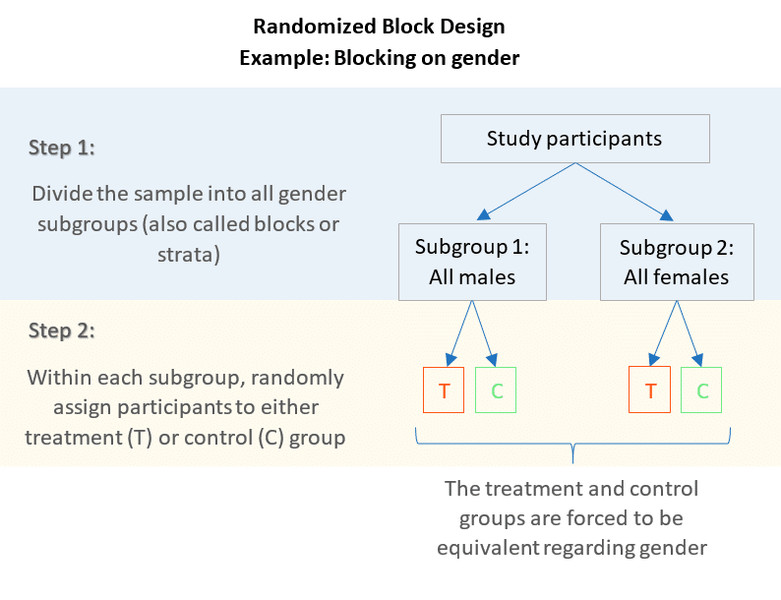
Randomized block design example blocking on gender
Purpose: Control variation from a known source.
In the diagram above, participants are first separated by gender, then treatment (T) and control (C) are randomly assigned within each gender group. The same idea works for any variable you expect to influence the response.
Suppose you’re testing two workout programs and you know starting fitness level matters. You could:
- Divide participants into “low fitness” and “high fitness” blocks.
- Randomly assign each block to both programs.
- Compare programs within blocks.
Why this helps:
- Reduces variability.
- Makes treatment comparisons more precise.
- Prevents the blocking variable from becoming a confounder.
Important: You must use all blocks in the experiment. And blocking only controls for the variable you block on.
On AP questions, you should explain that blocking reduces variability in the response, which increases the ability to detect treatment differences.
Matched Pairs Design
This is a special case of a randomized block design used when there are exactly two treatments.
Two forms:
1. Paired individuals
Match similar subjects (twins, similar test scores, same age). Randomly assign one in each pair to each treatment.
2. Repeated measures
Each subject receives both treatments. Order is randomized to avoid order effects.
The diagram below shows the paired-individuals version. Subjects are first matched with their closest partner, then one person in each pair is randomly assigned to the treatment group and the other to the control group.
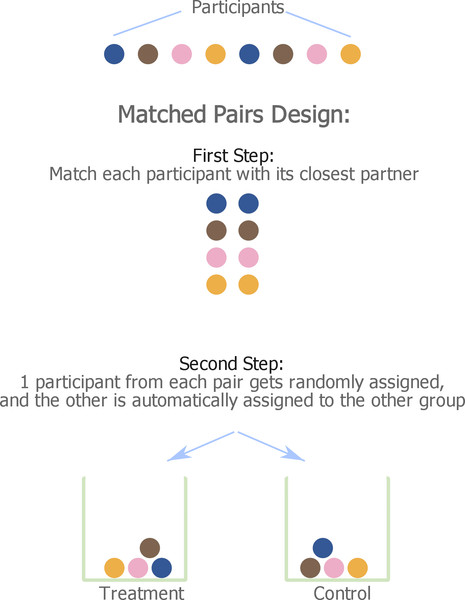
Matched pairs design: pairing first, then random assignment within each pair
Why it’s powerful:
- Controls for individual differences.
- Often reduces variability more than regular blocking.
Example: Comparing two headache medications by giving each person both drugs on different days in random order.
Limits:
- Only works with two treatments.
- Matching can be difficult.
- Repeated measures can have carryover effects.
Students sometimes call something “matched pairs” when it just has two groups. There must be pairing or repeated measurement.
Choosing the Best Design
Think about the situation itself.
| Situation | Strong Choice | Why |
|---|---|---|
| Subjects similar, no clear confounder | Completely Randomized | Simple and effective |
| Known variable strongly affects response | Randomized Block | Controls that variability |
| Two treatments, natural pairing possible | Matched Pairs | Maximizes precision |
Also consider:
- Resources (blocking takes planning)
- Sample size (matched pairs can be hard with large groups)
- Feasibility (can subjects receive both treatments?)
On exams, the strongest answers connect the design to:
- The research question
- Control of variability
- Practical constraints
Key Takeaways
Completely Randomized Design
Experimental units are assigned to treatments entirely by chance, without forming groups first.
Random Assignment Within a Completely Randomized Design
Label all units, then use a random method to place them into treatment groups.
Randomized Block Design
Experimental units are grouped by a relevant characteristic, then randomly assigned to treatments within each group.
Block / Blocking Variable
A group of similar units, or the characteristic used to create those similar groups.
Use All Blocks
Every block must receive all treatments so treatment comparisons are made within each block.
Matched Pairs Design
A blocked design for two treatments using matched pairs or one subject receiving both treatments.
Choosing Among Experimental Designs
Choose the simplest appropriate design: randomize if units are similar, block known differences, and match pairs for two treatments.
Notes
Completely Randomized Design
Experimental units are assigned to treatments entirely by chance, without forming groups first.
Random Assignment Within a Completely Randomized Design
Label all units, then use a random method to place them into treatment groups.
Randomized Block Design
Experimental units are grouped by a relevant characteristic, then randomly assigned to treatments within each group.
Block / Blocking Variable
A group of similar units, or the characteristic used to create those similar groups.
Use All Blocks
Every block must receive all treatments so treatment comparisons are made within each block.
Matched Pairs Design
A blocked design for two treatments using matched pairs or one subject receiving both treatments.
Choosing Among Experimental Designs
Choose the simplest appropriate design: randomize if units are similar, block known differences, and match pairs for two treatments.
