Topic 4.12 Notes – The Geometric Distribution
1. What a Geometric Random Variable Is
A geometric random variable counts the trial number of the first success in a sequence of independent trials.
This setup always has four ingredients:
- Two outcomes each trial: success or failure
- Constant probability of success
- Independent trials
If the first success happens on trial , then:
- Trials through were failures
- Trial was a success
That structure is the whole distribution.
Geometric vs. Binomial
Students mix these up constantly.
| Binomial | Geometric |
|---|---|
| Fixed number of trials | No fixed number of trials |
| Counts number of successes | Counts trials until first success |
If the question says “how many trials until the first…”, your brain should jump to geometric immediately.
2. The Geometric Probability Formula
For :
Why it works:
- → first trials are failures
- → the th trial is success
Example: Suppose a free throw shooter makes shots with probability . What’s the probability the first made shot is on the 4th attempt?
Interpretation (this wording matters on FRQs):
The probability that the player makes their first free throw on the 4th attempt is 0.0189.
Cumulative Probabilities
A huge shortcut you should know:
“More than trials” means the first were all failures.
Then:
On your calculator:
geometpdf(p, x)givesgeometcdf(p, x)gives
Common slip: forgetting that starts at 1. There is no .
3. Mean and Standard Deviation
For :
Interpreting the Mean
The mean is the long-run average number of trials needed to get the first success.
If :
Interpretation:
On average, it takes 5 trials to get the first success.
Units are trials, not probability.
Notice the relationship:
- Larger → smaller mean
- Smaller → larger mean
That makes sense. Rare successes take longer to happen.
Shape
Every geometric distribution is right-skewed.
Here is what a geometric distribution looks like when .
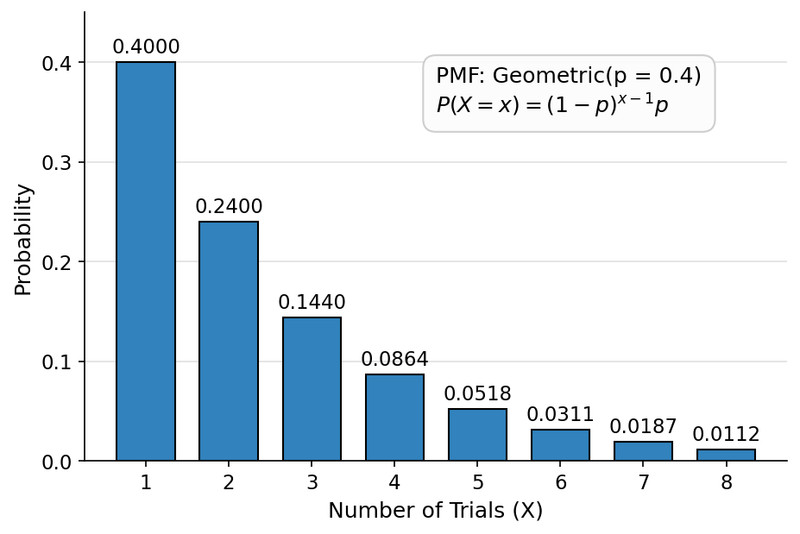
Geometric distribution with p = 0.4
The highest probability is always at , and probabilities decrease as increases.
4. How to Recognize and Use It on the Exam
When you see a scenario, mentally check:
- Independent repeated trials?
- Two outcomes?
- Constant ?
- Counting until the first success?
If yes, use geometric.
Memoryless Property
Geometric distributions are memoryless:
If you haven’t had success yet, nothing changes going forward. The probability of success on the next trial is still .
Students often fall into the “it’s due now” thinking. It isn’t. Each trial is independent.
Interpreting in Context
On quizzes and the AP exam, vague answers lose points.
Good probability interpretation:
The probability that the first defective item is produced on the 6th item is 0.064.
Good mean interpretation:
On average, it takes 8 items to get the first defective item.
Name the variable. Name the situation. Use correct units.
Key Takeaways
Geometric Random Variable
A discrete variable counting the trial number on which the first success occurs.
Conditions For A Geometric Distribution
Independent trials, two outcomes, constant success probability p, and interest in the first success.
Geometric Probability Function
P(X = x) = (1 - p)^(x - 1)p for x = 1, 2, 3, ....
Mean Of A Geometric Distribution
The expected number of trials until the first success, equal to 1/p.
Standard Deviation Of A Geometric Distribution
The spread in trials until the first success, equal to sqrt(1 - p)/p.
Possible Values Of A Geometric Random Variable
Positive integers 1, 2, 3, ... because the first success can occur on any trial.
Binomial Vs. Geometric Distribution
Binomial counts successes in n fixed trials; geometric counts trials until the first success.
Contextual Interpretation Of Geometric Parameters
Describe mean or standard deviation as numbers of trials until the first success in context.
Shape Of A Geometric Distribution
Always skewed right, with larger trial numbers becoming progressively less likely.
Notes
Geometric Random Variable
A discrete variable counting the trial number on which the first success occurs.
Conditions For A Geometric Distribution
Independent trials, two outcomes, constant success probability p, and interest in the first success.
Geometric Probability Function
P(X = x) = (1 - p)^(x - 1)p for x = 1, 2, 3, ....
Mean Of A Geometric Distribution
The expected number of trials until the first success, equal to 1/p.
Standard Deviation Of A Geometric Distribution
The spread in trials until the first success, equal to sqrt(1 - p)/p.
Possible Values Of A Geometric Random Variable
Positive integers 1, 2, 3, ... because the first success can occur on any trial.
Binomial Vs. Geometric Distribution
Binomial counts successes in n fixed trials; geometric counts trials until the first success.
Contextual Interpretation Of Geometric Parameters
Describe mean or standard deviation as numbers of trials until the first success in context.
Shape Of A Geometric Distribution
Always skewed right, with larger trial numbers becoming progressively less likely.
