Topic 4.9 Notes – Combining Random Variables
1. Linear Transformations of a Random Variable
A linear transformation has the form
- a shifts every value (adds/subtracts a constant).
- b rescales every value (multiplies/divides by a constant).
What Happens to the Distribution
For :
Notice two patterns:
- Adding/subtracting (a) changes the mean only, not the spread.
- Multiplying/dividing (b) changes both the mean and the standard deviation.
- The shape stays the same as long as .
- If , the distribution is reflected (like flipping it across a vertical axis).
To see this in action, compare a normal distribution for with the transformed variable :
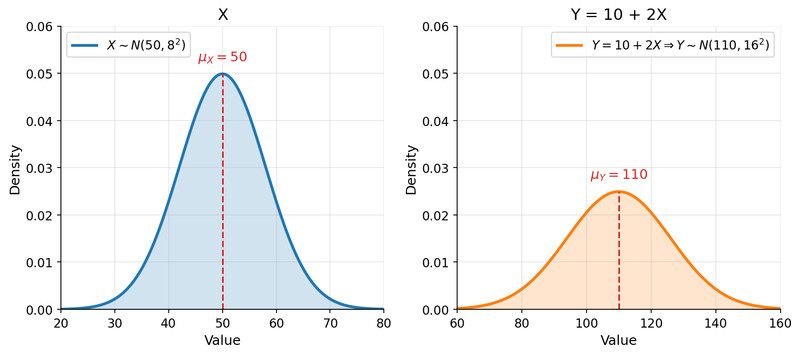
Effect of on a normal distribution
The new curve is still bell-shaped, but its center shifts and its spread increases because every value was multiplied by 2 and then shifted up by 10.
Quick Example
Suppose test scores have:
If a teacher adds 5 points to every score:
- New mean:
- New SD: still
If instead every score is multiplied by 1.1 (curve scaled):
- New mean:
- New SD:
Students often think adding 5 changes the SD. It doesn’t. Spread only changes when you multiply or divide.
2. Linear Combinations of Random Variables
Now we combine two random variables.
A linear combination looks like:
This includes:
- Sums
- Differences
- Weighted combos like
We care about how the mean and variance behave.
3. Means of Sums and Differences
This part is simple and always works, even if the variables are not independent.
Special cases
- If , then
- If , then
Independence is not required for means.
Example
Let:
- = time (minutes) to finish Part A,
- = time (minutes) to finish Part B,
If , then:
In context:
The mean total time to complete both parts is 75 minutes.
Always name the variable and the situation. That wording matters on FRQs.
4. Variance and Standard Deviation of Sums and Differences
This is where independence matters.
Two variables are independent if knowing one gives no information about the distribution of the other.
If and are independent:
Then take the square root for SD.
Special cases
If :
If :
Notice something important:
You add variances even for subtraction.
Example
Suppose:
If independent:
Students mess this up by:
- Adding SDs directly (4 + 3 = 7 ❌)
- Subtracting variances for differences ❌
- Forgetting to square coefficients in
If independence is not stated, you cannot assume variances add.
Key Takeaways
Linear Transformation of a Random Variable
Changing a variable by adding a constant, multiplying by a constant, or both.
Y = a + bX Transformation Rules
Mean becomes a + bμx, standard deviation becomes |b|σx, and shape stays the same if b > 0.
Linear Combination of Random Variables
An expression formed by multiplying variables by constants and then adding them, like aX + bY.
Mean of a Linear Combination
For aX + bY, the mean is aμx + bμy.
Independent Random Variables
Two variables where knowing one value does not change the other's probability distribution.
Mean of a Sum or Difference
Add means for sums and subtract means for differences, keeping the order of subtraction.
Effects of Linear Transformations
Adding shifts center only, while multiplying changes center and spread and may reflect shape.
Spread of Linear Combinations of Independent Variables
For independent variables, variances add in sums or differences, then take the square root for standard deviation.
Notes
Linear Transformation of a Random Variable
Changing a variable by adding a constant, multiplying by a constant, or both.
Y = a + bX Transformation Rules
Mean becomes a + bμx, standard deviation becomes |b|σx, and shape stays the same if b > 0.
Linear Combination of Random Variables
An expression formed by multiplying variables by constants and then adding them, like aX + bY.
Mean of a Linear Combination
For aX + bY, the mean is aμx + bμy.
Independent Random Variables
Two variables where knowing one value does not change the other's probability distribution.
Mean of a Sum or Difference
Add means for sums and subtract means for differences, keeping the order of subtraction.
Effects of Linear Transformations
Adding shifts center only, while multiplying changes center and spread and may reflect shape.
Spread of Linear Combinations of Independent Variables
For independent variables, variances add in sums or differences, then take the square root for standard deviation.
