Topic 4.5 Notes – Conditional Probability
1. Conditional Probability Explained
Suppose you’re looking at students in a school. Let
- A = student is on the soccer team
- B = student is a senior
If you want the probability a student is on the soccer team given that the student is a senior, you write:
Read it as “the probability of A given B.”
The Formula
Break that down:
- means both A and B happen.
- You divide by because you are restricting your attention to only the outcomes where B occurred.
That’s the key idea.
When you condition on B, you shrink the sample space to just B. Then you ask: What fraction of that group also satisfies A?
Trigger word on tests: “given.” If you see it, think conditional probability immediately.
2. The Multiplication Rule and Joint Probability
Rearrange the conditional probability formula:
This is the general multiplication rule.
You can also write:
Both are correct.
Interpretation:
- First event happens.
- Multiply by the probability the second event happens given the first already occurred.
This works for any two events. Independence is not required.
Big connection to remember:
- Conditional probability → divide
- Multiplication rule → multiply
They’re the same relationship, just rearranged.
On multiple-choice questions, they often give you and and ask for . That’s a straight multiplication rule situation.
3. Finding Conditional Probability from Different Representations
The structure is always the same:
numerator = joint, denominator = conditioning event.
What changes is how the information is presented.
a. Two-Way Tables
Here’s a typical layout:
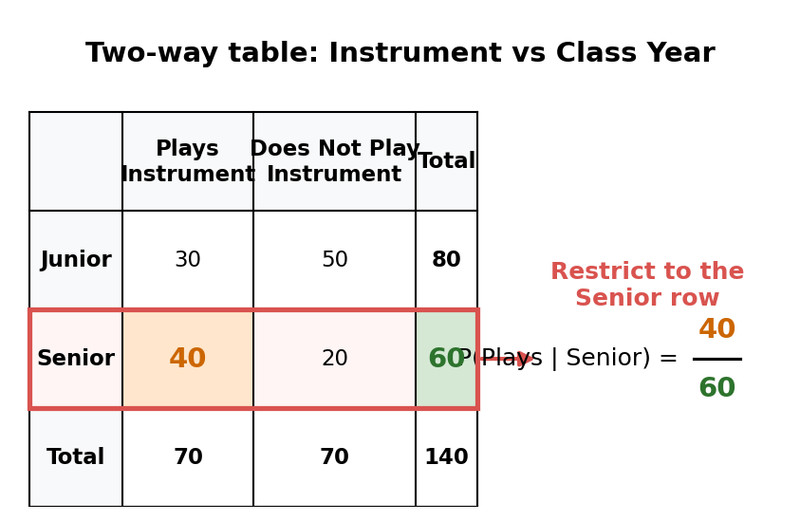
Two-way table of instrument participation by class year
Suppose you want .
- Conditioning event = Senior → denominator = 60 (the Senior row total)
- Joint count (Plays AND Senior) = 40 (the cell where Senior and Plays intersect)
Common mistake: dividing by 140 (the grand total). Once you see “given Senior,” the total seniors becomes your whole world.
b. Venn Diagrams
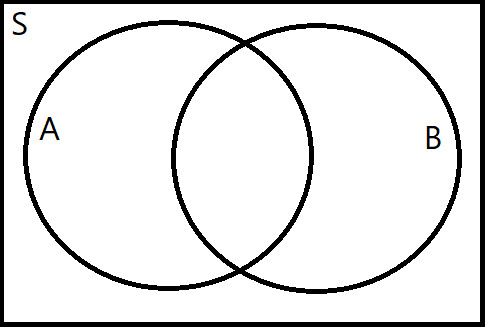
Venn diagram with sample space S and events A and B
In a Venn diagram:
- The overlap is .
- To find , mentally zoom into circle B.
- Ask: what fraction of circle B is also in A?
You’re comparing the overlap to the entire B circle.
c. Tree Diagrams
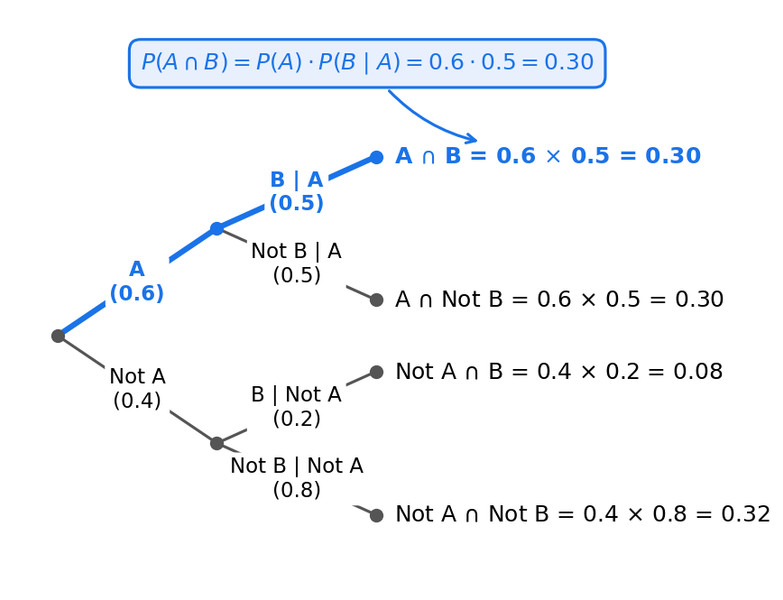
Probability tree with conditional branches
Tree diagrams are great for multi-stage processes.
- First branches = initial probabilities.
- Second branches = conditional probabilities.
- Multiply along a path to get a joint probability.
Example from the tree above:
Each full path represents an intersection.
4. How to Approach Conditional Probability Problems
When you’re stuck, slow it down:
- Rewrite the question using notation.
- Identify the conditioning event → that’s your denominator.
- Find the joint probability → numerator.
- Divide.
If you’re given a conditional probability and a marginal probability and need a joint probability, switch to the multiplication rule and multiply instead.
Always sanity-check:
- Answer must be between 0 and 1.
- If you’re conditioning on a small group, the denominator should reflect that smaller group.
5. Conditional Probability and Independence
Two events A and B are independent if learning that B happened does not change the probability of A.
Mathematically, independence means:
All three statements say the same thing in different forms.
If the conditional probability changes from the original probability, the events are not independent.
Students often assume independence automatically. On a test, you must either be told the events are independent or verify it using the probabilities.
Key Takeaways
General Multiplication Rule
The probability of both events occurring equals P(A ∩ B) = P(A) · P(B|A).
Joint Probability / Intersection
The probability that two events happen together, written as P(A ∩ B).
Given
A cue word indicating a conditional probability, meaning the sample space is restricted to the stated condition.
Two-Way Table
A table of counts or proportions for two categorical variables, useful for finding joint and conditional probabilities.
Venn Diagram
A set diagram using overlapping regions to show events, intersections, and conditional relationships.
Tree Diagram
A branching diagram for multistage chance processes, where branch probabilities are often conditional probabilities.
Conditional Probability
The probability of event A given event B is P(A|B)=P(A∩B)/P(B).
Notes
General Multiplication Rule
The probability of both events occurring equals P(A ∩ B) = P(A) · P(B|A).
Joint Probability / Intersection
The probability that two events happen together, written as P(A ∩ B).
Given
A cue word indicating a conditional probability, meaning the sample space is restricted to the stated condition.
Two-Way Table
A table of counts or proportions for two categorical variables, useful for finding joint and conditional probabilities.
Venn Diagram
A set diagram using overlapping regions to show events, intersections, and conditional relationships.
Tree Diagram
A branching diagram for multistage chance processes, where branch probabilities are often conditional probabilities.
Conditional Probability
The probability of event A given event B is P(A|B)=P(A∩B)/P(B).
