Topic 3.5 Notes – Introduction to Experimental Design
1. How Experiments Establish Causation
An experiment deliberately imposes a treatment on individuals and measures a response. The key difference from an observational study is that treatments are imposed; when they are imposed by random assignment, the comparison is fair. Because the researcher controls who gets what treatment, experiments can justify cause-and-effect conclusions.
If treatments are imposed and randomly assigned, you can say the explanatory variable caused the change in the response.
Core Components of an Experiment
Let’s ground the vocabulary clearly.
- Experimental units
The individuals or objects receiving treatments.
If they’re people, they’re often called subjects or participants.
- Explanatory variable (factor)
The variable the researcher manipulates.
Its specific values are called levels.
- Treatments
The specific conditions applied to units.
A treatment can be:
- One level of a factor (e.g., 50 mg dose)
- A combination of levels from multiple factors
- Response variable
The outcome measured after the treatment.
- Confounding variable
A variable that:
- Is related to the explanatory variable
- Affects the response variable
- Makes it unclear whether the treatment actually caused the effect
If confounding isn’t controlled, you can’t confidently attribute differences in response to the treatment.
On quizzes, you’ll often be asked to identify all five of these in context. Be specific and use the scenario’s language.
2. Principles of a Well-Designed Experiment
Strong experiments share four features. Miss one, and the design weakens.
Comparison
There must be at least two treatment groups so responses can be compared.
Often one is a control group, which may receive:
- No treatment, or
- A baseline or placebo treatment
Without comparison, you have nothing to evaluate.
Random Assignment
Each experimental unit has an equal chance of receiving any treatment.
This:
- Balances known and unknown confounding variables
- Justifies causal conclusions
Do not mix this up with random sampling.
Random sampling → generalizing to a population.
Random assignment → cause-and-effect.
Replication
More than one unit per treatment group.
Replication:
- Reduces chance variation
- Makes differences more believable
One person per treatment is not an experiment.
Control of Confounding Variables
You try to:
- Hold some variables constant
- Use blocking when helpful
- Randomize the rest
A phrase teachers love because it works:
Control what you can, block what you can’t, randomize the rest.
3. Control Groups, Placebos, and Blinding
Control Group
A control group receives no treatment of interest or receives a placebo. It provides a baseline for comparison.
Placebo and Placebo Effect
A placebo is an inactive treatment that looks like the real one.
The placebo effect happens when subjects improve simply because they believe they are receiving treatment.
Without a placebo, improvements might be psychological rather than caused by the treatment itself.
Blinding
- Single-blind: Either the subjects or the researchers interacting with them don’t know treatment assignments.
- Double-blind: Neither subjects nor interacting researchers know.
Blinding prevents bias in:
- Behavior
- Reporting
- Measuring responses
AP questions often test whether you recognize when blinding is missing.
4. Completely Randomized Design
This is the simplest design.
All experimental units are assigned to treatments entirely at random.
A completely randomized design looks like this:

Completely randomized design
How Random Assignment Happens
- Label each experimental unit.
- Use a random number generator, random digit table, or draw chips.
- Assign treatments according to the random results.
Group sizes might not be perfectly equal. That’s fine.
Random assignment tends to balance confounding variables, so differences in response can be attributed to the treatment.
5. Randomized Block and Matched Pairs Designs
Sometimes there’s a known variable that strongly affects the response. Ignoring it adds extra variation.
Randomized Complete Block Design
You:
- Divide units into blocks based on a blocking variable (e.g., grade level).
- Randomly assign treatments within each block.
The diagram below contrasts a completely randomized design with a blocked design. On the left, everyone is randomly assigned straight to treatment or control. On the right, subjects are first separated into blocks, then randomly assigned within each block.
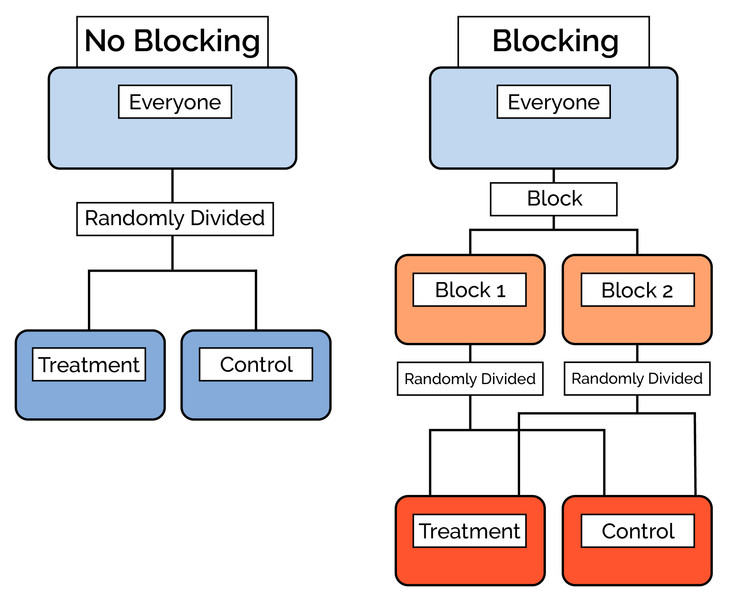
Completely randomized design vs. randomized block design
Blocking ensures units within each block are similar at the start.
This separates natural variability from treatment effects and increases precision.
Matched Pairs Design
A special case of blocking with block size 2.
Two common setups:
- Match similar subjects into pairs, randomly assign one treatment to each.
- Each subject receives both treatments in random order.
Matched pairs control individual differences extremely well.
Key Takeaways
Experiment
A study that imposes treatments on units to measure resulting responses.
Experimental Units / Subjects / Participants
Individuals or objects assigned to treatments in an experiment; people are called subjects or participants.
Explanatory Variable / Factor and Treatments
The manipulated variable in an experiment; its levels or level combinations are the treatments.
Response Variable
The outcome measured on experimental units after treatments are applied.
Confounding Variable
A variable related to the treatment that also affects the response, obscuring the true effect.
Control Group
Units receiving no treatment of interest or an inactive treatment for baseline comparison.
Placebo and Placebo Effect
An inactive treatment; the resulting response to it is the placebo effect.
Single-Blind vs. Double-Blind Experiment
Single-blind: subjects or evaluators unaware; double-blind: neither subjects nor interacting evaluators aware.
Completely Randomized Design
A design that assigns treatments to all experimental units entirely by chance.
Methods of Random Assignment
Use a random number generator, random digits table, or drawing chips without replacement.
Matched Pairs Design
A block design using pairs or repeated measurements so each pair or subject gets both treatments.
Principles of a Well-Designed Experiment
Uses comparison, random assignment, replication, and control to reduce bias and confounding.
Randomized Complete Block Design and Blocking
Groups similar units into blocks, then randomly assigns treatments within each block.
Notes
Experiment
A study that imposes treatments on units to measure resulting responses.
Experimental Units / Subjects / Participants
Individuals or objects assigned to treatments in an experiment; people are called subjects or participants.
Explanatory Variable / Factor and Treatments
The manipulated variable in an experiment; its levels or level combinations are the treatments.
Response Variable
The outcome measured on experimental units after treatments are applied.
Confounding Variable
A variable related to the treatment that also affects the response, obscuring the true effect.
Control Group
Units receiving no treatment of interest or an inactive treatment for baseline comparison.
Placebo and Placebo Effect
An inactive treatment; the resulting response to it is the placebo effect.
Single-Blind vs. Double-Blind Experiment
Single-blind: subjects or evaluators unaware; double-blind: neither subjects nor interacting evaluators aware.
Completely Randomized Design
A design that assigns treatments to all experimental units entirely by chance.
Methods of Random Assignment
Use a random number generator, random digits table, or drawing chips without replacement.
Matched Pairs Design
A block design using pairs or repeated measurements so each pair or subject gets both treatments.
Principles of a Well-Designed Experiment
Uses comparison, random assignment, replication, and control to reduce bias and confounding.
Randomized Complete Block Design and Blocking
Groups similar units into blocks, then randomly assigns treatments within each block.
