Topic 4.6 Notes – Independent Events and Unions of Events
1. What Independent Events Are
Two events A and B are independent if knowing that one happened does not change the probability that the other happens.
In symbols, any of these equivalent statements define independence:
They all say the same thing in different ways.
What that means in plain language
If learning that B occurred changes the probability of A, then A and B are dependent.
Examples you should instantly recognize:
- Two separate spins of a spinner → independent.
- Drawing two marbles without replacement → dependent (first draw changes what’s left).
How to check independence with numbers
Suppose:
Check:
Since that matches , the events are independent.
If those numbers don’t match, they’re dependent.
Independent vs. Mutually Exclusive
This confuses people every year.
- Mutually exclusive means events cannot happen together.
So .
If A and B are mutually exclusive and both have positive probability, then:
So they cannot be independent.
If they can’t happen together, knowing one happened definitely affects the other.
2. The Multiplication Rule for Independent Events
The general multiplication rule is:
If A and B are independent, then .
That gives the shortcut:
This is the rule you’ll use constantly when a question says “and” and tells you the events are independent.
Quick example
A student has:
- 0.7 probability of passing Stats
- 0.8 probability of passing Biology
If passing the two classes are independent events, then:
So there’s a 0.56 probability the student passes both classes.
On quizzes, watch for hidden dependence. If the same group of students is involved and one success makes the other more likely, you cannot multiply unless independence is justified.
3. What a Union Is
A union means “A or B or both.”
Notation:
Think: at least one happens.
If a problem says:
- “A or B”
- “At least one”
- “One or both”
You’re looking for a union.
4. The Addition Rule
To find a union, use:
You subtract the overlap because adding counts the shared part twice.
Here’s what that overlap looks like in a Venn diagram:
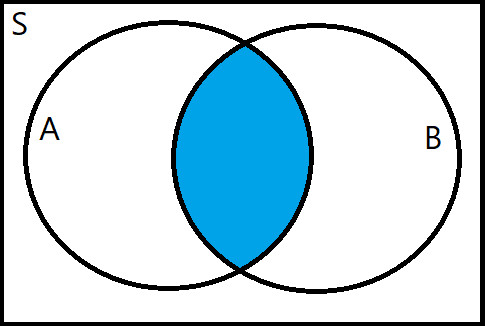
Intersection of events A and B
The shaded middle region is counted in both circles. Subtract it once.
Special case 1: Independent events
If events are independent, substitute:
So:
Example:
If and , independent:
Special case 2: Mutually exclusive events
If events cannot happen together:
Then:
No subtraction needed because there’s no overlap.
5. Choosing the Right Rule
Translate words into symbols.
- “A and B” → → multiplication rule
- “A or B” → → addition rule
- “Independent” → replace with
- “Mutually exclusive” → intersection equals 0
If independence is not stated, do not assume it.
On free-response questions, define events in context before calculating. Then write something like, “Because events A and B are independent, .” That justification earns credit.
Key Takeaways
Independent Events
Two events where knowing one occurred does not change the other's probability.
Independence Conditions
If events are independent, then P(A|B)=P(A), P(B|A)=P(B), and P(A ∩ B)=P(A)P(B).
Union of Events
The probability that event A or event B or both occurs, written P(A ∪ B).
Addition Rule
Add individual probabilities and subtract overlap: P(A ∪ B)=P(A)+P(B)-P(A ∩ B).
Notes
Independent Events
Two events where knowing one occurred does not change the other's probability.
Independence Conditions
If events are independent, then P(A|B)=P(A), P(B|A)=P(B), and P(A ∩ B)=P(A)P(B).
Union of Events
The probability that event A or event B or both occurs, written P(A ∪ B).
Addition Rule
Add individual probabilities and subtract overlap: P(A ∪ B)=P(A)+P(B)-P(A ∩ B).
