Topic 2.2 Notes – Cell Size
What Surface Area-to-Volume Ratio Means
Surface area is the amount of outer surface available for exchange. In cells, that means the plasma membrane, which is the boundary across which nutrients, gases, wastes, and heat move.
Volume is the amount of internal space. That internal space has to be supplied with materials and cleared of waste, so bigger volume means bigger demand.
That gives you the core idea:
- Higher SA:V ratio = more membrane available per unit of internal space, so exchange is faster and more efficient.
- Lower SA:V ratio = less membrane available relative to internal demand, so exchange is less efficient.
A common trap is thinking “bigger cells have more surface area, so exchange is better.” Bigger cells do have more surface area, but their volume increases even faster, so the ratio drops.
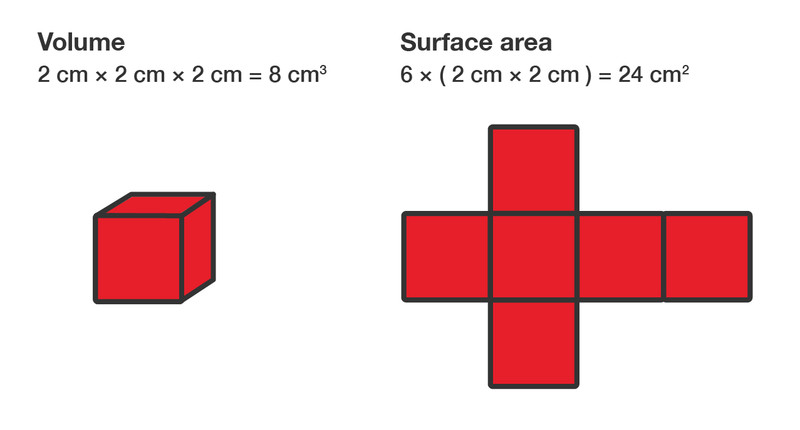
The cube example here shows why. A 2 cm cube has a surface area of 24 cm² and a volume of 8 cm³, which makes the ratio , or .
Calculating Surface Area, Volume, and SA:V
You always do this in the same order. Find surface area, find volume, then divide:
Keep units consistent when comparing cells or shapes.
Cube
If is the side length:
Rectangular solid
If is length, is width, and is height:
Sphere
If is radius:
Cylinder
If is radius and is height:
The trend that matters most is this:
- As size increases, volume grows faster than surface area
- So SA:V decreases
- For shapes with the same volume, the one with more surface area has the better exchange potential
How Cell Size and Shape Limit Exchange
A cell cannot just keep growing forever. Its plasma membrane has to move materials in and out fast enough for the whole cytoplasm.
Here’s what happens as a cell gets larger:
- Volume increases so nutrient demand rises
- Waste production increases
- SA:V decreases
- Exchange across the membrane becomes less efficient relative to the cell’s needs
That’s why smaller cells usually exchange materials more efficiently.
Shape matters too. Cells that are:
- long and thin
- flat
- highly folded
have more surface area relative to volume than compact shapes such as spheres. Membrane folds are a very common solution because they add exchange area without adding much volume.
Structures That Increase Exchange Surface
These are all applications of the same SA:V idea. Root hair cells are a good example because their long, thin shape increases the membrane area in contact with soil.

Root hair cell
- Root hairs increase surface area for water and mineral absorption from soil.
- Gut epithelial cells have microvilli, tiny membrane folds that increase surface area for nutrient absorption.
- Stomata are pores in leaves where gases move in and out.
- Guard cells control whether stomata open or close, so they regulate gas exchange with the environment.
- Cilia help move fluid or materials across a cell surface, which supports exchange in some tissues.
Know these together as examples of structures that increase surface area for exchange.
Why SA:V Matters for Whole Organisms
The same principle works beyond single cells. As organisms get larger, SA:V decreases.
That affects heat exchange:
- Smaller masses exchange proportionally more heat with the environment
- Larger masses exchange heat more slowly
- So larger organisms usually lose heat more slowly than smaller ones
It also connects to metabolic rate per unit body mass:
- Smaller organisms typically have a higher metabolic rate per unit body mass
- Larger organisms typically have a lower metabolic rate per unit body mass
So the cause-and-effect chain is:
bigger size → lower SA:V → slower exchange of chemicals and thermal energy
Key Takeaways
Surface Area-to-Volume Ratio
The amount of membrane surface available for exchange relative to internal cell volume.
Surface Area and Volume Formulas
Sphere: SA 4πr², V 4/3πr³; cube: SA 6s², V s³; rectangular solid: SA 2lh+2lw+2wh, V lwh; cylinder: SA 2πr²+2πrl, V πr²l.
Calculating SA:V Ratio
Find surface area and volume with the correct formula, then divide surface area by volume.
Exchange of Materials and SA:V
Higher ratios allow faster nutrient uptake, waste removal, and chemical exchange across membranes.
Membrane Folding and SA:V
Folds increase surface area greatly without much increase in volume.
Root Hairs
Thin extensions of root epidermal cells that increase surface area for water and mineral absorption.
Guard Cells and Stomata
Paired cells regulate stomatal openings, controlling gas exchange and water loss in leaves.
Gut Epithelial Cells and Microvilli
Intestinal lining cells have membrane projections that increase surface area for nutrient absorption.
Cilia
Short hairlike cell projections that increase exposed surface and help move materials past cells.
Heat Exchange and Body Size
Smaller bodies lose heat faster because they have more surface area relative to volume.
Metabolic Rate per Unit Body Mass
Smaller multicellular organisms usually use energy faster per gram than larger organisms.
Cell Size Limits and Plasma Membrane Exchange
As cells grow, volume increases faster than membrane area, limiting efficient material exchange.
Notes
Surface Area-to-Volume Ratio
The amount of membrane surface available for exchange relative to internal cell volume.
Surface Area and Volume Formulas
Sphere: SA 4πr², V 4/3πr³; cube: SA 6s², V s³; rectangular solid: SA 2lh+2lw+2wh, V lwh; cylinder: SA 2πr²+2πrl, V πr²l.
Calculating SA:V Ratio
Find surface area and volume with the correct formula, then divide surface area by volume.
Exchange of Materials and SA:V
Higher ratios allow faster nutrient uptake, waste removal, and chemical exchange across membranes.
Membrane Folding and SA:V
Folds increase surface area greatly without much increase in volume.
Root Hairs
Thin extensions of root epidermal cells that increase surface area for water and mineral absorption.
Guard Cells and Stomata
Paired cells regulate stomatal openings, controlling gas exchange and water loss in leaves.
Gut Epithelial Cells and Microvilli
Intestinal lining cells have membrane projections that increase surface area for nutrient absorption.
Cilia
Short hairlike cell projections that increase exposed surface and help move materials past cells.
Heat Exchange and Body Size
Smaller bodies lose heat faster because they have more surface area relative to volume.
Metabolic Rate per Unit Body Mass
Smaller multicellular organisms usually use energy faster per gram than larger organisms.
Cell Size Limits and Plasma Membrane Exchange
As cells grow, volume increases faster than membrane area, limiting efficient material exchange.
