Topic 2.6 Notes – Environmental Consequences of Connectivity
How Afro-Eurasian Connectivity Moved Living Things
The Silk Roads, Indian Ocean, and trans-Saharan routes carried biological life across regions. That means trade spread organisms, not just products.
- Biological diffusion means the movement of crops, animals, insects, and pathogens between ecological zones.
- The same routes that spread religions and technologies also spread seeds, rats, fleas, and infected people.
- Some transfers were deliberate. Merchants, migrants, and farmers carried seeds, cuttings, and useful plants to places where they could grow.
- Some were unintended. Rodents on ships, fleas in cargo, and sickness moving person to person traveled without anyone planning it.
- Strong empires made this easier because protected routes meant travel happened more often and more safely.
- The best example is the Mongol Empire. Pax Mongolica increased movement across Eurasia, which boosted trade and also helped disease travel much farther, much faster.
This trade-route map is a good reminder that exchange linked Afro-Eurasia by both land and sea, so living things could spread along caravan routes and shipping lanes alike.
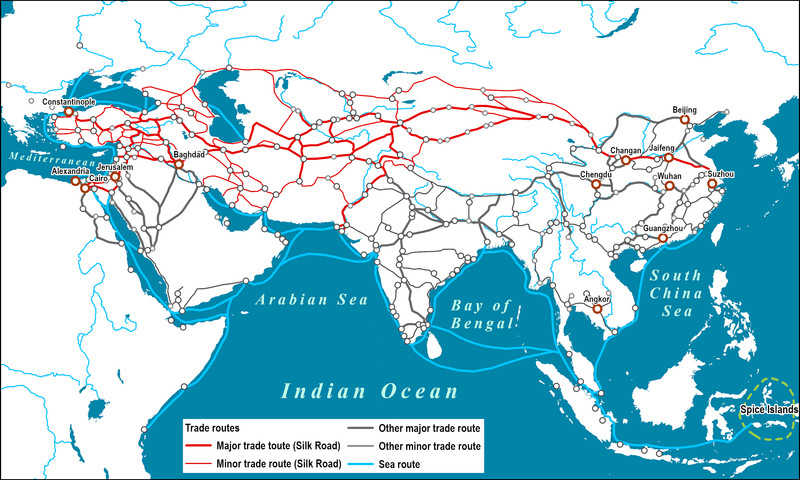
Afro-Eurasian trade routes
The causation chain here is the whole topic. More exchange networks → more organisms crossing regions → changes in agriculture, population, and environment.
Crops That Spread and Changed Agriculture
A crop only mattered if people actually adopted it and if local conditions fit. The shared pattern is simple. A crop moved, farmers used it where it worked, production grew, and then food supply and land use changed.
Bananas in Africa
Bananas came from Southeast Asia/New Guinea. They moved through Indian Ocean trade to Madagascar and East Africa, then spread inland.
- Bananas did well in warm, humid climates, where some grains struggled.
- They gave high yields from small areas and were a reliable food source.
- That helped support denser settlement and population growth in tropical and forest regions.
- They could support trade, specialization, and stronger states, but don't say bananas alone created states. AP likes that distinction.
Champa rice in East Asia
Champa rice came from Champa in present-day Vietnam and reached Song China by the 11th century.
- It was early-ripening and fairly drought-resistant.
- In some places, its short growing season made double cropping possible.
- Farmers expanded irrigation, terracing, and wet-rice farming, especially in southern China.
- Results included higher output, a more reliable food supply, population growth, urbanization, and more market activity.
Citrus in the Mediterranean
Citrus fruits such as lemons, limes, citrons, and sour oranges spread west from Asia.
- Muslim merchants, farmers, and rulers helped spread both the plants and the irrigation knowledge needed to grow them.
- Citrus became common in North Africa, al-Andalus, Sicily, and other Mediterranean regions.
- It diversified diets, expanded orchards and garden agriculture, and reshaped landscapes near cities and ports.
- After Christian conquests, rulers often kept Muslim irrigation systems and crops, which shows continuity across political change.
How Crop Diffusion Reshaped Population and Landscapes
Crops changed history because people used them.
- Environmental suitability + human choice determined whether a crop mattered.
- Common results:
- more food production
- population growth
- denser settlement
- more urbanization and specialization
- landscape modification through irrigation, terraces, paddies, orchards, and land clearing
This is a classic human-environment interaction story. The environment shaped what could grow, and people reshaped the environment to grow more of it.
The Black Death and the Spread of Pathogens
The deadliest biological consequence of connectivity was the Black Death, part of the second plague pandemic.
- A pathogen is a disease-causing agent.
- A vector is an organism that transmits disease.
- The Black Death was caused by Yersinia pestis.
- The usual model is fleas on rodents, though plague could also spread through infected people and, in pneumonic form, through droplets.
- It likely began in Central Eurasia, with early evidence near the Tian Shan region.
- It spread along caravan routes to the Black Sea, then by ship to Mediterranean ports in 1347, then across Europe, Southwest Asia, and North Africa.
- Kaffa in Crimea is the named place you should recognize.
This map traces that movement from the Black Sea into Mediterranean port cities and then across much of Afro-Eurasia.
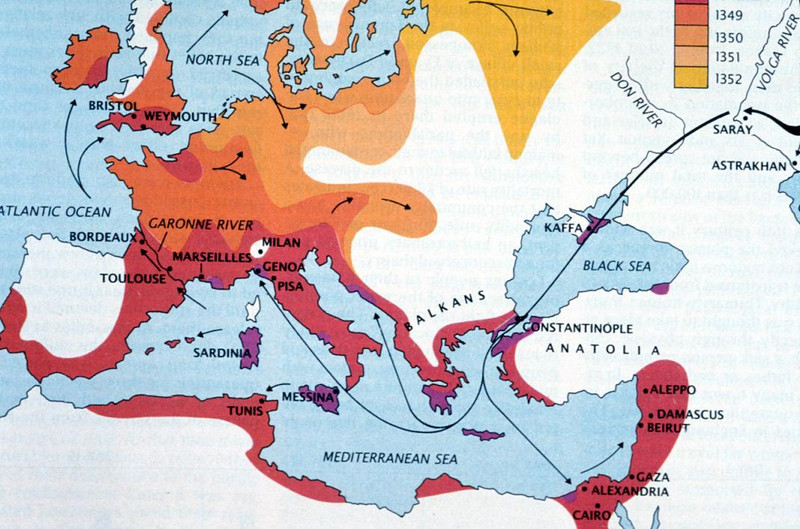
Spread of the Black Death, 1347-1352
Effects of the Black Death
The plague spread through the same connected world that had helped useful crops spread.
- It killed about one-third of Europe's population, often estimated at 30 to 50 percent.
- It also devastated parts of Southwest Asia and North Africa.
- It caused labor shortages, abandoned farms, disrupted trade, and weakened institutions.
- In western Europe, labor scarcity helped weaken serfdom over time.
- The English Statute of Labourers (1351) tried to keep wages from rising.
- People explained plague through miasma, prayer, and penance because they did not know germ theory.
- Jews were persecuted through false accusations of well-poisoning.
- Mediterranean port cities later used quarantine to slow spread.
Why Connectivity Had Both Productive and Deadly Consequences
Crops and plague are two outcomes of the same process, which was expanded exchange across Afro-Eurasia.
| Similarity | Difference |
|---|---|
| Both moved along trade routes | Crops were usually spread deliberately |
| Both changed population patterns | Pathogens spread unintentionally |
| Both crossed ecological zones | Crops were adopted selectively, disease spread rapidly |
The strongest AP World claim here is that Afro-Eurasian exchange from 1200 to 1450 increased biological diffusion, which raised agricultural production and population in some places but also made societies vulnerable to epidemic disease across huge distances. One connected world brought both growth and disaster.
Key Takeaways
Biological Diffusion
Movement of plants, animals, and disease organisms between ecological regions through trade, migration, conquest, and travel
Crop Diffusion
Introduction and adoption of cultivated plants outside their original regions, often changing food supplies, populations, settlements, and landscapes
Champa Rice
Early-ripening, drought-resistant rice from present-day Vietnam that could permit double cropping and increased Chinese food production and population
Citrus in the Mediterranean
Asian citrus crops spread west by Muslim merchants and farmers, encouraging irrigated orchards, commercial horticulture, and more varied diets
Pathogen
A disease-causing organism or agent that can spread between populations through travel and exchange
Epidemic vs. Pandemic
An epidemic is a sharp regional increase in disease; a pandemic spreads across multiple regions or continents
Black Death / Bubonic Plague
Fourteenth-century plague pandemic spread through Afro-Eurasian trade routes that killed roughly 30–50 percent of Europe’s population and caused widespread disruption
Yersinia pestis
The bacterium that caused the Black Death, conventionally spread to humans by fleas associated with infected rodents
Mongol Empire
Its partial integration of Eurasia increased movement across Central Asia, unintentionally creating pathways for plague transmission
Bananas in Africa
Southeast Asian crop spread through Indian Ocean contacts that supported denser settlement and population growth in tropical Africa
Notes
Biological Diffusion
Movement of plants, animals, and disease organisms between ecological regions through trade, migration, conquest, and travel
Crop Diffusion
Introduction and adoption of cultivated plants outside their original regions, often changing food supplies, populations, settlements, and landscapes
Champa Rice
Early-ripening, drought-resistant rice from present-day Vietnam that could permit double cropping and increased Chinese food production and population
Citrus in the Mediterranean
Asian citrus crops spread west by Muslim merchants and farmers, encouraging irrigated orchards, commercial horticulture, and more varied diets
Pathogen
A disease-causing organism or agent that can spread between populations through travel and exchange
Epidemic vs. Pandemic
An epidemic is a sharp regional increase in disease; a pandemic spreads across multiple regions or continents
Black Death / Bubonic Plague
Fourteenth-century plague pandemic spread through Afro-Eurasian trade routes that killed roughly 30–50 percent of Europe’s population and caused widespread disruption
Yersinia pestis
The bacterium that caused the Black Death, conventionally spread to humans by fleas associated with infected rodents
Mongol Empire
Its partial integration of Eurasia increased movement across Central Asia, unintentionally creating pathways for plague transmission
Bananas in Africa
Southeast Asian crop spread through Indian Ocean contacts that supported denser settlement and population growth in tropical Africa
