Topic 6.8 Notes – Causation in the Imperial Age
How to Explain the Effects of Imperialism
Imperialism means one state extending power over other peoples through colonies, protectorates, spheres of influence, settler rule, or economic domination. The key move is to explain how it caused change.
The usual causal chain works like this:
- Industrial capitalism increased demand for raw materials, markets, and places to invest.
- Imperial control gave outside powers access to land, labor, ports, and trade.
- Colonial policies then reshaped work, migration, society, and the environment.
That is stronger than just saying industrialization came first and imperialism came after. AP questions want the mechanism.
When you judge relative significance, rank effects by:
- scale: how many people were affected
- duration: how long it lasted
- depth: how much it changed institutions or daily life
- geographic reach: local or global
- later impact: what it set up afterward
A strong thesis is this: economic restructuring was usually the broadest effect, but loss of sovereignty was the immediate condition that made the rest possible.
The Main Effects of Imperialism
Imperialism changed several parts of life at once, so on tests you want to connect them, not list them separately.
Political effects
- Sovereignty shrank or disappeared under direct rule, indirect rule, or spheres of influence.
- Colonial states built censuses, taxes, courts, police, and borders to control people and resources.
- Empires often ruled through local elites, soldiers, and rulers, so collaboration mattered too.
- British Raj began after the Indian Rebellion of 1857, when Britain replaced Company rule with direct Crown rule.
- In China, treaty ports and extraterritoriality after the Opium Wars let foreigners operate under their own laws.
Economic effects
- Colonies were turned into export economies tied to global capitalism.
- The pattern was raw materials out, manufactured goods in.
- Examples include cotton in India and Egypt, rubber in the Congo and Amazon, palm oil in West Africa, guano in Peru and Chile, copper in Chile, and meat in Argentina and Uruguay.
- Railroads, ports, telegraphs, and canals were built mostly to move exports and troops, not to develop local economies evenly.
Labor and migration effects
- Coercion continued after slavery through forced labor, indenture, convict labor, and tax pressure.
- Indian and Chinese indentured laborers moved across the Caribbean, Africa, Southeast Asia, and the Pacific.
- Steamships and railroads made migration much larger in scale, with both voluntary and semicoerced movement.
Social and cultural effects
- Missionaries and schools spread Christianity, literacy, and Western political ideas.
- Migration created diasporas and ethnic enclaves such as Indian, Chinese, Irish, Italian, Lebanese, and Japanese communities.
- Social Darwinism and pseudoscientific racism hardened racial hierarchies.
- Exclusion laws included the Chinese Exclusion Act (1882) and the White Australia policy.
Environmental effects
- Export farming, mining, rubber extraction, logging, and monocropping changed land use.
- You see this clearly in Congo rubber, Chilean copper, African diamond mining, and cattle production in Argentina and Uruguay.
Case Studies That Show the Whole Causal Chain
British India
British cloth undercut Indian hand-produced textiles. India then exported raw cotton and imported British cloth. Railroads linked farms to ports and moved troops. The 1857 rebellion led to direct British rule in 1858. India also became a major source of indentured migrants.
Congo Free State
Industrial demand for rubber met Leopold II’s private control. Contemporary critics captured that brutality in political cartoons like the one below. Quotas were enforced by hostage-taking, mutilation, and killing. This is the clearest example of industrial demand leading to coercive labor and atrocity.
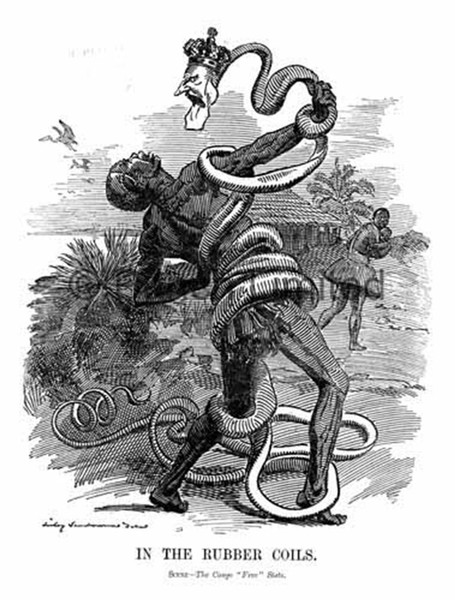
“In the Rubber Coils” political cartoon
China and Latin America as informal empire
China kept the Qing government, but after the Opium Wars it lost economic sovereignty. In Argentina, British investment and influence shaped trade and ports like Buenos Aires without full annexation.
Resistance and Feedback Loops
Imperial rule triggered warfare, rebellion, diplomacy, migration, and religious resistance. Major examples include the Indian Rebellion of 1857, Samory Touré, the Mahdist movement in Sudan, Yaa Asantewaa, the Ghost Dance, and Xhosa Cattle-Killing.
Even failed resistance mattered. It:
- raised the cost of empire
- delayed conquest
- forced administrative changes
- strengthened collective identities
The feedback loop is important. Imperial control caused resistance, and resistance often pushed empires toward bigger armies, more bureaucracy, and more direct rule.
What Was Most Significant Overall
The broadest argument is that economic restructuring had the widest and longest-lasting impact. It tied Africa, Asia, and Latin America to industrial economies and redirected labor, infrastructure, and production toward foreign demand.
That argument needs qualification. Political conquest made restructuring possible. In settler colonies like New Zealand, land seizure and indigenous marginalization may matter more. For migrants and receiving societies, diasporas and racial exclusion may have lasted longest.
