Topic 7.2 Notes – Causes of World War I
Why World War I Broke Out in 1914
You want to separate three layers of cause. The long-term causes made Europe unstable. The assassination explains why then. The July Crisis explains how leaders turned danger into war.
By 1900, Europe had the tools for a huge war:
- Industrialized states could mass-produce rifles, artillery, and shells.
- Mass conscription let governments call up millions of soldiers.
- Railroads moved troops fast, which made mobilization feel urgent.
- Modern weapons and war plans made leaders think in rigid timetables.
Multiethnic empires were especially shaky:
- Austria-Hungary ruled many ethnic groups, including Slavs who wanted more autonomy.
- The Ottoman Empire was weakening, which opened power struggles in southeastern Europe.
The AP move is never “WWI had one cause.” It came from the interaction of imperialism, nationalism, alliances, territorial disputes, and militarism.
The Main Long-Term Causes
Imperialism and competition for power and resources
Empires meant raw materials, markets, military bases, and prestige. Colonies were money and status at the same time.
- Germany’s Weltpolitik under Kaiser Wilhelm II pushed for a stronger navy and bigger global role, which alarmed Britain and France.
- The First Moroccan Crisis (1905 to 1906) and Second Moroccan Crisis (1911 at Agadir) grew out of Germany challenging French influence in Morocco. These crises ended peacefully, but they increased distrust and pushed Britain and France closer together.
- Imperial rivalry also helps explain why the war became global, since empires pulled in colonies, soldiers, and overseas territory.
Territorial and regional conflicts
Some tensions were inside Europe itself. The map here is most useful for spotting the rival alliance blocs and why the Balkans mattered so much.
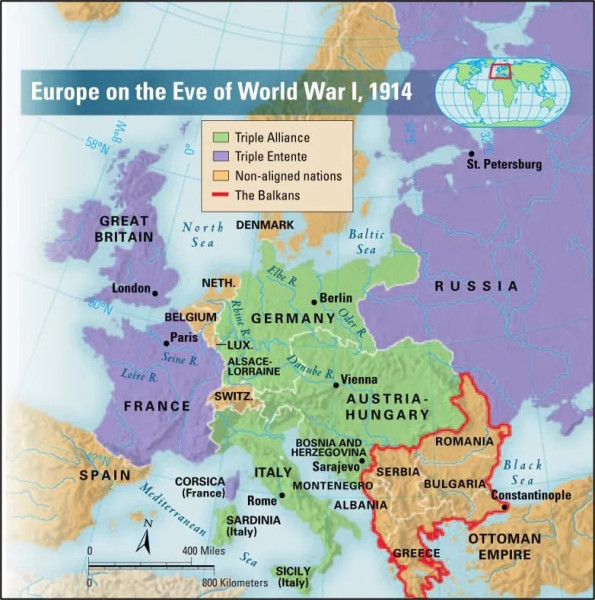
Europe and the alliance system, 1914
- Alsace-Lorraine had been taken by Germany from France after the Franco-Prussian War, so France carried resentment into 1914.
- The Balkans were the “powder keg of Europe” because Ottoman decline left a power vacuum.
- Austria-Hungary feared a stronger Serbia.
- Russia wanted influence in the Balkans and access through the Turkish Straits.
- In the Bosnian Crisis of 1908, Austria-Hungary annexed Bosnia and Herzegovina, angering Serbia and Russia.
- The Balkan Wars of 1912 to 1913 made Serbia stronger, which made Austria even more nervous.
Nationalism
Nationalism worked in two ways:
- State nationalism tied national greatness to military power, empire, and honor.
- Ethnic nationalism pushed groups inside empires to seek independence.
That second kind mattered a lot in the Balkans:
- Serbian nationalism and Yugoslavism aimed to unite South Slavs.
- Pan-Slavism connected Serbia to Russian support.
Nationalism made compromise look weak. A local dispute could feel like a test of national survival.
Alliances and militarism
Europe split into rival camps:
| Alliance | Members |
|---|---|
| Triple Alliance | Germany, Austria-Hungary, Italy |
| Triple Entente | Britain, France, Russia |
These alliances were not fully automatic, which is a common AP trap. Leaders still made choices. Still, they made every crisis more dangerous.
- Militarism meant glorifying military strength and accepting force as a solution.
- Britain and Germany competed in a naval arms race, especially after HMS Dreadnought in 1906.
- The Schlieffen Plan, mobilization schedules, and conscription made slow diplomacy harder.
The acronym MAIN helps, but you still need territorial conflict and the July Crisis to explain the war.
How the Balkans Turned Tension into Crisis
Serbia backed South Slav nationalism, which directly threatened Austria-Hungary’s unity. Russia backed Serbia for Pan-Slavic reasons and for strategic influence.
On June 28, 1914, Archduke Franz Ferdinand was assassinated in Sarajevo by Gavrilo Princip, a Bosnian Serb nationalist tied to Young Bosnia. The Black Hand helped arm the conspirators.
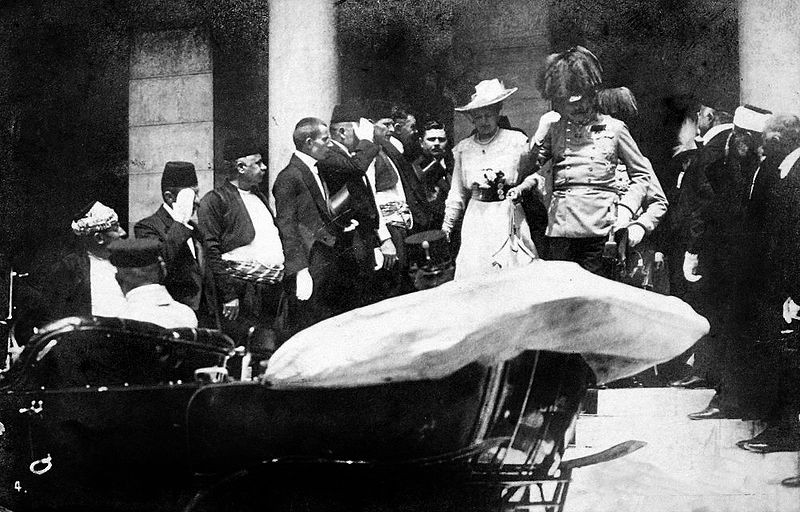
Archduke Franz Ferdinand in Sarajevo, 1914
This photo shows Franz Ferdinand in Sarajevo shortly before the assassination. The killing mattered because it confirmed Austrian fears and gave Austria-Hungary a reason to crush Serbia.
How the July Crisis Became a European War
Here’s the chain reaction:
- July 5 to 6. Germany gave Austria-Hungary a blank check and promised support.
- July 23. Austria-Hungary sent Serbia a harsh ultimatum.
- Serbia accepted most demands but rejected ones that violated its sovereignty.
- July 28. Austria-Hungary declared war on Serbia.
- Russia mobilized to support Serbia.
- August 1. Germany declared war on Russia.
- August 3. Germany declared war on France.
- Germany invaded neutral Belgium under the Schlieffen Plan.
- August 4. Britain declared war on Germany.
The key point is that alliances did not force war like dominoes. Leaders made choices inside a system already loaded with pressure.
Why the War Became Global
European empires spread the war far beyond Europe.
- Britain, France, Germany, and Russia drew on colonies and dominions for troops, labor, food, and raw materials.
- Japan entered in 1914 and seized German possessions in East Asia and the Pacific.
- The Ottoman Empire joined the Central Powers, expanding the war into the Middle East.
So the clean causal summary is this:
- Long-term causes were imperialism, nationalism, territorial rivalry, alliances, and militarism.
- Immediate trigger was Sarajevo.
- Escalation mechanisms were the blank check, ultimatum, mobilization, and Schlieffen Plan.
- Result was a Balkan crisis that became a European war and then a global war.
Key Takeaways
Long-Term Causes vs. Immediate Trigger
Imperialism, territorial rivalry, alliances, nationalism, and militarism made Europe vulnerable; Franz Ferdinand’s assassination triggered war in 1914
Imperialism
Competition for colonies, resources, markets, bases, and prestige increased prewar tensions and later spread the war through imperial networks
Weltpolitik
Kaiser Wilhelm II’s assertive policy of seeking greater German colonial, naval, and global influence
Kaiser Wilhelm II
German emperor who pursued Weltpolitik and expanded Germany’s navy and international influence, alarming Britain and France
First Moroccan Crisis
Germany challenged French influence in Morocco in 1905–1906 but became isolated and strengthened British-French cooperation
Second Moroccan Crisis
Germany sent the gunboat Panther to Agadir in 1911, increasing German, French, and British suspicion despite a diplomatic settlement
Alsace-Lorraine
Territory lost by France to Germany after the Franco-Prussian War, contributing to French resentment and distrust of Germany
Balkans / Powder Keg of Europe
Unstable southeastern European region where Ottoman decline, territorial disputes, nationalism, and Austro-Russian rivalry converged
Serbian Nationalism
The effort to enlarge Serbia or unite South Slavs, which Austria-Hungary saw as a threat to its multiethnic empire
Pan-Slavism
The belief that Slavic peoples shared common interests, used by Russia to support Serbia and claim protection of Balkan Slavs
National Self-Determination
The principle that a nation should govern itself, which threatened multiethnic empires such as Austria-Hungary and the Ottoman Empire
Bosnian Crisis / Annexation of Bosnia and Herzegovina
Austria-Hungary’s 1908 annexation angered Serbia and Russia, deepening Serbian hostility and damaging Russian prestige
Balkan Wars
Wars of 1912–1913 that weakened Ottoman rule, enlarged Serbia, and increased Austro-Hungarian fear and Russian support for Serbia
Nationalism
Loyalty to national power and ethnic identity that encouraged interstate rivalry, imperial prestige, separatism, and resistance to compromise
Triple Alliance
The 1882 defensive alliance of Germany, Austria-Hungary, and Italy; Italy remained neutral in 1914 and joined the Allies in 1915
Triple Entente
Prewar diplomatic grouping of Britain, France, and Russia; a set of alliances and understandings rather than one treaty requiring automatic entry into war
Alliance System
Rival blocs spread security fears and encouraged risk-taking, helping turn the Austro-Serbian dispute into a general war without making escalation automatic
Militarism
The elevation of military strength, values, and solutions in politics, making governments more prepared and willing to use war
Conscription
Mandatory military service used to create large armies and reserves that could be mobilized rapidly
Anglo-German Naval Arms Race
British-German competition to build modern battle fleets, accelerated by HMS Dreadnought, that threatened British naval security and increased suspicion
Schlieffen Plan
German plan to defeat France quickly through neutral Belgium before shifting forces east against slower-mobilizing Russia
Mobilization
Calling up and transporting armies under rigid schedules, which made delay seem dangerous and turned military preparation into a threat
Archduke Franz Ferdinand
Heir to the Austro-Hungarian throne whose assassination at Sarajevo on June 28, 1914 triggered the July Crisis
Gavrilo Princip
Bosnian Serb nationalist associated with Young Bosnia who assassinated Franz Ferdinand and Sophie at Sarajevo
Young Bosnia
Revolutionary South Slavic nationalist movement associated with Princip and opposition to Austro-Hungarian rule in Bosnia
Black Hand
Serbian secret nationalist network whose members supplied weapons and assistance to the Sarajevo conspirators
Assassination at Sarajevo
The June 28, 1914 murder of Franz Ferdinand and Sophie by Gavrilo Princip, providing the immediate trigger for World War I.
German Blank Check
Germany’s July 5–6 promise to support Austria-Hungary against Serbia even if Russian intervention produced a wider war
Austro-Hungarian Ultimatum to Serbia
Severe July 23 demands that Serbia mostly accepted but partly rejected because Austro-Hungarian participation in Serbian proceedings violated sovereignty
July Crisis
The 1914 escalation from Austria-Hungary’s ultimatum and war on Serbia through Russian mobilization and German, French, and British entry
Arms Race
Competitive military buildup in which each state’s expansion prompted rivals to expand, increasing fear, suspicion, and readiness for war
MAIN
Militarism, alliances, imperialism, and nationalism; a mnemonic for major long-term causes of World War I, not a complete causal explanation
Notes
Long-Term Causes vs. Immediate Trigger
Imperialism, territorial rivalry, alliances, nationalism, and militarism made Europe vulnerable; Franz Ferdinand’s assassination triggered war in 1914
Imperialism
Competition for colonies, resources, markets, bases, and prestige increased prewar tensions and later spread the war through imperial networks
Weltpolitik
Kaiser Wilhelm II’s assertive policy of seeking greater German colonial, naval, and global influence
Kaiser Wilhelm II
German emperor who pursued Weltpolitik and expanded Germany’s navy and international influence, alarming Britain and France
First Moroccan Crisis
Germany challenged French influence in Morocco in 1905–1906 but became isolated and strengthened British-French cooperation
Second Moroccan Crisis
Germany sent the gunboat Panther to Agadir in 1911, increasing German, French, and British suspicion despite a diplomatic settlement
Alsace-Lorraine
Territory lost by France to Germany after the Franco-Prussian War, contributing to French resentment and distrust of Germany
Balkans / Powder Keg of Europe
Unstable southeastern European region where Ottoman decline, territorial disputes, nationalism, and Austro-Russian rivalry converged
Serbian Nationalism
The effort to enlarge Serbia or unite South Slavs, which Austria-Hungary saw as a threat to its multiethnic empire
Pan-Slavism
The belief that Slavic peoples shared common interests, used by Russia to support Serbia and claim protection of Balkan Slavs
National Self-Determination
The principle that a nation should govern itself, which threatened multiethnic empires such as Austria-Hungary and the Ottoman Empire
Bosnian Crisis / Annexation of Bosnia and Herzegovina
Austria-Hungary’s 1908 annexation angered Serbia and Russia, deepening Serbian hostility and damaging Russian prestige
Balkan Wars
Wars of 1912–1913 that weakened Ottoman rule, enlarged Serbia, and increased Austro-Hungarian fear and Russian support for Serbia
Nationalism
Loyalty to national power and ethnic identity that encouraged interstate rivalry, imperial prestige, separatism, and resistance to compromise
Triple Alliance
The 1882 defensive alliance of Germany, Austria-Hungary, and Italy; Italy remained neutral in 1914 and joined the Allies in 1915
Triple Entente
Prewar diplomatic grouping of Britain, France, and Russia; a set of alliances and understandings rather than one treaty requiring automatic entry into war
Alliance System
Rival blocs spread security fears and encouraged risk-taking, helping turn the Austro-Serbian dispute into a general war without making escalation automatic
Militarism
The elevation of military strength, values, and solutions in politics, making governments more prepared and willing to use war
Conscription
Mandatory military service used to create large armies and reserves that could be mobilized rapidly
Anglo-German Naval Arms Race
British-German competition to build modern battle fleets, accelerated by HMS Dreadnought, that threatened British naval security and increased suspicion
Schlieffen Plan
German plan to defeat France quickly through neutral Belgium before shifting forces east against slower-mobilizing Russia
Mobilization
Calling up and transporting armies under rigid schedules, which made delay seem dangerous and turned military preparation into a threat
Archduke Franz Ferdinand
Heir to the Austro-Hungarian throne whose assassination at Sarajevo on June 28, 1914 triggered the July Crisis
Gavrilo Princip
Bosnian Serb nationalist associated with Young Bosnia who assassinated Franz Ferdinand and Sophie at Sarajevo
Young Bosnia
Revolutionary South Slavic nationalist movement associated with Princip and opposition to Austro-Hungarian rule in Bosnia
Black Hand
Serbian secret nationalist network whose members supplied weapons and assistance to the Sarajevo conspirators
Assassination at Sarajevo
The June 28, 1914 murder of Franz Ferdinand and Sophie by Gavrilo Princip, providing the immediate trigger for World War I.
German Blank Check
Germany’s July 5–6 promise to support Austria-Hungary against Serbia even if Russian intervention produced a wider war
Austro-Hungarian Ultimatum to Serbia
Severe July 23 demands that Serbia mostly accepted but partly rejected because Austro-Hungarian participation in Serbian proceedings violated sovereignty
July Crisis
The 1914 escalation from Austria-Hungary’s ultimatum and war on Serbia through Russian mobilization and German, French, and British entry
Arms Race
Competitive military buildup in which each state’s expansion prompted rivals to expand, increasing fear, suspicion, and readiness for war
MAIN
Militarism, alliances, imperialism, and nationalism; a mnemonic for major long-term causes of World War I, not a complete causal explanation
