Topic 1.5 Notes – Human–Environmental Interaction
Human-Environmental Interaction
Geographers care about spatial relationships, so the question is never just “what is the environment like?” It’s “how do environmental conditions and human choices create different patterns across places?”
A simple way to think about this is as a two-way relationship between environment and society.
The environment gives people:
- Resources such as water, soil, minerals, energy, and land
- Opportunities such as fertile plains or river transport
- Hazards and constraints such as drought, cold, steep slopes, or flooding
Societies respond through:
- Culture and values
- Technology such as irrigation or air-conditioning
- Land use decisions
- Policy and management
Then people change the environment, and that creates feedback. A dam, for example, helps irrigation and power generation, but it also changes river flow and ecosystems, which affects future choices.
Three relationships
- Dependence means people rely on environmental features. Farming depends on water, soil, and climate. Cities depend on land and water. Industry depends on energy and raw materials.
- Adaptation means adjusting to conditions without removing them. Steep roofs fit snowy climates. Ventilation fits hot climates. Crop choices match temperature and rainfall.
- Modification means changing the environment itself. Irrigation, dams, terracing, deforestation, wetland drainage, and urban paving all do this.
A common AP move is to identify three pieces together: the environmental condition, the human response, and the consequence.
Natural Resources, Land Use, and Sustainability
These belong together. Resources are what people use, land use is how space is organized to use them, and sustainability asks whether that pattern can keep going.
Natural resources
A natural resource is anything in the physical environment that people see as useful.
Examples include:
- fresh water
- fertile soil
- forests
- fish
- sunlight and wind
- fossil fuels
- minerals
A resource is not just “something found in nature.” It becomes a resource when technology, demand, cost, and political control make it usable. Petroleum existed long before it became valuable. It mattered much more once industrialization and engines created demand for it.
Renewable and nonrenewable resources
| Type | Meaning | Examples | Important nuance |
|---|---|---|---|
| Renewable | Replaced on a human time scale | solar, wind, flowing water, forests, fisheries, soil, freshwater | Renewable does not mean unlimited |
| Nonrenewable | Finite or replaced too slowly for human use | coal, petroleum, natural gas, uranium, minerals | Recycling can extend supply, but does not make them renewable |
Water is the classic tricky example. Surface water often renews through the water cycle, but if groundwater is pumped faster than recharge, or if it comes from a fossil aquifer, it works like a nonrenewable resource.
Land use and land cover
- Land use means the human purpose of the land, such as farming, mining, housing, transportation, recreation, or conservation.
- Land cover means what is physically on the surface, such as forest, cropland, water, pavement, or buildings.
The same land cover can have different uses. A forest might be used for timber, recreation, or watershed protection.
Sustainability
The Brundtland Commission defined sustainability in 1987 as meeting present needs without hurting future generations’ ability to meet theirs.
- For renewables, use should stay at or below regeneration rates.
- For nonrenewables, societies rely on efficiency, recycling, alternatives, and limiting damage.
Trade-offs are built in. Dams can provide electricity and irrigation, but they can also block fish migration and displace communities.
The Aral Sea Case
This is the standard example because it ties the whole topic together.
Beginning in the 1960s, the Soviet Union diverted the Amu Darya and Syr Darya rivers to irrigate cotton in dry Central Asia.
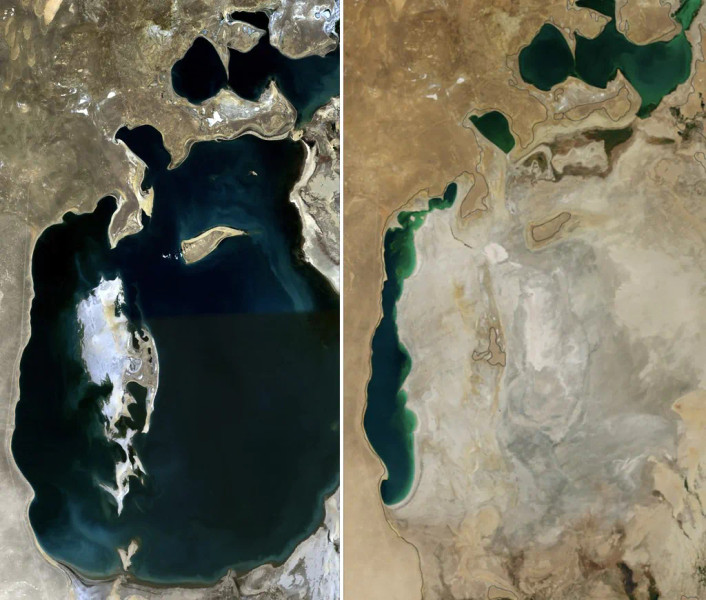
Aral Sea shrinkage over time
In the side-by-side satellite view, you can see how a large inland sea was reduced to smaller, separated bodies of water surrounded by exposed seabed.
What it shows:
- Dependence on limited water resources
- Adaptation through irrigation in an arid region
- Modification through river diversion
Consequences:
- the Aral Sea shrank
- salinity increased
- fisheries collapsed
- exposed seabed created salt and dust storms
- soils and human health were damaged
The spatial relationship matters most here. Upstream water withdrawal caused downstream environmental change.
Environmental Determinism and Possibilism
These are two different ways to explain the relationship between environment and society.
Environmental determinism
Environmental determinism says the environment controls human outcomes. A deterministic claim would say aridity automatically causes poverty or prevents agriculture.
Geographers reject this because it ignores:
- culture
- technology
- politics
- economics
- history
It also has a bad history tied to racist and imperialist arguments in the late 1800s and early 1900s.
Possibilism
Possibilism says the environment sets limits and opportunities, but people choose among possible responses.
Examples:
- irrigation in dry climates
- terracing on steep slopes
- heating in cold places
- trade to overcome local scarcity
This is the modern geographic view.
Telling them apart
- Determinism = environment directly causes an inevitable social outcome
- Possibilism = environment matters, but human agency shapes the result
A strong possibilist answer includes all three parts: environmental condition, human response, and consequence.
Key Takeaways
Human–Environmental Interaction
The reciprocal relationship in which societies depend on, adapt to, and modify the natural environment, which in turn affects later human choices
Dependence
Human reliance on environmental components such as water, land, energy, soil, and raw materials
Adaptation
Adjusting behavior or technology to environmental conditions without necessarily removing those conditions
Modification
Human alteration of the physical environment, such as through irrigation, dams, terracing, deforestation, or urban construction
Natural Resource
An element or process of the physical environment that people recognize as useful
Renewable Resource
A resource naturally replenished on a human time scale, though it can be depleted if use exceeds regeneration
Perpetual Resource (Inexhaustible Resource)
A renewable environmental flow, such as sunlight or wind, that is not depleted by present human use
Nonrenewable Resource
A finite resource or one that forms too slowly to be replaced on a human time scale
Land Use
The human purpose for which land is occupied, managed, or altered
Land Cover
The physical material visible at Earth’s surface, such as forest, water, cropland, pavement, or buildings
Sustainability
Using and managing resources and environments to meet present needs without undermining future generations’ ability to meet their needs
Environmental Determinism
The theory that the physical environment controls or determines the development and characteristics of human societies
Possibilism
The theory that the environment creates opportunities and constraints, while societies choose among possible responses
Notes
Human–Environmental Interaction
The reciprocal relationship in which societies depend on, adapt to, and modify the natural environment, which in turn affects later human choices
Dependence
Human reliance on environmental components such as water, land, energy, soil, and raw materials
Adaptation
Adjusting behavior or technology to environmental conditions without necessarily removing those conditions
Modification
Human alteration of the physical environment, such as through irrigation, dams, terracing, deforestation, or urban construction
Natural Resource
An element or process of the physical environment that people recognize as useful
Renewable Resource
A resource naturally replenished on a human time scale, though it can be depleted if use exceeds regeneration
Perpetual Resource (Inexhaustible Resource)
A renewable environmental flow, such as sunlight or wind, that is not depleted by present human use
Nonrenewable Resource
A finite resource or one that forms too slowly to be replaced on a human time scale
Land Use
The human purpose for which land is occupied, managed, or altered
Land Cover
The physical material visible at Earth’s surface, such as forest, water, cropland, pavement, or buildings
Sustainability
Using and managing resources and environments to meet present needs without undermining future generations’ ability to meet their needs
Environmental Determinism
The theory that the physical environment controls or determines the development and characteristics of human societies
Possibilism
The theory that the environment creates opportunities and constraints, while societies choose among possible responses
