Topic 2.11 Notes – Forced and Voluntary Migration
What Forced and Voluntary Migration Are
In AP Human Geography, forced migration means people had little or no meaningful choice. Voluntary migration means they still had meaningful choice, even if life at home was hard.
A quick reminder so the categories don’t blur together:
- Push and pull factors explain why people move, like war pushing people out or jobs pulling them in.
- Forced vs voluntary explains what kind of movement it is.
- One migration can have more than one label at once. A person can be a voluntary transnational migrant, or a forced internal migrant.
The messy part is that coercion sits on a continuum. Someone enslaved has zero choice. Someone moving for a better job has clear choice. In between are people pressured by poverty, drought, or insecurity. On the AP exam, you usually pick the clearest label supported by evidence.
A good habit is to ask three things every time:
- How much choice did the migrant have?
- Did they cross a national border?
- What specific pathway, legal status, or settlement pattern fits the move?
Types of Forced Migration
Forced migration is about compulsion, danger, or removal.
Slavery and forced transport
- Slavery is forced migration because movement happens against people’s will by direct coercion.
- The classic example is the Atlantic slave trade. Millions of Africans were forcibly transported to the Americas through the Middle Passage.
- That movement crossed oceans and borders, so it was transnational in distance, but it was still forced.
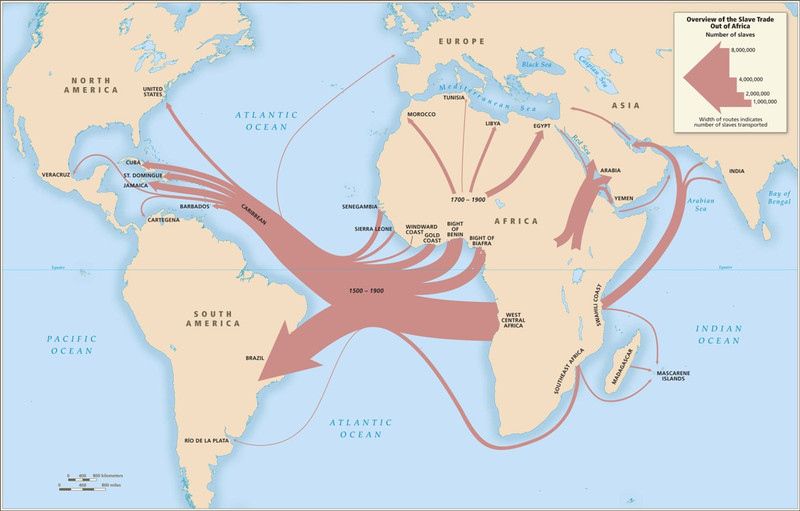
Major slave-trade routes out of Africa
- On the map, the thickest routes run from West and West Central Africa to Brazil and the Caribbean, which helps you see the scale of forced transatlantic movement.
- Government removal also fits. The Indian Removal Act of 1830 led to the Trail of Tears, when the U.S. government forced Indigenous peoples, including the Cherokee, westward. That was internal forced migration because it happened within U.S. territory.
Refugees
- Refugees are forced to leave home and cross an international border.
- They cannot safely return.
- The legal standard from the 1951 Refugee Convention centers on persecution based on race, religion, nationality, political opinion, or membership in a social group.
- Standard example: Syrians fleeing the civil war into Turkey, Lebanon, or Jordan.
Internally displaced persons
- IDPs are forced to leave home but stay within the same country.
- The key difference from refugees is simple: no international border crossed.
- Example: someone forced from Aleppo to another part of Syria.
Asylum seekers
- Asylum seekers are outside their home country and have requested protection, but the claim is still pending.
- The difference from a refugee is procedural status. Refugee status has been recognized; asylum seeker status is still being decided.
- This is not the same as being an unauthorized migrant.
Quick cues:
- Crossed border + fleeing danger = refugee or asylum seeker
- Stayed inside country = IDP
- Direct compelled transport or removal = slavery/removal
Types of Voluntary Migration
Voluntary migration types are not mutually exclusive. They describe different parts of the move.
| Type | What it means | Example |
|---|---|---|
| Transnational migration | Crosses borders and keeps strong ties to origin | Remittances, return visits, property, family links |
| Internal migration | Move within one country | Great Migration of African Americans |
| Rural-to-urban migration | Countryside to city | Movement to Shenzhen, Guangzhou, Shanghai |
| Chain migration | Earlier migrants help later ones | Mexican town-to-U.S. networks |
| Step migration | One migrant moves in stages | village → town → city |
| Guest-worker migration | Legal temporary labor migration abroad | Turkish Gastarbeiter in West Germany |
| Transhumance | Seasonal movement of pastoralists and livestock | Alpine herders moving between valleys and high pastures |
A couple of these get mixed up a lot:
- Chain migration is about networks of people. Relatives or neighbors help later migrants with housing, job info, and support.
- Step migration is about one person or household moving in stages through intermediate residences, such as village → town → regional city → major city.
For guest workers, the key word is legal temporary labor. West Germany recruited Turkish workers after the 1961 agreement, and many later built permanent communities.
For transhumance, remember it is seasonal and cyclical, usually tied to livestock. It often overlaps with circulation, but AP still includes it here.
How to Classify Migration on the Exam
Use this sequence when you read a scenario:
- Identify choice
- War, persecution, slavery, government removal, immediate disaster threat = forced
- Work, family, education, lifestyle = voluntary
- Identify border pattern
- Within one country = internal
- Across a border = transnational/international
- Forced + across border = maybe refugee/asylum seeker
- Forced + within country = IDP
- Identify the specific pattern
- Family/community network = chain
- Multiple residential stages = step
- Rural origin and urban destination = rural-to-urban
- Temporary legal labor contract = guest worker
- Seasonal livestock movement = transhumance
Key Takeaways
Migration
A permanent or semipermanent change in residence
Forced Migration
Migration in which people are compelled to leave their homes or are transported elsewhere against their will
Voluntary Migration
Migration in which people retain meaningful choice over whether and where to relocate
Refugee
A person forced across an international border who cannot safely return, typically because of a well-founded fear of persecution
Internally Displaced Person (IDP)
A person forced to leave home who remains within the borders of the same country
Asylum Seeker
A person who has requested protection in another country but whose claim has not yet been finally decided
Transnational Migration
Migration across national borders, especially when migrants maintain social, economic, political, or cultural ties across countries
Internal Migration
Movement to a new residence within the borders of one country
Rural-to-Urban Migration
Movement from the countryside or agricultural settlements to towns and cities
Chain Migration
Migration in which earlier migrants help or encourage people from the same family, community, or place of origin to move to the same destination
Step Migration
Migration toward a destination through a sequence of intermediate residential moves rather than one direct relocation
Transhumance
The regular seasonal movement of pastoralists and livestock between established grazing areas
Guest Worker
A migrant legally admitted to another country for employment, usually temporarily under a work permit or contract
Notes
Migration
A permanent or semipermanent change in residence
Forced Migration
Migration in which people are compelled to leave their homes or are transported elsewhere against their will
Voluntary Migration
Migration in which people retain meaningful choice over whether and where to relocate
Refugee
A person forced across an international border who cannot safely return, typically because of a well-founded fear of persecution
Internally Displaced Person (IDP)
A person forced to leave home who remains within the borders of the same country
Asylum Seeker
A person who has requested protection in another country but whose claim has not yet been finally decided
Transnational Migration
Migration across national borders, especially when migrants maintain social, economic, political, or cultural ties across countries
Internal Migration
Movement to a new residence within the borders of one country
Rural-to-Urban Migration
Movement from the countryside or agricultural settlements to towns and cities
Chain Migration
Migration in which earlier migrants help or encourage people from the same family, community, or place of origin to move to the same destination
Step Migration
Migration toward a destination through a sequence of intermediate residential moves rather than one direct relocation
Transhumance
The regular seasonal movement of pastoralists and livestock between established grazing areas
Guest Worker
A migrant legally admitted to another country for employment, usually temporarily under a work permit or contract
