Topic 4.1 Notes – Introduction to Political Geography
What States and Nations Are
Everything in this topic grows out of one distinction.
- A state is an independent political-territorial unit. In AP Human Geography, that usually means a sovereign country.
- A nation is a group of people with a shared identity. It is about peoplehood, not legal borders.
State
An independent state has five traits:
- Permanent population
- Defined territory
- Government
- Sovereignty
- Recognition by other states
Sovereignty means ultimate authority over internal and external affairs. A sovereign state makes its own laws at home and acts as an independent unit abroad.
Examples of independent states include Japan, Brazil, Nigeria, and the United States.
A common trap is the word state in the U.S. sense. Texas and California are not states in the APHG sense because they are not sovereign. They are subnational units inside the United States.
Also lock in this distinction:
- State = the political unit
- Government = the people and institutions currently running it
Governments can change after elections or coups. The state can still remain.
Nation
A nation forms around shared identity. That identity can come from:
- language
- ethnicity
- religion
- history
- customs
- homeland
- symbols
- shared political future
No single trait is required every time. What matters is that people see themselves as part of the same community.
Types of Political Entities
Once you know state vs nation, the combined terms become much easier. Keep the world map in mind as a reference for sovereign states, because the categories below are really about how nations line up, or do not line up, with those state boundaries.
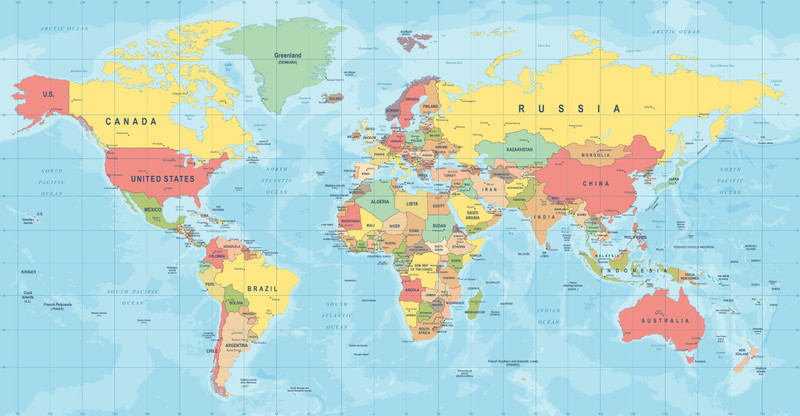
Political world map of sovereign states
Nation-state
A nation-state is when one principal nation matches closely with one sovereign state. It is an ideal type, so it does not require perfect cultural uniformity.
- Japan
- Iceland
Minorities can still exist in a nation-state. The point is close alignment, not total sameness.
Multinational state
A multinational state is one state containing two or more nations with durable identities.
Examples:
- United Kingdom
- Russia
- India
- Canada
- Belgium
- Nigeria
The UK is the classic example. It includes English, Scottish, Welsh, and the mixed national identities tied to Northern Ireland.
Multistate nation
A multistate nation is one nation spread across two or more sovereign states.
- Koreans across North Korea and South Korea
- Kurds across Turkey, Syria, Iraq, and Iran
This is the opposite pattern of a multinational state.
Stateless nation
A stateless nation is a nation without its own independent sovereign state.
- Kurds are the standard example
- Palestinians are another commonly cited case
Stateless does not mean a people lack identity, leaders, or a homeland claim. It only means they lack a sovereign state of their own.
Autonomous and semiautonomous regions
These are subnational areas with some self-government inside a larger sovereign state.
- Autonomous = more self-rule
- Semiautonomous = less self-rule
Possible powers include education, language policy, policing, land management, and local institutions.
Examples:
- Greenland within Denmark
- Kurdistan Region within Iraq
- American Indian reservations
- Navajo Nation in the U.S.
Trap: Navajo Nation has “nation” in the name, but it is not an independent nation-state.
How the Categories Fit Together
These labels are doing different jobs.
| Term | What it describes |
|---|---|
| Independent state | sovereign political unit |
| Autonomous / semiautonomous region | subnational political unit with some self-rule |
| Nation | identity group |
| Nation-state | one nation mostly matches one state |
| Multinational state | many nations in one state |
| Multistate nation | one nation across many states |
| Stateless nation | nation without a state |
One case can fit several labels at once:
- Iraq = independent state + multinational state
- Kurds = nation + multistate nation + stateless nation
- Kurdistan Region = autonomous region within Iraq
Scale matters. A world map may show only states, but cultural or subnational maps reveal nations and autonomy.
Reading the World Political Map
A political map mainly shows states, not nations.
Common features include:
- international boundaries
- capitals
- major cities
- internal boundaries
- disputed borders
- dependent or autonomous territories
Different colors usually separate states for clarity. They do not prove each state is a separate nation.
To identify nations, compare the political map with an ethnolinguistic, religious, or cultural map.
The Kurdish example gets tested a lot:
- The political map shows land divided among Turkey, Syria, Iraq, and Iran
- An ethnic map shows Kurds across all four
- That supports multistate nation
- No sovereign Kurdish state supports stateless nation
- The Kurdistan Region in Iraq shows autonomy without independence
Always use the title, legend, labels, and boundary symbols to figure out what unit the map is showing.
Key Takeaways
Independent State / Sovereign State / State / Country
A politically organized territory with a permanent population, defined territory, government, sovereignty, and recognition as independent by other states; examples include Japan and Brazil
Sovereignty
A state's ultimate governing authority over its internal and external affairs without legal subordination to another state
Nation
A people who understand themselves as a cultural and political community based on a shared identity, such as the Japanese or Kurds
Nation-State
An independent state whose territory corresponds closely to the homeland of one principal nation, such as Japan or Iceland
Multinational State
An independent state containing two or more nations with significant distinct identities, such as the United Kingdom
Multistate Nation
A nation whose members and traditional homeland extend across two or more independent states, such as Koreans or Kurds
Stateless Nation
A nation that lacks its own independent sovereign state, such as the Kurds
Autonomous Region
A subnational territory with substantial authority to govern its own affairs while remaining part of a sovereign state, such as Greenland
Semiautonomous Region
A subnational territory with limited self-government that remains under the sovereignty of a larger state, such as an American Indian reservation
Notes
Independent State / Sovereign State / State / Country
A politically organized territory with a permanent population, defined territory, government, sovereignty, and recognition as independent by other states; examples include Japan and Brazil
Sovereignty
A state's ultimate governing authority over its internal and external affairs without legal subordination to another state
Nation
A people who understand themselves as a cultural and political community based on a shared identity, such as the Japanese or Kurds
Nation-State
An independent state whose territory corresponds closely to the homeland of one principal nation, such as Japan or Iceland
Multinational State
An independent state containing two or more nations with significant distinct identities, such as the United Kingdom
Multistate Nation
A nation whose members and traditional homeland extend across two or more independent states, such as Koreans or Kurds
Stateless Nation
A nation that lacks its own independent sovereign state, such as the Kurds
Autonomous Region
A subnational territory with substantial authority to govern its own affairs while remaining part of a sovereign state, such as Greenland
Semiautonomous Region
A subnational territory with limited self-government that remains under the sovereignty of a larger state, such as an American Indian reservation
