Topic 4.9 Notes – Challenges to Sovereignty
What Challenges to Sovereignty Are
A challenge to sovereignty does not usually mean a state disappears. It means the central government no longer has total freedom to act alone.
- Sovereignty = a state's authority over territory, population, laws, and foreign policy.
- Authority can shift downward to states, provinces, or regions.
- Authority can shift upward to supranational organizations like the EU or UN.
- The two main processes here are devolution and supranationalism.
The APHG idea to keep in your head is that sovereignty is often shared, limited, or redistributed. A national government might still control defense, but a region could control schools, language policy, or transportation. Power can exist at the local, regional, national, and international scales at the same time.
Political, economic, cultural, and technological changes can all create these challenges.
Devolution and State Breakup
Devolution is the transfer of power from the central government to regional or local governments. States do this to manage diversity, reduce conflict, or give regions more self-rule.
Devolved powers often include:
- education and language policy
- policing
- taxation
- transportation
- social services
Devolution can calm separatism, but it can also strengthen it by giving a region its own institutions and identity.
Spain
Spain's 1978 constitution created 17 autonomous communities.
The most tested examples are Catalonia and the Basque Country, where strong regional-national identities never disappeared.
- Catalonia held an independence referendum in 2017.
- Spain declared it unconstitutional.
- The key distinction is autonomy is not independence.
Belgium
Belgium devolved power because of language divisions.
- Flanders = Dutch-speaking
- Wallonia = French-speaking
- Brussels = bilingual
- Small German-speaking area in the east
Belgium's federal system includes both regions and language communities, which shows that devolution can be built around culture as well as territory.
Canada
Canada shows how a strong cultural identity can be concentrated in one subnational unit.
- Quebec is the center of French language and identity.
- Sovereignty referendums happened in 1980 and 1995.
- Both failed, so Quebec stayed in Canada.
Nigeria
Nigeria has a federal system with 36 states and a Federal Capital Territory.
Creating more states helped reduce the dominance of major ethnic regional blocs. This is a good example of devolution being used to preserve unity in a very diverse state.
Secession and disintegration
Devolution can go farther than autonomy.
- Secession = a region leaves a state and becomes independent.
- Disintegration = a whole state breaks into multiple sovereign states.
South Sudan is a clear example of secession that produced a new independent state.
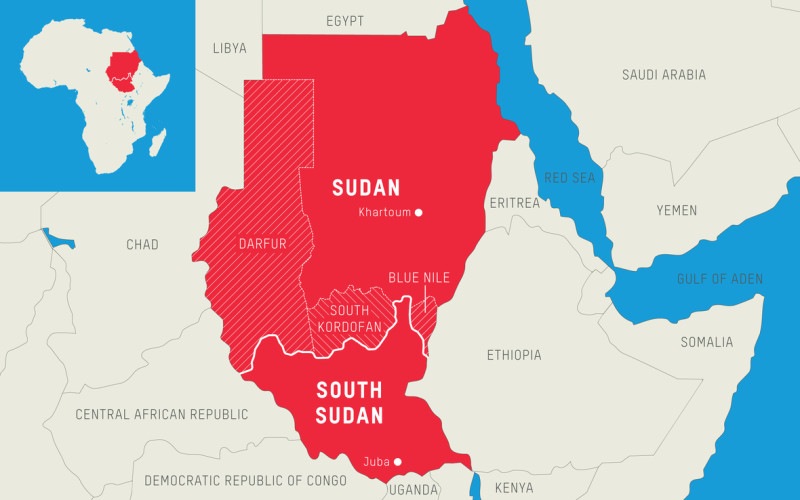
Sudan and South Sudan
- South Sudan became independent in 2011 after civil war and a referendum. This is secession/partition.
- The Soviet Union dissolved in 1991 into 15 independent states. Internal republic borders became international borders. This is state disintegration.
Communication Technology and Democratization
Technology changes sovereignty because it makes organizing across distance much easier.
- Regional and separatist movements can spread messages fast.
- People can coordinate protests, elections, and referendums.
- Diasporas can support movements from abroad.
- International audiences can see state repression quickly.
Technology also helps supranational cooperation because states and organizations can negotiate, share information, and coordinate more easily.
Democratization means movement toward broader participation, competitive elections, civil liberties, and accountability.
The classic example is the Arab Spring in 2010-2011. Social media and mobile phones helped organize protests and publicize dissent. The important caveat is that technology helped mobilization, but it did not guarantee successful democratization.
States also use technology for surveillance, censorship, and propaganda, so its effects go both ways.
Supranationalism and Why States Join
Supranationalism means states cooperate through organizations above the national scale and accept some common rules.
States join for four big reasons:
- Transnational problems
Climate change, pandemics, terrorism, refugees, pollution, and shared waterways cross borders. - Economies of scale
Larger markets and pooled resources can lower costs and increase bargaining power. - Trade agreements
States lower tariffs and accept common rules, but lose some freedom over economic policy. - Military alliances
Collective defense improves security, but creates obligations.
The tradeoff is simple. States give up some independence to gain security, efficiency, influence, or market access.
Major Supranational Organizations
| Organization | What it does | How it limits sovereignty |
|---|---|---|
| UN | Founded 1945; diplomacy, peacekeeping, humanitarian work, development, human rights norms | Can pressure states through sanctions, norms, and collective action |
| NATO | Founded 1949; military alliance based on Article 5 collective defense | Members face obligations on strategy, readiness, and defense spending |
| EU | Strongest APHG example; single market, trade, agriculture, standards, environment, movement | Directly limits member choices more than other groups |
| ASEAN | Southeast Asian cooperation | Uses consensus and noninterference, so limits are weaker |
| Arctic Council | Arctic environment, sustainability, scientific cooperation | Encourages coordination more than binding control |
| African Union | Diplomacy, peace and security, election observation | Can pressure or suspend governments |
The EU is the strongest example because it places the most direct limits on sovereignty. The map below highlights EU member states across Europe. Some members use the euro, and many participate in Schengen. Brexit matters because the UK voted to leave in 2016 and officially left in 2020, showing a state trying to reclaim sovereignty from a supranational body.
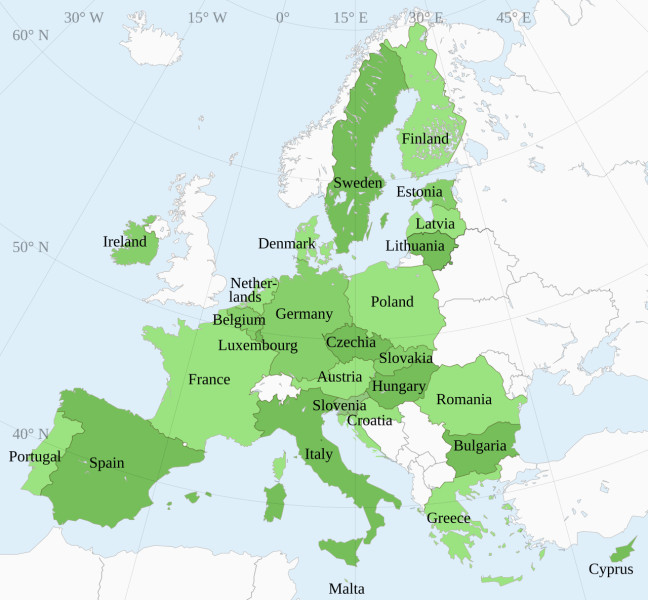
European Union member states
Key Takeaways
State Sovereignty
A state's authority to govern its territory and population, control domestic and foreign policy, and act without subordination to another political authority
Devolution
The transfer of political authority from a central government to regional or local governments
Autonomous Region
A subnational region that governs some internal affairs but remains part of its sovereign state
Secession
The withdrawal of a region from an existing state to form an independent state or join another state
Partition
The division of a state's territory into separate political units, typically producing two or more sovereign states
State Disintegration (State Breakup)
The breakup of an existing state into multiple independent sovereign states
Democratization
The transition toward broader political participation, competitive elections, civil liberties, and public accountability
Supranationalism
The organization or pooling of political and economic authority above individual states through common institutions, rules, or obligations
Transnational Problem
A problem that crosses political boundaries or cannot be managed effectively by one state acting alone
Economies of Scale
Cost savings, greater efficiency, or increased bargaining power gained by operating at a larger scale
Trade Agreement
An agreement that reduces trade barriers and establishes common rules for commerce among participating states
Military Alliance
An agreement through which states coordinate defense, pool military capabilities, and commit to mutual security
United Nations (UN)
A global organization established in 1945 for diplomacy, security, humanitarian work, and international cooperation whose norms and collective measures can constrain states
North Atlantic Treaty Organization (NATO)
A military alliance founded in 1949 that coordinates defense around the principle that an attack on one member is an attack on all
European Union (EU)
A highly integrated political and economic organization with a single market and institutions that can make binding rules in designated policy areas
Association of Southeast Asian Nations (ASEAN)
A regional organization promoting economic cooperation, political consultation, and stability in Southeast Asia through consensus and noninterference
Arctic Council
A consensus-based forum of the eight Arctic states and Indigenous permanent participants addressing environmental protection, science, and sustainable development
African Union (AU)
A continental organization promoting African political and economic cooperation, integration, diplomacy, peace, and security
Notes
State Sovereignty
A state's authority to govern its territory and population, control domestic and foreign policy, and act without subordination to another political authority
Devolution
The transfer of political authority from a central government to regional or local governments
Autonomous Region
A subnational region that governs some internal affairs but remains part of its sovereign state
Secession
The withdrawal of a region from an existing state to form an independent state or join another state
Partition
The division of a state's territory into separate political units, typically producing two or more sovereign states
State Disintegration (State Breakup)
The breakup of an existing state into multiple independent sovereign states
Democratization
The transition toward broader political participation, competitive elections, civil liberties, and public accountability
Supranationalism
The organization or pooling of political and economic authority above individual states through common institutions, rules, or obligations
Transnational Problem
A problem that crosses political boundaries or cannot be managed effectively by one state acting alone
Economies of Scale
Cost savings, greater efficiency, or increased bargaining power gained by operating at a larger scale
Trade Agreement
An agreement that reduces trade barriers and establishes common rules for commerce among participating states
Military Alliance
An agreement through which states coordinate defense, pool military capabilities, and commit to mutual security
United Nations (UN)
A global organization established in 1945 for diplomacy, security, humanitarian work, and international cooperation whose norms and collective measures can constrain states
North Atlantic Treaty Organization (NATO)
A military alliance founded in 1949 that coordinates defense around the principle that an attack on one member is an attack on all
European Union (EU)
A highly integrated political and economic organization with a single market and institutions that can make binding rules in designated policy areas
Association of Southeast Asian Nations (ASEAN)
A regional organization promoting economic cooperation, political consultation, and stability in Southeast Asia through consensus and noninterference
Arctic Council
A consensus-based forum of the eight Arctic states and Indigenous permanent participants addressing environmental protection, science, and sustainable development
African Union (AU)
A continental organization promoting African political and economic cooperation, integration, diplomacy, peace, and security
