Topic 5.3 Notes – Agricultural Origins and Diffusions
What Agricultural Origins and Diffusion Are
The First Agricultural Revolution was the long shift to farming about 10,000 to 12,000 years ago. People did not suddenly invent agriculture in one place and then everyone copied it. Different societies developed it independently in several regions.
A hearth is the source region where something begins and spreads outward. In this topic, hearths are the places where plants and animals were first domesticated.
Domestication means humans controlled reproduction over many generations and selected useful traits. That is why maize looks so different from wild teosinte. People kept replanting seeds from plants with better traits like bigger edible parts or easier harvesting.
The diffusion ideas from earlier in the course show up here:
- Relocation diffusion happens when people carry seeds, animals, and farming knowledge with them.
- Expansion diffusion happens when nearby groups adopt a crop or practice through contact or trade.
- Stimulus diffusion happens when people borrow the idea but adapt it to local conditions.
A common trap is mixing up origin with current importance.
- Maize originated in Mesoamerica.
- Potatoes originated in the Andes, even though many students associate them with Europe or Ireland.
- Coffee originated in Ethiopia/Africa, even though Brazil is a huge producer today.
Major Agricultural Hearths
Different environments produced different domesticated species.
| Hearth | Key crops | Key animals | Why it matters |
|---|---|---|---|
| Southwest Asia | wheat, barley, lentils, peas | sheep, goats, cattle, pigs | Earliest major hearth; spread a powerful crop-livestock package widely |
| Indus River Valley | cotton, sesame, mung bean; also wheat and barley by diffusion | zebu cattle | Shows hearths could mix local species with borrowed ones |
| East Asia | millet in Huang He, rice in Yangtze | - | Climate shaped crops, with dry north and wet south |
| Southeast Asia and New Guinea | taro, yams, bananas, sugarcane | chickens | Vegetative planting mattered here |
| Sub-Saharan Africa | sorghum, pearl millet, African rice, yams, oil palm, cowpeas, teff, coffee | cattle in some areas | Several African zones, not one single hearth |
| Mesoamerica | maize, beans, squash, chili peppers, avocados, cacao | turkeys | Major independent hearth |
| Andes and South America | potatoes, quinoa, cassava, peanuts | llamas, alpacas, guinea pigs | Highland and tropical domestication both mattered |
Three Sisters farming
In Mesoamerica, maize, beans, and squash worked together:
- maize gave beans a stalk to climb
- beans added nitrogen to the soil
- squash shaded the ground and limited weeds
That system shows agriculture was ecological knowledge, not just planting random crops.
How Crops and Animals Spread
Once species were domesticated, they moved through several kinds of diffusion at the same time.
- Relocation diffusion
Southwest Asian farmers moved through Anatolia into Europe carrying wheat, barley, sheep, and goats. - Expansion diffusion
Neighboring groups adopted crops and methods through trade, intermarriage, and imitation. - Stimulus diffusion
Rice farming spread, but communities changed methods to fit their own water supply, terrain, and climate.
Diffusion depended on several factors:
- climate compatibility
- soil and water
- mountains, deserts, and oceans
- trade routes and transportation
- food preferences
- conquest, empire, colonization, and migration
The Columbian Exchange
After 1492, sustained contact connected Eastern and Western Hemisphere agriculture. This map highlights the two-way flow of crops, animals, and diseases across the Atlantic.
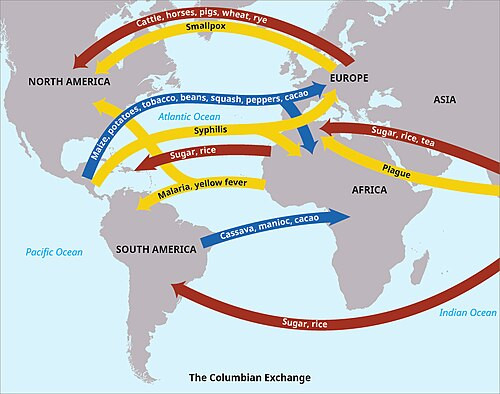
The Columbian Exchange
From the Americas outward
- maize, potatoes, cassava, tomatoes, cacao, peanuts, chili peppers, beans, squash
- Potatoes boosted European diets and population.
- Cassava became a major staple in Africa.
- Chili peppers became central in South and Southeast Asian cuisines.
To the Americas
- Crops include wheat, rice, sugarcane, coffee, bananas, citrus.
- Animals include horses, cattle, pigs, sheep, goats.
- Horses transformed Plains Indigenous life.
- Sugarcane became tied to plantations and enslaved labor.
- Coffee spread from Africa to Arabia to the Americas.
Disease also spread, and that was devastating to Indigenous Americans. On tests, make sure you show the exchange went both directions, which is exactly what the arrows on the map are showing.
How to Read Maps and Compare Agricultural Revolutions
On maps, separate the hearth from the modern production region. Brazil growing coffee does not make Brazil coffee’s origin. Ireland and potatoes is the same trap.
Arrows show movement over time, not a one-time jump. A strong map explanation connects origin + diffusion process + destination + reason it spread.
The agricultural revolutions in order are:
- First Agricultural Revolution = initial domestication and spread of farming
- Second Agricultural Revolution = industrial-era mechanization and productivity growth
- Green Revolution = twentieth-century high-yield seeds and inputs
This topic is mainly about the first one. The later two matter here only as later examples of agricultural diffusion, not for their full details.
Key Takeaways
Domestication
Multigenerational human control of reproduction and selection that changes the traits and geographic distribution of plants or animals
Independent Domestication
The separate development of domestication by communities in multiple regions rather than its spread from one universal birthplace
First Agricultural Revolution (Neolithic Agricultural Revolution)
The gradual transition beginning about 12,000–10,000 years ago from hunting and gathering toward agriculture based on domesticated plants and animals
Agricultural Hearth
A source region where plants or animals were first domesticated or agricultural practices originated and then diffused outward
Fertile Crescent
Southwest Asian agricultural hearth where wheat, barley, lentils, peas, sheep, goats, cattle, and pigs were domesticated
Indus River Valley Agricultural Hearth
South Asian hearth associated with cotton, sesame, mung beans, and zebu cattle, while wheat and barley arrived from Southwest Asia
Huang He (Yellow River) Agricultural Hearth
Northern Chinese hearth associated with the domestication of drought- and cool-tolerant millet
Chang Jiang (Yangtze River) Agricultural Hearth
Central and southern Chinese hearth associated with the early domestication of rice in warmer, wetter environments
Southeast Asia and New Guinea Agricultural Hearth
Tropical hearth associated with vegetatively reproduced crops such as taro, yams, bananas, and sugarcane; chickens originated in South and Southeast Asia
Vegetative Planting
Reproducing a plant from a root, cutting, tuber, or shoot instead of planting a seed
Sub-Saharan African Agricultural Hearths
African domestication zones associated with sorghum, pearl millet, African rice, yams, oil palm, cowpeas, teff, and coffee
Mesoamerican Agricultural Hearth
Independent hearth in central and southern Mexico and northern Central America associated with maize, beans, squash, chili peppers, avocados, cacao, and turkeys
Three Sisters
Mesoamerican intercropping of maize, beans, and squash, which respectively provide support, soil nitrogen, and ground cover
Andean Agricultural Hearth
Western South American highland hearth associated with potatoes, quinoa, beans, llamas, alpacas, and guinea pigs
Agricultural Revolution
A major transformation in agricultural methods and productivity that diffuses unevenly over time rather than occurring instantaneously everywhere
Columbian Exchange
The bidirectional transfer after 1492 of plants, animals, people, diseases, and technologies between the Americas and the Eastern Hemisphere
Notes
Domestication
Multigenerational human control of reproduction and selection that changes the traits and geographic distribution of plants or animals
Independent Domestication
The separate development of domestication by communities in multiple regions rather than its spread from one universal birthplace
First Agricultural Revolution (Neolithic Agricultural Revolution)
The gradual transition beginning about 12,000–10,000 years ago from hunting and gathering toward agriculture based on domesticated plants and animals
Agricultural Hearth
A source region where plants or animals were first domesticated or agricultural practices originated and then diffused outward
Fertile Crescent
Southwest Asian agricultural hearth where wheat, barley, lentils, peas, sheep, goats, cattle, and pigs were domesticated
Indus River Valley Agricultural Hearth
South Asian hearth associated with cotton, sesame, mung beans, and zebu cattle, while wheat and barley arrived from Southwest Asia
Huang He (Yellow River) Agricultural Hearth
Northern Chinese hearth associated with the domestication of drought- and cool-tolerant millet
Chang Jiang (Yangtze River) Agricultural Hearth
Central and southern Chinese hearth associated with the early domestication of rice in warmer, wetter environments
Southeast Asia and New Guinea Agricultural Hearth
Tropical hearth associated with vegetatively reproduced crops such as taro, yams, bananas, and sugarcane; chickens originated in South and Southeast Asia
Vegetative Planting
Reproducing a plant from a root, cutting, tuber, or shoot instead of planting a seed
Sub-Saharan African Agricultural Hearths
African domestication zones associated with sorghum, pearl millet, African rice, yams, oil palm, cowpeas, teff, and coffee
Mesoamerican Agricultural Hearth
Independent hearth in central and southern Mexico and northern Central America associated with maize, beans, squash, chili peppers, avocados, cacao, and turkeys
Three Sisters
Mesoamerican intercropping of maize, beans, and squash, which respectively provide support, soil nitrogen, and ground cover
Andean Agricultural Hearth
Western South American highland hearth associated with potatoes, quinoa, beans, llamas, alpacas, and guinea pigs
Agricultural Revolution
A major transformation in agricultural methods and productivity that diffuses unevenly over time rather than occurring instantaneously everywhere
Columbian Exchange
The bidirectional transfer after 1492 of plants, animals, people, diseases, and technologies between the Americas and the Eastern Hemisphere
