Topic 3.5 Notes – Historical Causes of Diffusion
What Historical Causes of Diffusion Are
This topic is about why diffusion happened and why its effects lasted. In 3.4, you focused on types of diffusion like relocation and hierarchical diffusion. Here, the point is the cause behind the spread.
The core chain looks like this:
- A historical force connects places.
- People and cultural traits move.
- Groups interact, sometimes voluntarily and sometimes under unequal power.
- Traits get imposed, adopted, exchanged, or blended.
- Institutions keep that pattern going.
That produces a few common outcomes:
- Persistence means a trait stays in place long after the original empire or trade system ends.
- Replacement means one trait largely pushes out another.
- Coexistence means old and new traits remain side by side.
- New forms means contact creates something different, like a creole language.
On the exam, the move is usually this: connect a historical process to a current spatial pattern such as language, religion, place names, architecture, or land use.
The Three Historical Forces
Imperialism
Imperialism is the broad extension of power over other peoples or territories. That power can be political, military, economic, or cultural.
- Common mechanisms include official languages, laws, roads, armies, missionaries, elite adoption, and displacement.
- Diffusion often spreads hierarchically through rulers, cities, and elites, then outward.
- It also spreads by relocation when soldiers, settlers, or officials move.
A classic example is the Roman Empire. At its height, Rome controlled territory all around the Mediterranean, as the map shows, and spread Latin while building networks of roads and cities that also helped Christianity travel.
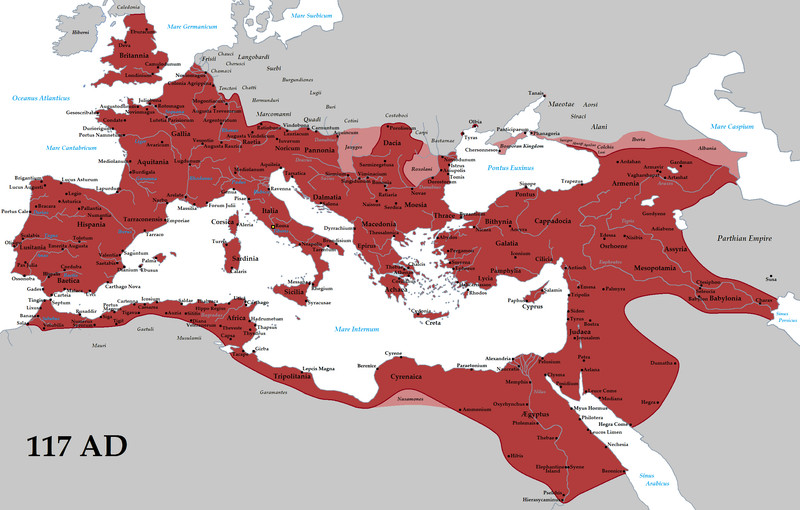
Roman Empire at its greatest extent, 117 CE
Imperialism does not always erase local culture. Many places kept local languages and customs alongside imperial ones.
Colonialism
Colonialism is direct political control of territory by an outside state. It is a specific form of imperial power.
- Mechanisms include settlement, colonial schools, government, missionaries, plantations, mining, forced labor, renaming places, and colonial cities.
- Settler colonies usually had more cultural replacement because many colonizers moved in. Examples include the United States and Australia.
- Extractive colonies often kept indigenous languages in daily life while the colonizer’s language stayed official or elite. This fits many former British and French colonies in Africa and South Asia.
Standard map pattern:
- Spanish in most of Latin America
- Portuguese in Brazil
- English and French across many former colonies
Christianity also spread through colonialism, especially in the Americas through missionaries, settlement, and coercion.
Trade
Trade moved more than goods. Merchants, sailors, caravan workers, and diasporic communities carried culture too.
- Major corridors were the Silk Roads, Indian Ocean trade, and Trans-Saharan trade.
- Traits usually spread along routes and nodes like ports, oases, and market towns.
This map helps you picture that network. It combines overland Silk Road routes across Eurasia with maritime routes across the Indian Ocean basin.
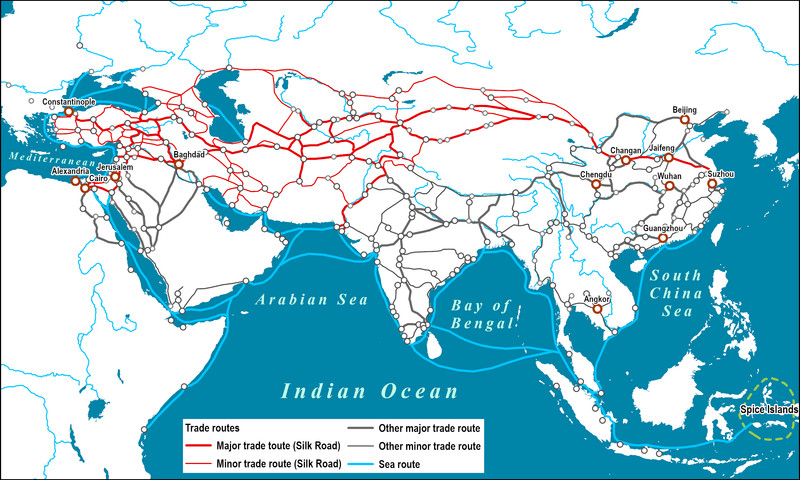
Silk Road and Indian Ocean trade routes
Examples you should know:
- Buddhism spread along the Silk Roads.
- Islam spread through Indian Ocean and Trans-Saharan trade.
- The Atlantic slave trade forced relocation and created new cultural contact zones in the Americas.
Lingua Francas and Creolization
These are two major results of historical contact, and students mix them up all the time.
Lingua franca
A lingua franca is a shared language used by people with different native languages. It exists because people need to trade, govern, study, or migrate together.
- It does not need to be anyone’s first language.
- It does not need to be a creole.
Examples:
- Swahili in East Africa
- English globally, first spread by British colonialism and later reinforced by U.S. influence
Creolization
Creolization means sustained contact creates a new cultural form. It can affect language, food, music, religion, or architecture.
Language pathway:
- Pidgin = limited contact language
- Creole = full native language used in everyday life
The key example is Haitian Creole. French colonialism, the Atlantic slave trade, and plantation contact in Saint-Domingue produced a new language.
Telling them apart
- Lingua franca = a bridge language
- Creolization = a new blended form
One language can be one, the other, or both depending on context.
Why Historical Patterns Last
Historical patterns survive because institutions keep them alive.
- Language persists through government, schools, courts, publishing, and commerce.
- Religion persists through churches, missions, family practice, and sacred sites.
- Colonial legacies are often layered. A country may have an official European language plus many indigenous languages.
Change is also uneven:
- Ports, capitals, and administrative centers usually show the strongest outside influence.
- Rural and interior regions often preserve more local culture.
- Demography matters. Many settlers usually mean more replacement. Few rulers over many locals usually mean more coexistence.
Reading the Pattern on the Exam
Look for historical clues in the cultural landscape:
- official languages and school language
- churches or mosques
- toponyms, or place names
- street grids and colonial architecture
- plantation land use
Use this explanation pattern:
- Identify the present pattern.
- Name the historical force.
- Explain how contact or movement happened.
- Explain the power relationship or institution.
- Show why it persisted.
Common pairings:
- French in West Africa = colonial administration, education, and lingua franca role
- Christianity in Latin America = colonialism, missionaries, coercion, settlement
- Swahili on the East African coast = Indian Ocean trade and lingua franca use
- Haitian Creole = plantation system, forced migration, creolization
Key Takeaways
Imperialism
A state’s extension of political, military, economic, or cultural power over other peoples or territories, often spreading culture through institutions, migration, and authority
Colonialism
Direct political control and organization of a territory by an outside state, often for settlement, extraction, strategy, or exploitation
Lingua Franca
A language used for communication among people who do not share the same native language
Creolization
The process by which sustained contact among cultural groups produces a new cultural expression combining elements from multiple sources
Pidgin
A limited contact language with no initial native speakers, typically developed for functions such as trade or labor
Creole Language
A complete native language that develops through sustained language contact, often when a contact language expands and becomes a community’s first language
Notes
Imperialism
A state’s extension of political, military, economic, or cultural power over other peoples or territories, often spreading culture through institutions, migration, and authority
Colonialism
Direct political control and organization of a territory by an outside state, often for settlement, extraction, strategy, or exploitation
Lingua Franca
A language used for communication among people who do not share the same native language
Creolization
The process by which sustained contact among cultural groups produces a new cultural expression combining elements from multiple sources
Pidgin
A limited contact language with no initial native speakers, typically developed for functions such as trade or labor
Creole Language
A complete native language that develops through sustained language contact, often when a contact language expands and becomes a community’s first language
