Topic 4.3 Notes – Political Power and Territoriality
What Political Power and Territoriality Are
Political power is geographic control. It means deciding who can use a place, move through it, work there, vote there, or benefit from its resources.
Geographers care about the spatial side of power:
- Who controls a place and who does not
- Who can use land or resources
- Who benefits from what a place produces
- How influence travels from one place to another
A place matters because other places depend on it. A strait matters because ships must pass through it. A debtor state matters to lenders because money creates leverage. Power is relational.
Territoriality is the connection between people, culture, economic life, and land. It also includes the effort to claim, organize, use, defend, or contest that land.
A quick distinction:
- Territoriality explains attachment and claims
- Political power explains whether those claims can actually be enforced
Territory is simply an area claimed or controlled by a person, group, or institution.
Sovereignty is narrower. It means a state's legal authority over territory. Territoriality is broader because nonstate groups can have strong territorial claims too.
Dimensions of Territoriality
Territoriality has a few different forms, and they often overlap in the same place.
- Cultural territoriality ties land to identity, language, religion, memory, sacred sites, and homeland.
- Political territoriality ties land to authority, jurisdiction, representation, borders, and self-government.
- Economic territoriality ties land to grazing, farming, mining, trade routes, taxation, and resource access.
- Symbolic territoriality marks possession or identity through flags, monuments, maps, place-names, architecture, and ceremonies.
Territoriality also works at different scales:
- individual property
- neighborhoods
- Indigenous lands
- ethnic homelands
- state territory
Multiple claims can exist in the same place at once.
Sámi and Sápmi
The Sámi example shows why territoriality is bigger than state borders. On this map, the broad colored bands mark the transboundary region of Sápmi across northern Norway, Sweden, Finland, and Russia.
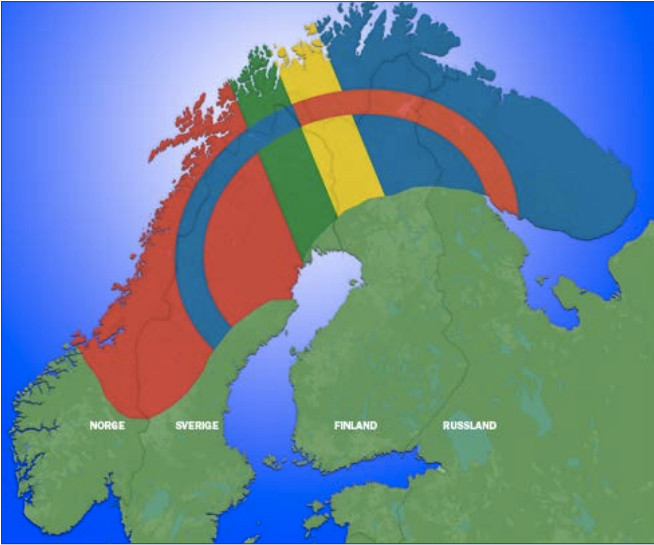
Sápmi across northern Scandinavia and Russia
- Sápmi is a cultural region spread across four states.
- It is tied to language, identity, and reindeer herding.
- The Sámi cultural territory crosses international borders, even though it is not a sovereign state.
- Conflicts can involve mining, energy projects, transportation, conservation, and private property.
This is the classic example of a cultural territory that does not match formal state jurisdiction.
Geographic Expressions of Political Power
Three main patterns show how power operates across space.
Neocolonialism
Neocolonialism is indirect control over another state without ruling it as a colony. The target state stays formally independent, but outside actors gain leverage.
Common mechanisms:
- Loans and debt
- IMF or World Bank conditions
- Privatization and trade liberalization
- Foreign ownership of strategic assets
- Dependence on one export or one market
- Media and cultural influence
The key idea is dependency, not just foreign investment.
- Ghana is the standard example. Structural adjustment programs tied to IMF and World Bank lending pushed policy changes like spending cuts and privatization.
- That meant outside institutions influenced decisions inside Ghana without annexing it.
Shatterbelts
A shatterbelt is a region with internal divisions that is also caught between competing outside powers.
Two things must both be present:
- internal conflict or division
- external rivalry
Internal divisions can come from ethnicity, religion, ideology, nationalism, uneven development, or disputed territory. Outside powers may arm, fund, or intervene for local groups.
- Classic examples include the Balkans and eastern Europe
- During the Cold War, Germany was divided
- The Soviet Union intervened in Hungary in 1956 and Czechoslovakia in 1968
- A current example is Syria, with involvement from Russia, the United States, Iran, Turkey, and Gulf states
Choke points
A choke point is a narrow transportation corridor where major movement is concentrated.
Major examples:
- Strait of Hormuz
- Strait of Malacca
- Suez Canal
- Panama Canal
- Bosporus and Dardanelles
- Bab el-Mandeb
Why these chokepoints matter:
- Strait of Hormuz matters because huge oil and LNG flows pass through it.
- Suez Canal became a global political issue when Nasser nationalized it in 1956.
- The Ever Given blockage in 2021 showed how one accident in a narrow route can disrupt global trade.
Why These Matter and How They Show Up on the Exam
All three concepts show control over people, land, and resources through spatial relationships.
- Neocolonialism means influence crosses borders without annexation.
- Shatterbelts mean local territorial struggles get intensified by outside rivalry.
- Choke points mean a tiny location can affect trade, energy prices, and military strategy.
Location often matters more than size. A canal, strait, port, or border zone can be more powerful than a huge territory.
Exam clue words
| If the question shows... | Think... |
|---|---|
| debt, loans, financial pressure, outside policy influence | Neocolonialism |
| internal conflict plus rival outside powers | Shatterbelt |
| narrow route controlling major flows | Choke point |
Key Takeaways
Political Power
The ability to influence or control the decisions, actions, and resources of other people or groups, expressed geographically through control over people, land, and resources
Territory
An area claimed or controlled by an individual, group, or political institution
Territoriality
The connection of people, their cultures, and their economic systems to land, including efforts to claim, use, organize, or control space
Neocolonialism
Indirect control or influence over a legally independent state or region through economic, political, financial, or cultural pressure rather than formal colonial rule
Shatterbelt
A region where internal divisions interact with competition among stronger outside powers, increasing instability, intervention, or conflict
Choke Point
A narrow, strategically important transportation corridor where concentrated movement allows control or disruption to create political and economic leverage
Notes
Political Power
The ability to influence or control the decisions, actions, and resources of other people or groups, expressed geographically through control over people, land, and resources
Territory
An area claimed or controlled by an individual, group, or political institution
Territoriality
The connection of people, their cultures, and their economic systems to land, including efforts to claim, use, organize, or control space
Neocolonialism
Indirect control or influence over a legally independent state or region through economic, political, financial, or cultural pressure rather than formal colonial rule
Shatterbelt
A region where internal divisions interact with competition among stronger outside powers, increasing instability, intervention, or conflict
Choke Point
A narrow, strategically important transportation corridor where concentrated movement allows control or disruption to create political and economic leverage
