Topic 3.6 Notes – Contemporary Causes of Diffusion
What Contemporary Causes of Diffusion Are
Culture is socially constructed. That means people and institutions create its meanings over time. Language, music, food, dress, identity, and customs are learned, shared, changed, and argued over by families, schools, governments, media, and communities.
You already know from Topic 3.4 that diffusion still happens through relocation, contagious, hierarchical, and stimulus diffusion. This topic is about why those same processes move faster, farther, and through denser networks today.
The main drivers are globalization and urbanization. They work through channels like:
- media and communication technology such as social media and streaming
- transportation such as air travel
- politics such as language laws or censorship
- economics such as TNCs and advertising
- migration, travel, and social ties such as diaspora networks and study abroad
A common AP move is to name the modern process causing spread, then say whether the result is convergence, divergence, or both. Historical patterns still matter too. English spreads today through the internet, but its global reach was built earlier through British imperialism and later reinforced by U.S. power.
The Main Contemporary Causes
Globalization
Globalization is increasing interconnection among places through economic, political, technological, and cultural networks.
- It spreads information, products, people, and practices across borders.
- Standard examples include TNCs, global trade, tourism, NGOs, and international education.
- English as a global lingua franca is the classic example. British colonialism spread it widely first, then U.S. business, science, film, and media kept strengthening it.
Urbanization
Urbanization matters because cities pack people together and connect many groups at once.
- Cities are mixing zones where migrants bring languages, foods, religions, and customs.
- A cultural trait may begin in a migrant neighborhood, spread across the city, then jump to other cities.
- Big cities often spread culture hierarchically to smaller cities and rural areas.
Communication and transportation technologies
The same pattern also depends on transportation and communication networks that link major cities and regions across long distances.
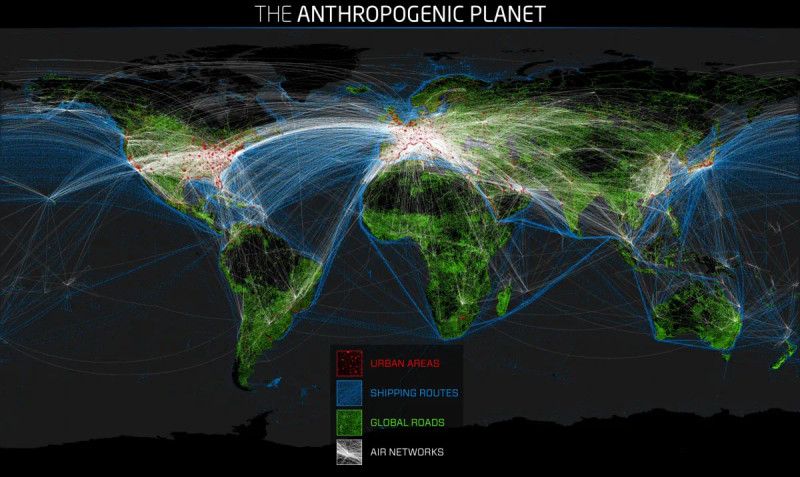
Global transportation and urban networks
The internet, smartphones, fiber-optic cables, satellites, streaming, and air travel reduce the friction of distance.
- Contact becomes faster and cheaper
- Diffusion can happen without physical proximity
- A trend can spread globally even if the people involved never meet face-to-face
Political causes
Governments shape diffusion by promoting, directing, or restricting it.
- Official-language laws
- Bilingual education
- Internet restrictions or censorship
- State funding for cultural industries
Economic and social causes
Economic networks spread culture along with goods and jobs.
- TNCs, advertising, tourism, global labor networks, remittances, diaspora ties, study abroad, intermarriage
- McDonald’s is a classic case. The brand spreads globally, but local menus adapt to local tastes, which shows stimulus diffusion.
Time-space Convergence and Networked Diffusion
Time-space convergence means the time and cost needed to connect places goes down. Geography does not disappear, but distance becomes less of an obstacle.
- Transportation and communication improve
- Friction of distance declines
- Long-distance interaction increases
- Cultural traits spread faster and wider
- Outcomes become convergence, divergence, or both
Diffusion today is often network-based. Traits may jump from one connected city to another before reaching nearby rural areas.
Digital media often combine diffusion types in one case:
- hierarchical when a celebrity, company, or platform introduces content
- contagious when users rapidly share it
- stimulus when local users adapt it
K-pop and Korean dramas show this perfectly. Entertainment firms, South Korean government support, streaming platforms, and fan translation communities all help them spread.
Cultural Convergence and Cultural Divergence
Convergence means cultures become more similar.
- shared use of English
- similar social media platforms
- worldwide entertainment, sports, fashion, and business habits
Divergence means cultures become more distinct.
- indigenous language revitalization
- protection of national identity
- local versions of global products
- distinct online communities
Both can happen at once. A global platform creates convergence because everyone uses the same app, but users still form language-based or region-based communities.
Language Change and Scale
Language is the clearest example here. English spreads through colonial history, global business, science, aviation, higher education, entertainment, and internet content.
Its effects include:
- convergence through shared communication
- language shift away from indigenous or minority languages
- divergence through local English varieties and revitalization efforts
Māori in New Zealand is a key example. Education and broadcasting have helped revitalize the language. A bilingual classroom sign like this shows that revival in everyday school life.

Bilingual Māori-English classroom sign
Scale matters:
- global: English and internet connectivity
- national: language policy and media systems
- local: urban-rural gaps, unequal access, neighborhood change
Key Takeaways
Social Construction of Culture
The creation, sharing, maintenance, and revision of cultural meanings through human interaction rather than biology or permanent attachment to place
Globalization
The increasing interconnection and interdependence of places through economic, political, technological, and sociocultural networks
Urbanization
An increase in the proportion of people living in urban areas, creating dense and diverse settings that intensify cultural interaction
Time-Space Convergence / Time-Space Compression
The reduction in the time and cost needed to connect places because of improved transportation and communication
Friction of Distance
The constraining effect of distance on interaction, which declines as transportation and communication become faster, cheaper, or more accessible
Diaspora Network
Connections linking a geographically dispersed population with one another and with an ancestral homeland
Lingua Franca
A common language used for communication among people whose first languages differ
Language Shift
The gradual replacement of a heritage language as speakers increasingly use a dominant language and transmit the heritage language less often to children
Language Revitalization
Efforts to restore or strengthen the use and transmission of a threatened language through institutions, education, media, and community action
Cultural Convergence
The process by which cultures or places become more similar as they share cultural traits
Cultural Divergence
The process by which cultures or places become more distinct through resistance, revitalization, or local adaptation of shared traits
Notes
Social Construction of Culture
The creation, sharing, maintenance, and revision of cultural meanings through human interaction rather than biology or permanent attachment to place
Globalization
The increasing interconnection and interdependence of places through economic, political, technological, and sociocultural networks
Urbanization
An increase in the proportion of people living in urban areas, creating dense and diverse settings that intensify cultural interaction
Time-Space Convergence / Time-Space Compression
The reduction in the time and cost needed to connect places because of improved transportation and communication
Friction of Distance
The constraining effect of distance on interaction, which declines as transportation and communication become faster, cheaper, or more accessible
Diaspora Network
Connections linking a geographically dispersed population with one another and with an ancestral homeland
Lingua Franca
A common language used for communication among people whose first languages differ
Language Shift
The gradual replacement of a heritage language as speakers increasingly use a dominant language and transmit the heritage language less often to children
Language Revitalization
Efforts to restore or strengthen the use and transmission of a threatened language through institutions, education, media, and community action
Cultural Convergence
The process by which cultures or places become more similar as they share cultural traits
Cultural Divergence
The process by which cultures or places become more distinct through resistance, revitalization, or local adaptation of shared traits
