Topic 3.7 Notes – Diffusion of Religion and Language
What Religious and Language Diffusion Is
Religion, language, dialects, ethnic cultures, and even gender roles begin in cultural hearths and spread outward. Expectations about men's and women's work, dress, and public roles often travel with a religion or a migrating ethnic group and are reshaped where they land. The same diffusion types you learned earlier still apply here:
- Relocation diffusion means people move and carry the trait with them.
- Expansion diffusion means the trait spreads outward but stays strong in the source area.
- Contagious diffusion spreads through close contact between neighbors.
- Hierarchical diffusion spreads through rulers, cities, schools, ports, or elites.
- Stimulus diffusion spreads the idea, but it changes form.
The AP move is always the same. Identify the hearth, the carrier (migrants, missionaries, traders, rulers), the diffusion type, and the pattern on the map.
Religion and language often travel together through migration, trade, conquest, colonization, missionary work, schools, and government. A place can keep evidence of that long after the original spread happened.
- Present concentration does not always show the hearth.
- Buddhism began in South Asia but is now concentrated in East and Southeast Asia.
- Christianity began in Southwest Asia, not Europe or the Americas.
This world map is useful as a reminder of that idea. It shows where major religions are concentrated today, which is exactly why you should be careful not to confuse a current cluster with the original hearth.
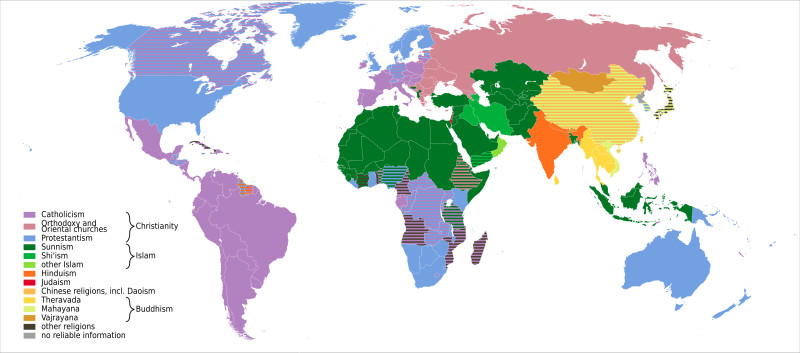
Present-day distribution of major religions
Map clues matter:
- Continuous zones usually suggest expansion diffusion.
- Scattered diaspora clusters suggest relocation diffusion.
- Spread through rulers, cities, schools, or ports suggests hierarchical diffusion.
Toponyms also preserve diffusion. San Francisco, Santa Fe, and Los Angeles show Spanish language and Roman Catholic influence.
Cultural landscape clues include churches, mosques, synagogues, temples, stupas, pagodas, and gurdwaras.
Universalizing and Ethnic Religions
Religions spread differently because they are organized differently. Universalizing religions seek converts, so they usually spread widely. Ethnic religions are tied to a people or homeland, so they usually stay concentrated near the hearth.
Universalizing religions
Christianity, Islam, Buddhism, and Sikhism fit here.
A common pattern looks like this:
- Migrants, missionaries, or traders carry the religion somewhere new.
- Rulers or institutions support it.
- Local people convert, and expansion follows.
Things that help spread include openness to converts, missionary work, trade routes, migration networks, portable texts and practices, and state support.
Ethnic religions
Hinduism and Judaism are the main examples.
They usually stay close to the hearth because they are tied to ancestry, sacred landscapes, homeland, or inherited identity. When followers migrate, the religion moves too, but often as diaspora nodes instead of broad conversion zones.
Important comparison
- Universalizing does not mean largest everywhere.
- Ethnic does not mean it never moves.
- Monotheistic vs. polytheistic is not the dividing line.
Standard Religious Examples You Need to Know
- Christianity
Hearth in the eastern Mediterranean/Southwest Asia. It spread through Roman roads, cities, ports, missionaries, and common languages. Constantine legalized it in 313 CE, and imperial support sped hierarchical diffusion. Later it spread to Europe, then the Americas, Sub-Saharan Africa, and the Pacific through colonization and migration. Branches are Roman Catholic, Protestant, Eastern Orthodox. - Islam
Hearth in Mecca and Medina on the Arabian Peninsula. It spread by conquest, trade, merchants, and migration. Indonesia is the classic example of traders carrying Islam first, then elites and communities spreading it further. Branches are Sunni and Shia. - Buddhism
Hearth in northern South Asia, tied to Siddhartha Gautama. Ashoka is the key hierarchical diffusion example. It spread on Silk Roads and maritime routes to China, Korea, Japan, Sri Lanka, and Southeast Asia. Branches are Theravada, Mahayana, Vajrayana. - Sikhism
Hearth in Punjab, founded by Guru Nanak. Still concentrated there, but migration created clusters in the UK, Canada, the US, and East Africa. - Hinduism
Hearth in South Asia, strongest in India and Nepal. Strong tie to sacred landscapes like the Ganges. Diaspora spread through labor migration to Trinidad and Tobago, Guyana, Fiji, Mauritius, and South Africa. - Judaism
Hearth in Southwest Asia/eastern Mediterranean. Diaspora was shaped by migration, expulsion, and persecution. A key event was the Roman destruction of the Second Temple in 70 CE. Major concentrations today are Israel and the United States.
How Language Diffusion Works
Languages spread through migration, conquest, trade, colonization, schools, and government, just like religions do.
- Language family means related languages from a common ancestor.
- Branch means a smaller division within a family.
- Dialect means regional or social variation within one language.
Indo-European
This is the major family to know.
| Branch | Example languages |
|---|---|
| Germanic | English, German |
| Romance | Spanish, French, Portuguese, Italian, Romanian |
| Balto-Slavic | Russian, Polish |
| Indo-Iranian | Hindi, Urdu, Persian |
| Celtic | Irish, Welsh |
Romance languages show Latin spreading through Roman conquest, then breaking apart into different languages.
English spread by relocation diffusion through British settlement and colonialism, then by hierarchical diffusion through administration and schools. In South Asia, English stayed important in government, higher education, and business.
Other families to recognize:
- Sino-Tibetan
- Niger-Congo
- Afro-Asiatic
- Austronesian
Austronesian from Madagascar across the Pacific is great evidence of relocation diffusion by seafaring peoples.
Language maps and charts:
- Language trees show relationship, not physical distance.
- Isogloss means the boundary of a linguistic feature.
- Official languages, lingua francas, bilingualism, and multilingualism show institutional diffusion and language contact.
This Indo-European tree is a good reminder that these charts track historical relationships among branches over time, not where languages are located today.
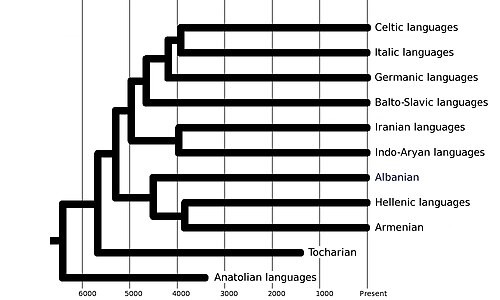
Indo-European language family tree
Key Takeaways
Cultural Hearth
The area where a cultural trait, innovation, or cultural system originates
Universalizing Religion
A religion open to people regardless of ethnicity that generally seeks converts and spreads through relocation and expansion diffusion
Ethnic Religion
A religion closely tied to a particular people, ancestry, homeland, or cultural tradition and spread mainly through relocation diffusion
Christianity
A universalizing religion originating in Southwest Asia that spread through missionaries, political support, migration, imperialism, and colonization
Islam
A universalizing religion originating in Mecca and Medina that spread through migration, trade, political expansion, and conversion
Buddhism
A universalizing religion originating in northern South Asia that spread through rulers, monks, merchants, travelers, and trade routes
Sikhism
A universalizing, monotheistic religion originating in Punjab whose overseas communities were created mainly through migration
Hinduism
An ethnic religion originating in South Asia that remains concentrated near its hearth but also occurs in migrant diaspora communities
Judaism
An ethnic, monotheistic religion originating in Southwest Asia whose distribution was shaped largely by migration, expulsion, persecution, and diaspora
Diaspora
The dispersal of a people from an ancestral homeland and the communities formed by that dispersal
Language Family
A collection of languages descended from a shared ancestral language
Protolanguage
A reconstructed ancestral language from which the languages of a family descended
Language Branch / Subfamily
A division within a language family containing languages with a more recent common origin and clearer similarities
Dialect
A systematic regional or social variation of a language in vocabulary, pronunciation, and grammar
Isogloss
A boundary marking the spatial extent of a particular pronunciation, vocabulary term, or other linguistic feature
Language Divergence
The development of distinct dialects or languages after speakers become spatially or socially separated
Language Convergence
The acquisition of shared linguistic features, or adoption of a common language, through sustained contact
Indo-European Language Family
The most widely spoken language family, including most European languages and many languages of South and Southwest Asia
Anatolian Hypothesis / Sedentary-Farmer Hypothesis
The hypothesis that Indo-European languages spread from Anatolia with the expansion of agriculture
Kurgan Hypothesis / Steppe Hypothesis
The hypothesis that Indo-European languages spread from north of the Black and Caspian seas through pastoral migration and military expansion
Sino-Tibetan Language Family
A major language family concentrated mainly in China, Southeast Asia, and the Himalayan region
Niger-Congo Language Family
A major language family distributed across much of Sub-Saharan Africa
Afro-Asiatic Language Family
A major language family found across North Africa and parts of Southwest Asia and the Horn of Africa
Austronesian Language Family
A language family extending from Madagascar through island Southeast Asia into the Pacific because of maritime migration
Official Language
A language designated for government functions such as administration, courts, schools, and public documents
Lingua Franca
A shared language used for communication among people with different native languages
Toponym
A place name that can preserve evidence of past linguistic, religious, or political influence
Language Tree
A chart showing genealogical relationships from a protolanguage through families, branches, and more recent linguistic divisions
Bilingualism
The use of two languages by a person or population
Multilingualism
The use of multiple languages by a person or population
Notes
Cultural Hearth
The area where a cultural trait, innovation, or cultural system originates
Universalizing Religion
A religion open to people regardless of ethnicity that generally seeks converts and spreads through relocation and expansion diffusion
Ethnic Religion
A religion closely tied to a particular people, ancestry, homeland, or cultural tradition and spread mainly through relocation diffusion
Christianity
A universalizing religion originating in Southwest Asia that spread through missionaries, political support, migration, imperialism, and colonization
Islam
A universalizing religion originating in Mecca and Medina that spread through migration, trade, political expansion, and conversion
Buddhism
A universalizing religion originating in northern South Asia that spread through rulers, monks, merchants, travelers, and trade routes
Sikhism
A universalizing, monotheistic religion originating in Punjab whose overseas communities were created mainly through migration
Hinduism
An ethnic religion originating in South Asia that remains concentrated near its hearth but also occurs in migrant diaspora communities
Judaism
An ethnic, monotheistic religion originating in Southwest Asia whose distribution was shaped largely by migration, expulsion, persecution, and diaspora
Diaspora
The dispersal of a people from an ancestral homeland and the communities formed by that dispersal
Language Family
A collection of languages descended from a shared ancestral language
Protolanguage
A reconstructed ancestral language from which the languages of a family descended
Language Branch / Subfamily
A division within a language family containing languages with a more recent common origin and clearer similarities
Dialect
A systematic regional or social variation of a language in vocabulary, pronunciation, and grammar
Isogloss
A boundary marking the spatial extent of a particular pronunciation, vocabulary term, or other linguistic feature
Language Divergence
The development of distinct dialects or languages after speakers become spatially or socially separated
Language Convergence
The acquisition of shared linguistic features, or adoption of a common language, through sustained contact
Indo-European Language Family
The most widely spoken language family, including most European languages and many languages of South and Southwest Asia
Anatolian Hypothesis / Sedentary-Farmer Hypothesis
The hypothesis that Indo-European languages spread from Anatolia with the expansion of agriculture
Kurgan Hypothesis / Steppe Hypothesis
The hypothesis that Indo-European languages spread from north of the Black and Caspian seas through pastoral migration and military expansion
Sino-Tibetan Language Family
A major language family concentrated mainly in China, Southeast Asia, and the Himalayan region
Niger-Congo Language Family
A major language family distributed across much of Sub-Saharan Africa
Afro-Asiatic Language Family
A major language family found across North Africa and parts of Southwest Asia and the Horn of Africa
Austronesian Language Family
A language family extending from Madagascar through island Southeast Asia into the Pacific because of maritime migration
Official Language
A language designated for government functions such as administration, courts, schools, and public documents
Lingua Franca
A shared language used for communication among people with different native languages
Toponym
A place name that can preserve evidence of past linguistic, religious, or political influence
Language Tree
A chart showing genealogical relationships from a protolanguage through families, branches, and more recent linguistic divisions
Bilingualism
The use of two languages by a person or population
Multilingualism
The use of multiple languages by a person or population
