Topic 2.8 Notes – Women and Demographic Change
What Women and Demographic Change Means
This topic connects gender roles to population patterns. You’re explaining how women’s changing roles affect fertility most directly, but also mortality and migration.
- TFR means total fertility rate, or the average number of children a woman is expected to have.
- Replacement-level fertility is about 2.1 children per woman in low-mortality societies.
- Infant mortality = deaths under age 1.
- Child mortality = deaths among young children, often under age 5.
- Maternal mortality = deaths related to pregnancy and childbirth.
- Life expectancy = average years a person is expected to live.
Empowerment means women can make real decisions about schooling, marriage, work, migration, health care, and reproduction. That matters because demographic change happens through those choices.
The APHG claim here is specific. More education, paid work, health care, contraception, and decision-making power usually lower fertility. Don’t stop at “developed places have lower birth rates.” Say how those things delay marriage, shorten reproductive years, improve child survival, and raise the cost of having many children.
This also helps explain the DTM. Death rates usually fall first. Birth rates fall later, and women’s changing roles are a big reason why.
Why Fertility Falls as Women’s Roles Change
These drivers usually work together, not one at a time.
Education
Female secondary education matters a lot.
- Staying in school often delays marriage and first birth.
- A later first birth shortens the number of reproductive years, so completed family size usually drops.
- Education improves knowledge of contraception, prenatal care, and child health.
- It also opens other paths besides early marriage and constant childbearing.
Employment and opportunity cost
Paid work often connects to smaller families because of opportunity cost.
- Time spent raising children can mean lost wages, experience, and career advancement.
- That often leads to later childbirth, wider birth spacing, and fewer children.
- This pattern is strongest in urban, waged, formal, or career-oriented jobs.
Be careful here. If women are doing unpaid subsistence farming or household labor, fertility does not automatically fall.
Health care and child survival
Better health care changes both death rates and birth decisions.
- Prenatal care, trained birth attendants, vaccines, sanitation, and treatment for childhood disease lower maternal, infant, and child mortality.
- When parents are more confident children will survive, they usually choose fewer births.
- Safer spacing and delayed first pregnancy also reduce health risks.
Contraception and reproductive autonomy
Contraception lets women time, space, and limit births.
- It reduces unintended pregnancy.
- Real access means it is legal, affordable, nearby, socially accepted, and usable.
- The effect is biggest when contraception is paired with education, health services, and legal rights.
Changing social values
Family size also changes when norms change.
- Later marriage
- Greater acceptance of women working or studying
- Smaller-family norms
These ideas spread through media, cities, and role models. Values vary within countries, so don’t use a simple “traditional vs modern” label.
How Women’s Changing Roles Affect Mortality and Migration
Once fertility starts changing, other population patterns shift too.
Mortality
Educated women often know more about nutrition, sanitation, vaccination, and pregnancy risks. More control over income can mean more spending on food, medicine, transport, and care. Reproductive autonomy lowers high-risk pregnancies through delay, spacing, and fewer total pregnancies. These effects help children and households too, though mortality still depends on conflict, disease, sanitation, and health systems.
Migration
Women increasingly migrate independently, not just as dependents.
- Common pulls include university, factory work, domestic service, nursing, and professional jobs.
- Migration can expose women to smaller-family norms, higher urban living costs, and better reproductive health services.
- It also changes the age-sex composition of both origin and destination places.
Ravenstein’s laws and the feminization of migration
Ernst Georg Ravenstein published migration laws in 1885 and 1889.
Know these patterns:
- Most migrants move short distances.
- Long-distance migrants head to major centers.
- Migration often happens in stages.
- Economic motives are major.
Historically, women were more common in short-distance internal migration, while men were more prominent in long-distance and international migration. As women gained education, income, and legal rights, that pattern changed. Feminization of migration means women make up a large and increasingly independent share of migration streams.
The map below gives one example of a major pull factor behind that shift, especially in Southeast Asia. Focus on the spread of urban areas from 2000 to 2019, since growing cities create more jobs, schools, and services that attract migrants.
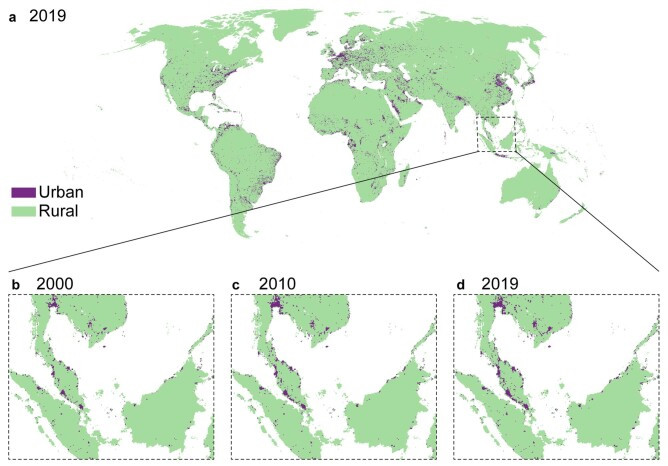
Urban growth and migration pull factors
Spatial Patterns and the Bangladesh Example
Maps show broad patterns, but the exam wants pattern + mechanism.
- Lowest TFRs are common in Europe and East Asia.
- TFR is also relatively low in much of North America and Latin America.
- Highest TFRs are concentrated in parts of Sub-Saharan Africa.
- Places with more female education and better reproductive health access usually have lower TFR.
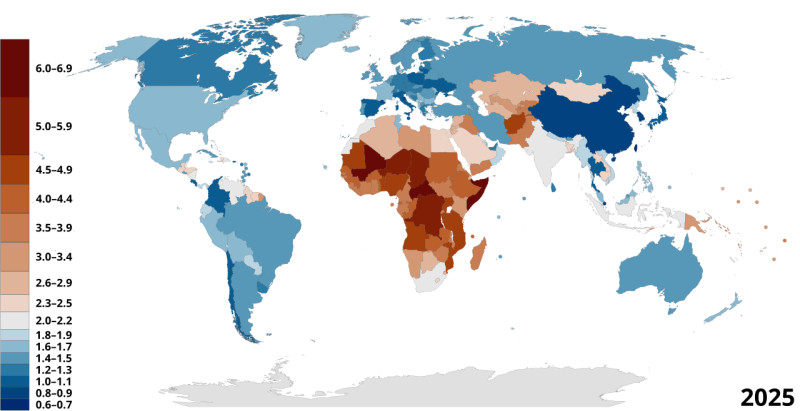
World total fertility rate map, 2025
This map shows the broad regional pattern you should recognize, especially very low fertility across much of Europe and East Asia and much higher fertility across much of Sub-Saharan Africa. National averages still hide urban-rural and regional differences, so scale matters.
Bangladesh as the key case
Bangladesh is the classic example because fertility fell from very high levels to near replacement without “wealth alone” explaining it.
- Family-planning programs and community health workers expanded contraceptive access.
- Better child survival reduced the need for many births.
- More girls’ schooling delayed marriage.
- Garment industry jobs increased women’s paid employment.
- Rural-to-urban migration reinforced smaller-family norms.
The takeaway is that several female-role changes worked together.
Key Takeaways
Total Fertility Rate (TFR)
The average number of children a woman would have during her reproductive years if current age-specific fertility rates continued
Replacement-Level Fertility
The fertility rate needed to replace a population without migration, about 2.1 children per woman where mortality is low
Infant Mortality
Deaths of children under one year of age
Child Mortality
Deaths among young children, commonly measured as deaths before age five
Maternal Mortality
Deaths associated with pregnancy and childbirth
Life Expectancy
The average number of years a person is expected to live under current mortality conditions
Female Educational Attainment
The level of schooling completed by girls and women; greater attainment commonly delays marriage and first birth
Female Labor-Force Participation
The share of working-age women who are employed or actively seeking employment, often undercounting unpaid care work
Contraception and Family Planning
Methods, information, and services that allow people to influence the timing, spacing, and number of births
Women’s Empowerment
Expansion of women’s capacity to make consequential decisions about education, work, marriage, migration, health, and reproduction
Opportunity Cost of Childbearing
Income, career advancement, or experience forgone when time is devoted to pregnancy and child care instead of other activities
Reproductive Autonomy
The practical ability to decide whether, when, and how many children to have
Political Participation
Voting, holding office, civil-society organizing, and advocacy that can shape laws, rights, services, and public investment
Ravenstein’s Laws of Migration
Empirical patterns that most migration is short-distance, long-distance migrants move toward major commercial and industrial centers, migration may occur in stages, rural residents are more migratory than urban residents, and economic motives predominate; historically, women migrated more within countries and over shorter distances, while men dominated long-distance and international migration
Feminization of Migration
The trend in which women constitute a large and increasingly independent share of migration streams
Notes
Total Fertility Rate (TFR)
The average number of children a woman would have during her reproductive years if current age-specific fertility rates continued
Replacement-Level Fertility
The fertility rate needed to replace a population without migration, about 2.1 children per woman where mortality is low
Infant Mortality
Deaths of children under one year of age
Child Mortality
Deaths among young children, commonly measured as deaths before age five
Maternal Mortality
Deaths associated with pregnancy and childbirth
Life Expectancy
The average number of years a person is expected to live under current mortality conditions
Female Educational Attainment
The level of schooling completed by girls and women; greater attainment commonly delays marriage and first birth
Female Labor-Force Participation
The share of working-age women who are employed or actively seeking employment, often undercounting unpaid care work
Contraception and Family Planning
Methods, information, and services that allow people to influence the timing, spacing, and number of births
Women’s Empowerment
Expansion of women’s capacity to make consequential decisions about education, work, marriage, migration, health, and reproduction
Opportunity Cost of Childbearing
Income, career advancement, or experience forgone when time is devoted to pregnancy and child care instead of other activities
Reproductive Autonomy
The practical ability to decide whether, when, and how many children to have
Political Participation
Voting, holding office, civil-society organizing, and advocacy that can shape laws, rights, services, and public investment
Ravenstein’s Laws of Migration
Empirical patterns that most migration is short-distance, long-distance migrants move toward major commercial and industrial centers, migration may occur in stages, rural residents are more migratory than urban residents, and economic motives predominate; historically, women migrated more within countries and over shorter distances, while men dominated long-distance and international migration
Feminization of Migration
The trend in which women constitute a large and increasingly independent share of migration streams
