Topic 4.8 Notes – Defining Devolutionary Factors
What Devolution Is
Devolution means the transfer of power from a central government to regional or local governments. The main idea is simple. Authority becomes less centralized.
That can look very different depending on the case:
- Limited decentralization means the center gives regions some control over things like education or policing.
- Regional autonomy means a region governs many of its own affairs but stays inside the state.
- Federal restructuring means the whole state is reorganized so regions have more constitutional power.
- Secession means a region breaks away and becomes independent.
- State breakup is the most extreme result, when the state itself fragments.
This can happen in unitary states or federal states. A federal state already shares power, but regions can still demand more.
Devolution is not a coup. A coup changes who controls the state. Devolution changes the spatial level where power is exercised.
This is a centrifugal force because it pulls authority away from the center and can challenge sovereignty, the state’s power over its territory.
The Six Devolutionary Factors
These factors often overlap. The AP move is to name the factor, then explain how it weakens central control.
Division by physical geography
Mountains, deserts, islands, long distances, and noncontiguous territory can separate a region from the core. That makes communication, transport, administration, and military control harder and more expensive. Isolation can also preserve a distinct language, religion, or identity.
- East and West Pakistan were separated by India.
- East Pakistan was also Bengali-speaking, underrepresented, and repressed.
- In 1971, East Pakistan became Bangladesh.
This map helps you see the key spatial pattern. Pakistan existed in two separate wings, with Indian territory in between.
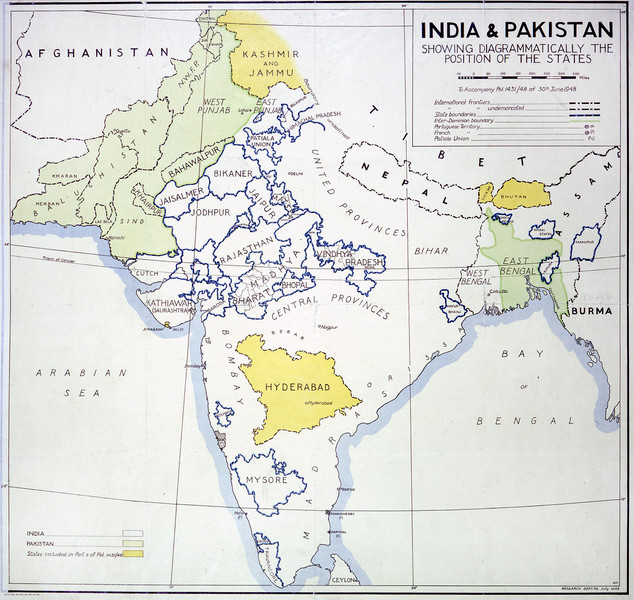
India and Pakistan after partition
Ethnic separatism
Ethnic separatism happens when a territorially concentrated ethnic group wants autonomy or independence. It is strongest when the group has a homeland, distinct identity, institutions, resources, or a history of self-rule.
- Catalonia in Spain has the Catalan language, strong regional identity, and a powerful Barcelona-centered economy.
- The 2017 independence referendum showed how regional identity can directly challenge the Spanish state.
Ethnic cleansing
Ethnic cleansing is the forced removal of a group from a territory to make it more homogeneous. That destroys coexistence and creates separated populations that become harder to govern within one state.
- In Yugoslavia during the 1990s, especially Bosnia and Herzegovina, Bosniaks, Croats, and Serbs were displaced as nationalist groups fought for territory.
Terrorism
Terrorism is violence used to create fear for a political goal. In devolution, it is usually a tactic, not the root cause.
- ETA in the Basque region of Spain and France used bombings and assassinations for Basque independence.
- On the test, be careful here. Terrorism helps create pressure on the state, but it usually works alongside separatism or grievance.
Economic and social problems
Regional inequality can make people feel exploited, neglected, or unfairly taxed. This can happen in poor regions or wealthy ones.
- Belgium shows this well.
- Flanders is Dutch-speaking, Wallonia is French-speaking, and disputes over language, politics, and redistribution pushed major devolution.
- Belgium responded with strong federal devolution, not total breakup.
Irredentism
Irredentism is a claim that territory in one state should belong to another state because of shared ethnicity, language, culture, or history.
- This differs from separatism because the goal is union with another existing state, not just independence.
- Greater Somalia claimed Somali-inhabited land in Ethiopia, Kenya, and Djibouti.
- The Ogaden War involved Somali claims to Somali-populated territory in Ethiopia.
How Devolutionary Pressure Builds
Devolution usually comes from a combination of factors:
- Physical isolation preserves regional difference.
- Distinct identity becomes politically organized.
- Economic or social grievances deepen resentment.
- Some groups use violence or terrorism.
- Conflict can produce ethnic cleansing.
- Neighboring states may support irredentist claims.
Bangladesh is the clearest combo case. Physical separation, linguistic difference, political exclusion, economic grievance, and repression all worked together.
Telling the Factors Apart on Maps and the Exam
Maps usually show the pattern. You still have to explain how that pattern challenges central authority.
| Map clue | Likely factor |
|---|---|
| Islands, mountains, long distance from capital, separated territory | Physical geography |
| Clustered language or religion group plus referendum or autonomy movement | Ethnic separatism |
| Sudden displacement or disappearance of groups from contested areas | Ethnic cleansing |
| Attacks concentrated in one separatist region | Terrorism |
| Regional gaps in income, taxes, unemployment, resources, or services | Economic and social problems |
| Ethnic group crossing an international border plus territorial claim | Irredentism |
Belgium is a good reminder that map questions often test whether you can connect regional patterns to political tension. Here, the key clue is a clear regional divide, which points you toward ethnic and linguistic separatism rather than physical isolation.
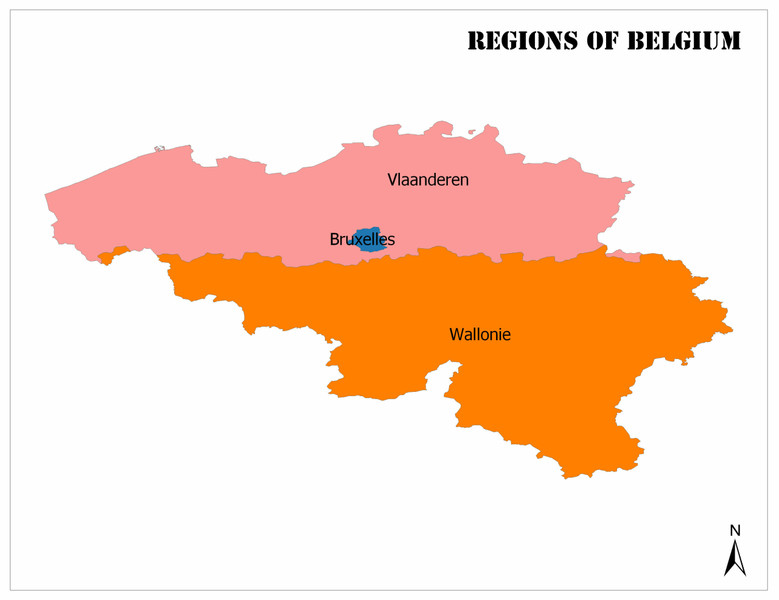
Belgium’s three regions
Key Takeaways
Devolution
Transfer of political power from a central government to regional or local governments, ranging from limited decentralization to autonomy or secession
Division of Groups by Physical Geography
Physical barriers, distance, or noncontiguous territory isolate a region, weaken its integration with the state, and can strengthen demands for self-government
Ethnic Separatism
A territorially concentrated ethnic group’s effort to gain greater autonomy or independence from its current state
Ethnic Cleansing
Forced removal of an ethnic, religious, or national group from a territory to make it more culturally homogeneous, often supporting exclusive territorial control
Terrorism
Use or threat of violence, often against civilians or symbolic targets, to create fear and achieve a political goal; separatists may use it to pressure a state for autonomy or independence
Economic and Social Problems
Territorially concentrated inequalities, exploitation, discrimination, or political exclusion that create grievances and demands for greater regional control
Irredentism
A claim that territory in one state should be annexed to or united with another state because of a shared ethnic, linguistic, cultural, or historical identity
Notes
Devolution
Transfer of political power from a central government to regional or local governments, ranging from limited decentralization to autonomy or secession
Division of Groups by Physical Geography
Physical barriers, distance, or noncontiguous territory isolate a region, weaken its integration with the state, and can strengthen demands for self-government
Ethnic Separatism
A territorially concentrated ethnic group’s effort to gain greater autonomy or independence from its current state
Ethnic Cleansing
Forced removal of an ethnic, religious, or national group from a territory to make it more culturally homogeneous, often supporting exclusive territorial control
Terrorism
Use or threat of violence, often against civilians or symbolic targets, to create fear and achieve a political goal; separatists may use it to pressure a state for autonomy or independence
Economic and Social Problems
Territorially concentrated inequalities, exploitation, discrimination, or political exclusion that create grievances and demands for greater regional control
Irredentism
A claim that territory in one state should be annexed to or united with another state because of a shared ethnic, linguistic, cultural, or historical identity
