Topic 5.1 Notes – Introduction to Agriculture
What Agriculture Is and How Physical Geography Shapes It
Agriculture means people intentionally cultivate crops and raise animals for food or other products. When people do that, they reshape the environment into agricultural landscapes such as fields, orchards, pastures, plantations, and irrigation systems.
That makes agriculture a classic human-environment interaction. The environment creates opportunities and limits, and people respond to them.
- Climate usually sets the broadest limits. It helps decide what can grow at all.
- Soil, water, topography, and elevation explain smaller local differences inside the same climate region.
- Culture and technology can change what is possible. Irrigation adds water, terracing makes steep slopes usable, greenhouses change temperature, fertilizers improve soil, machinery changes labor needs, and selective breeding improves crops or animals.
The AP distinction here is easy to miss. The environment influences agriculture, but it does not completely determine it. Two places with similar climates can still farm differently because of money, culture, water systems, or technology.
One quick classification reminder people mix up all the time:
- Intensive and extensive describe inputs per unit of land
- They do not mean commercial vs. subsistence
- They do not simply mean small farm vs. large farm
Physical Controls on Farming
Climate matters most at the broad scale because farming depends on heat, moisture, and timing.
Climate
- Temperature affects crop survival, frost risk, and length of growing season.
- Precipitation matters by amount, reliability, and seasonality. Rain at the wrong time can hurt farming almost as much as low rainfall.
- Dry climates or dry seasons often favor grazing unless irrigation is available.
- Too much rain can cause leaching, erosion, plant disease, and nutrient loss.
Mediterranean climates
Mediterranean climates have mild, wet winters and warm or hot, dry summers. On world maps, they show up in a few scattered west-coast regions rather than a huge continuous belt.
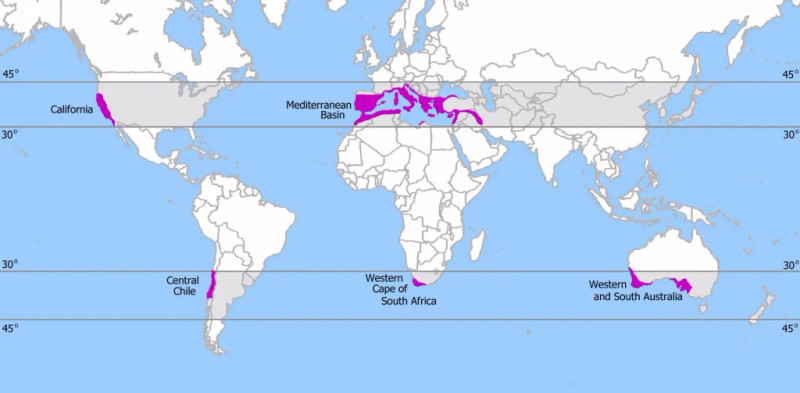
Global distribution of Mediterranean climate regions
Typical crops in these regions include:
- Grapes
- Olives
- Citrus
- Winter grains
- Irrigated horticulture
The logic is simple. Dry summers favor drought-tolerant crops, and irrigation lets farmers grow more during the dry season.
Tropical climates
Tropical climates stay warm year-round, but rainfall varies a lot.
- Humid tropical areas get heavy rainfall most of the year.
- Tropical wet-and-dry areas have strong wet and dry seasons.
Common crops include bananas, sugarcane, cacao, coffee in tropical uplands, rubber, and oil palm. Warmth allows long growing seasons and sometimes multiple harvests. Heavy rainfall can still create poor soils because nutrients get leached out.
Standard examples:
- Amazon Basin, Central Africa, Southeast Asia for shifting cultivation
- Tropical highlands of Latin America and East Africa for coffee
Soil, water, topography, and elevation
- Alluvial soils deposited by rivers are often very fertile and support intensive farming.
- Thin, rocky, acidic, saline, waterlogged, or heavily leached soils limit cultivation.
- Reliable water supports cropping. Variable water often favors herding.
- Flat land supports large fields and mechanization.
- Steep slopes raise erosion risk and often require terracing.
- Elevation lowers temperature, which is why tropical highlands can grow cooler-weather crops like coffee.
Types of Agricultural Practices
Once you connect environment to farming, the main job is telling intensive from extensive agriculture.
Intensive agriculture
Intensive agriculture uses high inputs per unit of land.
Market gardening
Also called truck farming. It grows fruits, vegetables, flowers, and other high-value crops for sale. It often developed near cities because the products spoil quickly, and it usually needs irrigation and careful management.Plantation agriculture
Large-scale production of one main cash crop, usually in tropical or subtropical regions. Standard crops are bananas, sugarcane, cacao, coffee, rubber, tea, and oil palm. Plantations are often export-oriented monocultures. Big size does not make them extensive.Mixed crop/livestock systems
Crops and animals are integrated on the same farm. Crops feed animals, and manure fertilizes fields. This is common in northwestern Europe and parts of the United States.
Extensive agriculture
Extensive agriculture uses low inputs per unit of land over large areas.
Shifting cultivation
Also called swidden. Slash-and-burn is the clearing method, not the whole system.- Clear plot
- Burn vegetation
- Farm temporarily
- Soil fertility declines
- Leave plot fallow
- Move to new plot
- Vegetation regrows
Nomadic herding
Also called pastoral nomadism. Herders move livestock to find water and pasture. Examples include camels and goats near the Sahara, cattle in the Sahel, sheep and horses in Mongolia, and reindeer in northern Eurasia. Transhumance means seasonal movement between fixed grazing zones.Ranching
Commercial livestock raising on large fixed areas of pasture or rangeland. Standard regions include the western United States, South American grasslands, southern Africa, and the Australian interior.
How to Identify Them on the Exam
MCQs and FRQs usually want the logic, not just the label.
- Intensive means high inputs per hectare, often with high-value output.
- Extensive means low inputs per hectare spread across more land.
- A plantation may be huge and still be intensive.
- Shifting cultivation often shows cropped plots surrounded by regrowth forest.
- Nomadic herding shows herd movement and temporary camps.
- Ranching shows fixed property, commercial grazing, and low stocking density.
For FRQs, use this chain: physical condition → effect on farming → resulting practice.
Example: unreliable rainfall limits crops and creates scattered pasture, so large-area grazing or herd movement becomes more practical.
A common trap is saying climate alone causes a practice. Good answers connect rainfall, soils, water access, terrain, and human modification together.
Key Takeaways
Agriculture
The deliberate cultivation of plants and raising of animals for food and other useful products
Mediterranean Climate
A climate with mild, wet winters and warm or hot, dry summers, favoring grapes, olives, winter grains, orchards, and irrigated horticulture
Tropical Climates
Year-round warm climates ranging from humid to seasonally wet-and-dry; continuous warmth can permit year-round growth and multiple harvests, while heavy rainfall may leach nutrients from humid tropical soils
Intensive Agriculture
Agriculture using relatively large inputs of labor, capital, water, chemicals, machinery, or management per unit of land to obtain a high yield or high-value output
Extensive Agriculture
Agriculture using relatively small inputs per unit of land across comparatively large areas, generally producing lower output per unit of land
Market Gardening / Truck Farming
Intensive cultivation of fruits, vegetables, flowers, or other high-value horticultural products for sale
Plantation Agriculture
Large-scale, intensive production of one principal cash crop, usually in a tropical or subtropical environment and commonly for export
Mixed Crop/Livestock Agriculture
An intensive system integrating crops and livestock so crops or residues feed animals and animal manure fertilizes fields
Shifting Cultivation / Swidden Agriculture
An extensive system that temporarily cultivates a cleared plot, leaves it fallow to recover, and shifts cultivation to another plot
Slash-and-Burn
A land-clearing technique in which vegetation is cut and burned, with the ash temporarily adding nutrients to the soil
Nomadic Herding / Pastoral Nomadism
The extensive raising and organized movement of livestock in search of seasonally available pasture and water
Transhumance
Seasonal movement of livestock between established grazing areas, often while the household retains a permanent settlement
Ranching
Commercial raising of grazing livestock over large areas of pasture or rangeland from a generally fixed landholding or base
Notes
Agriculture
The deliberate cultivation of plants and raising of animals for food and other useful products
Mediterranean Climate
A climate with mild, wet winters and warm or hot, dry summers, favoring grapes, olives, winter grains, orchards, and irrigated horticulture
Tropical Climates
Year-round warm climates ranging from humid to seasonally wet-and-dry; continuous warmth can permit year-round growth and multiple harvests, while heavy rainfall may leach nutrients from humid tropical soils
Intensive Agriculture
Agriculture using relatively large inputs of labor, capital, water, chemicals, machinery, or management per unit of land to obtain a high yield or high-value output
Extensive Agriculture
Agriculture using relatively small inputs per unit of land across comparatively large areas, generally producing lower output per unit of land
Market Gardening / Truck Farming
Intensive cultivation of fruits, vegetables, flowers, or other high-value horticultural products for sale
Plantation Agriculture
Large-scale, intensive production of one principal cash crop, usually in a tropical or subtropical environment and commonly for export
Mixed Crop/Livestock Agriculture
An intensive system integrating crops and livestock so crops or residues feed animals and animal manure fertilizes fields
Shifting Cultivation / Swidden Agriculture
An extensive system that temporarily cultivates a cleared plot, leaves it fallow to recover, and shifts cultivation to another plot
Slash-and-Burn
A land-clearing technique in which vegetation is cut and burned, with the ash temporarily adding nutrients to the soil
Nomadic Herding / Pastoral Nomadism
The extensive raising and organized movement of livestock in search of seasonally available pasture and water
Transhumance
Seasonal movement of livestock between established grazing areas, often while the household retains a permanent settlement
Ranching
Commercial raising of grazing livestock over large areas of pasture or rangeland from a generally fixed landholding or base
