Topic 7.2 Notes – Economic Sectors and Patterns
What Economic Sectors Are
Economic sectors are categories of economic activity. They group work by function, not by how much money a worker makes.
A quick pattern you should keep in your head is this:
- Lower-development economies often have lots of primary work.
- Industrializing places usually grow in secondary work.
- More developed places usually have huge tertiary sectors and more quaternary and quinary jobs.
Be careful with employment versus output. A sector can employ many people but produce a smaller share of total value, or the reverse. Mechanized oil extraction, for example, may use few workers but create lots of output.
One company can span several sectors at once. A food company can include farmers, factory workers, truck drivers, data analysts, and executives.
The Five Economic Sectors
Different sectors exist because different stages of production do different jobs.
| Sector | What it does | Common examples | Spatial pattern |
|---|---|---|---|
| Primary | Takes raw materials from nature | farming, fishing, forestry, mining, oil and gas | tied to resources, climate, soil, water, terrain; common in peripheral and less industrialized regions |
| Secondary | Makes and processes goods | steel, cars, refining, food processing, construction, energy production | clusters where inputs, labor, transport, and markets work well; rises with industrialization |
| Tertiary | Provides services | retail, transport, banking, health care, education, tourism | grows in cities as incomes and urbanization rise |
| Quaternary | Handles knowledge and information | R&D, software, IT, data analysis, consulting | concentrated in metros, universities, research hubs, developed regions |
| Quinary | Makes top-level decisions | CEOs, senior officials, leaders of major organizations | concentrated in capitals, global cities, headquarters |
One common mistake is treating all service work as high-skill. Tertiary includes both low-wage and high-wage service jobs.
Development Patterns and Core-Periphery Differences
As economies develop, the sector mix usually changes. Primary employment tends to shrink, secondary often grows during industrialization, and tertiary becomes dominant later. Quaternary and quinary functions are most concentrated in advanced regions.
Manufacturing output can still stay high even when factory jobs fall. Automation and mechanization let fewer workers produce more.
Core, semiperiphery, and periphery
- Core regions have capital, advanced infrastructure, skilled labor, research, finance, big markets, and lots of quaternary/quinary control.
- Semiperiphery mixes manufacturing growth with growing urban markets but has less global control. Standard examples are China, India, and Brazil.
- Periphery often depends more on raw materials or labor-intensive manufacturing and has weaker infrastructure and less control over investment.
A key pattern is that production gets split up. Raw materials may come from the periphery, assembly may happen in the semiperiphery, and design, finance, and headquarters stay in the core.
What Pulls Manufacturing to Certain Places
Manufacturing location is about profit. Firms compare several location factors at once.
- Resources pull resource-oriented industries toward inputs. Bulk-reducing industries lose weight during processing, so they often locate near raw materials. Examples include copper smelting and canning near farms.
- Markets pull market-oriented industries toward consumers. Bulk-gaining industries gain weight or volume, so they often locate near markets. Beverage bottling is the classic example.
- Labor matters for wages, skill, productivity, and worker supply. Apparel manufacturing often seeks lower labor costs.
- Transportation depends on distance, weight, perishability, mode, and infrastructure. Highways, rail, ports, airports, and waterways all matter.
- Break-of-bulk points are places where cargo changes transport modes, like ports or rail terminals. They attract warehouses and industry because transfer happens there.
- Shipping containers make intermodal transport faster and cheaper. They reduce labor time, theft, and damage, and they strengthen major ports.
- Agglomeration means clustering near related firms to share suppliers, labor pools, infrastructure, and services.
A container port is a good example of how break-of-bulk points work in practice. Containers arrive by truck, rail, or smaller ships, then get transferred, stacked, and loaded onto larger vessels.
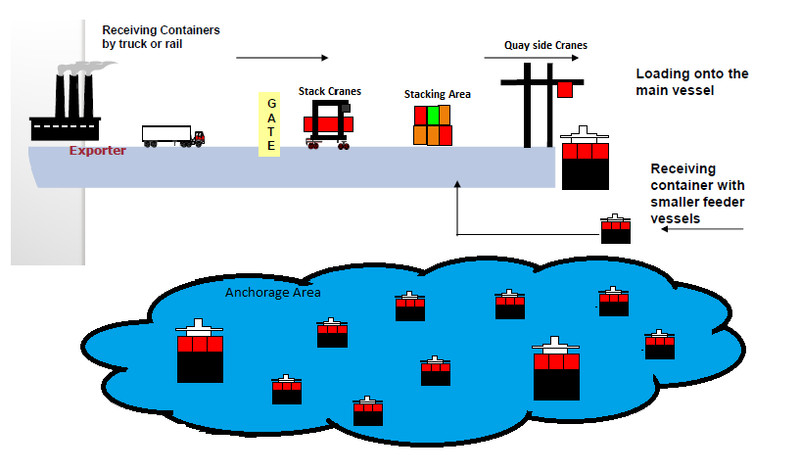
Intermodal container port
Weber’s Least Cost Theory
Weber explains industrial location through lowest total cost, especially transportation, labor, and agglomeration.
- Find the transportation minimum by comparing raw-material sites and the market.
- Ask whether inputs are localized or ubiquitous. Localized inputs pull harder.
- If the industry is bulk-reducing, it gets pulled toward resources.
- If the industry is bulk-gaining, it gets pulled toward the market.
- Then check whether cheaper or better labor justifies moving away from that spot.
- Then check whether agglomeration lowers total cost enough to justify clustering.
You can picture this with Weber’s locational triangle, which maps the pull of two raw-material sites and one market to find a least-cost location.
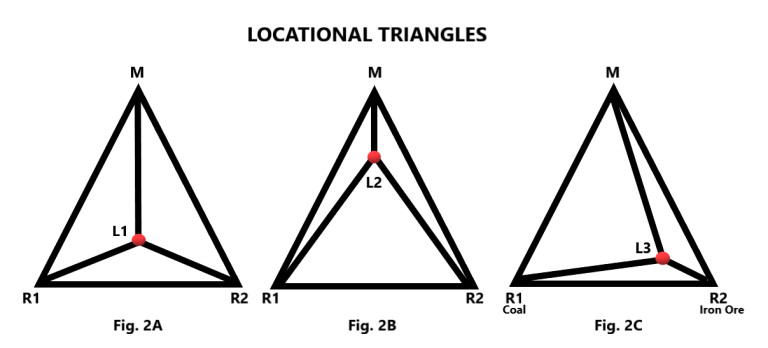
The classic example is Pittsburgh steel. It worked because of Appalachian coal, strong transport routes, and access to markets.
Real firms also respond to taxes, policy, regulation, technology, and multiple markets, so Weber is a model, not a perfect rule.
Key Takeaways
Primary Sector
Economic activities that obtain raw materials directly from nature, such as agriculture, fishing, forestry, mining, and extraction
Secondary Sector
Economic activities that transform raw materials into usable products through manufacturing, processing, construction, or energy generation
Tertiary Sector (Service Sector)
Economic activities that provide services rather than extracting raw materials or manufacturing goods
Quaternary Sector
Economic activities centered on creating, processing, managing, and communicating specialized information and knowledge
Quinary Sector
The highest levels of leadership, policy formation, and decision-making that direct major organizations or institutions
Core Region
A region with extensive capital, infrastructure, skilled labor, advanced technology, large markets, and strong control over investment and production
Semiperipheral Region
An industrializing region with substantial manufacturing and infrastructure but less global economic control than the core
Peripheral Region
A region with limited industrial capacity, weaker infrastructure, and less economic control that often specializes in primary commodities or labor-intensive production
Resource-Oriented Industry (Material-Oriented Industry)
An industry that locates near raw materials because they are fixed, bulky, heavy, perishable, or costly to transport
Bulk-Reducing Industry (Weight-Losing Industry)
An industry whose finished product weighs less or occupies less volume than its inputs, favoring locations near raw materials
Market-Oriented Industry
An industry that locates near customers because its finished goods are perishable, fragile, costly to transport, or responsive to local demand
Bulk-Gaining Industry (Weight-Gaining Industry)
An industry whose finished product gains weight or volume during production, favoring locations near its market
Labor-Intensive Industry
An industry in which worker compensation accounts for a relatively large share of production costs
Labor-Oriented Industry
An industry whose location is strongly influenced by the cost, availability, productivity, or specialized skills of workers
Break-of-Bulk Point
A location where cargo is transferred from one mode of transportation to another
Containerization
The use of standardized shipping containers that transfer among ships, trains, and trucks without unloading the individual goods inside
Intermodal Transportation
The movement of the same cargo unit by multiple transportation modes, such as ship, rail, and truck
Agglomeration
The clustering of related firms to share suppliers, infrastructure, transportation, specialized labor, services, and information
Footloose Industry
An industry with few transportation constraints because its inputs and outputs are lightweight, high-value, widely available, or electronic
Least Cost Theory
Alfred Weber’s theory that firms locate where the combined costs of transportation, labor, and agglomeration are lowest
Locational Triangle
Weber’s model of two resource locations and one market used to find the factory site with the lowest transportation cost
Localized Materials vs. Ubiquitous Materials
Localized materials occur only in particular places and exert a strong locational pull; ubiquitous materials are widely available and exert little pull
Notes
Primary Sector
Economic activities that obtain raw materials directly from nature, such as agriculture, fishing, forestry, mining, and extraction
Secondary Sector
Economic activities that transform raw materials into usable products through manufacturing, processing, construction, or energy generation
Tertiary Sector (Service Sector)
Economic activities that provide services rather than extracting raw materials or manufacturing goods
Quaternary Sector
Economic activities centered on creating, processing, managing, and communicating specialized information and knowledge
Quinary Sector
The highest levels of leadership, policy formation, and decision-making that direct major organizations or institutions
Core Region
A region with extensive capital, infrastructure, skilled labor, advanced technology, large markets, and strong control over investment and production
Semiperipheral Region
An industrializing region with substantial manufacturing and infrastructure but less global economic control than the core
Peripheral Region
A region with limited industrial capacity, weaker infrastructure, and less economic control that often specializes in primary commodities or labor-intensive production
Resource-Oriented Industry (Material-Oriented Industry)
An industry that locates near raw materials because they are fixed, bulky, heavy, perishable, or costly to transport
Bulk-Reducing Industry (Weight-Losing Industry)
An industry whose finished product weighs less or occupies less volume than its inputs, favoring locations near raw materials
Market-Oriented Industry
An industry that locates near customers because its finished goods are perishable, fragile, costly to transport, or responsive to local demand
Bulk-Gaining Industry (Weight-Gaining Industry)
An industry whose finished product gains weight or volume during production, favoring locations near its market
Labor-Intensive Industry
An industry in which worker compensation accounts for a relatively large share of production costs
Labor-Oriented Industry
An industry whose location is strongly influenced by the cost, availability, productivity, or specialized skills of workers
Break-of-Bulk Point
A location where cargo is transferred from one mode of transportation to another
Containerization
The use of standardized shipping containers that transfer among ships, trains, and trucks without unloading the individual goods inside
Intermodal Transportation
The movement of the same cargo unit by multiple transportation modes, such as ship, rail, and truck
Agglomeration
The clustering of related firms to share suppliers, infrastructure, transportation, specialized labor, services, and information
Footloose Industry
An industry with few transportation constraints because its inputs and outputs are lightweight, high-value, widely available, or electronic
Least Cost Theory
Alfred Weber’s theory that firms locate where the combined costs of transportation, labor, and agglomeration are lowest
Locational Triangle
Weber’s model of two resource locations and one market used to find the factory site with the lowest transportation cost
Localized Materials vs. Ubiquitous Materials
Localized materials occur only in particular places and exert a strong locational pull; ubiquitous materials are widely available and exert little pull
