Topic 4.7 Notes – Forms of Governance
What Federal and Unitary States Are
Forms of governance tell you how power is distributed across national and subnational levels. In AP Human Geography, state means a sovereign country. That matters because in the United States, “states” are also the regional units inside one federal state.
The big distinction is vertical power. You are asking where authority sits across levels of government.
- This is not democracy vs authoritarianism.
- This is not presidential vs parliamentary.
- This is not monarchy vs republic.
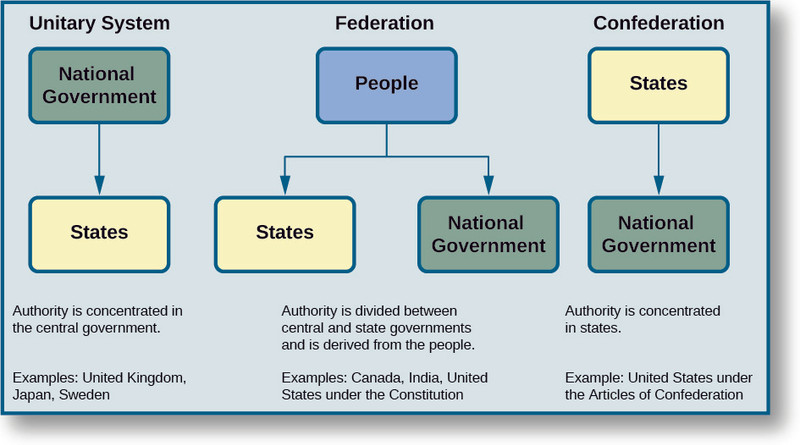
A unitary state has one ultimate source of authority, the national government.
- Local governments can exist and even do a lot.
- Their power comes from the national government.
- Power runs in a centralized, top-down hierarchy.
A federal state divides power between national and regional governments.
- That division is protected by the constitution.
- Both levels have real authority in their own areas.
- Regional governments cannot just be erased by ordinary national action.
The exam question that settles it is simple. Do subnational units have constitutionally protected power?
- No = unitary
- Yes = federal
One trap shows up a lot. Decentralization is not the same as federalism. A country can give regions more responsibility and still stay unitary. Also, a federal state is different from a confederation, which is looser and is outside the main AP focus here.
Examples
Examples make the definition concrete because AP questions often hide the label and test whether you can infer it.
Unitary states
- France is the classic example. It has regions, departments, and communes, but the national government remains the ultimate authority. That helps create more uniform national policies, especially in education.
- United Kingdom is still unitary even after devolution to Scotland, Wales, and Northern Ireland. Parliament still holds ultimate authority.
- China is unitary even though it is huge. Size alone does not make a country federal.
- Japan is democratic and unitary. Unitary does not mean authoritarian.
Federal states
- United States is the standard federal example. The Constitution divides power between the national government and the states, so Washington, D.C. is not the only important political center.
- Canada gives major powers to provinces. Quebec is the common example because of its French language and distinct identity.
- India uses federalism to manage major regional and linguistic diversity.
- Germany gives constitutionally recognized authority to its Länder.
Other federal examples worth recognizing are Brazil, Mexico, Australia, Nigeria, Switzerland, Belgium, and Russia.
A quick world map can help you lock in those examples and see the broad pattern.
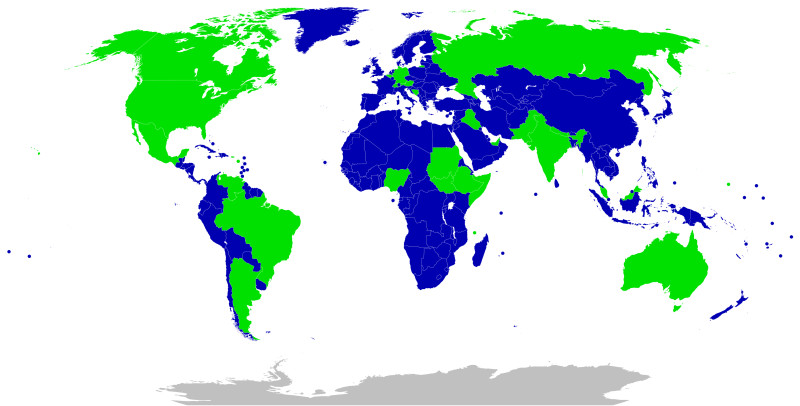
World map of federal and unitary states
How Power Is Organized Across Space
This is where the geography part shows up. Forms of governance shape what political space looks like. The basic pattern is simple. In a unitary system, power is concentrated at the national level. In a federal system, power is divided between national and regional governments.
Unitary spatial organization
- One dominant national political center, usually the capital
- Internal boundaries work mainly as administrative divisions
- Policies tend to be more uniform across the country
- Power flows downward from the center
Federal spatial organization
- Multiple meaningful power centers
- National capital and regional capitals both matter
- Internal boundaries have constitutional importance
- Crossing a state or provincial boundary can change laws, taxes, schools, policing, or elections
- More negotiation and conflict between levels
The diagram below gives a quick visual comparison. Focus on the first two columns, which show unitary and federal systems.
Why States Use These Systems and Their Effects
Countries often become unitary through political consolidation. A strong central government extends uniform control across the territory. That can make coordination faster and national policy more consistent, but distant regions may feel ignored.
Countries often become federal through negotiated unions of distinct territories or because they need to manage strong regional differences.
- The U.S. grew this way as states joined under a shared constitution.
- Federalism can preserve influence for regional, ethnic, linguistic, or historical groups.
Effects are mixed:
| System | Advantages | Disadvantages |
|---|---|---|
| Unitary | uniform policies, faster coordination, stronger national unity | less local responsiveness, peripheral regions may feel overlooked |
| Federal | regional autonomy, policies fit local needs, regional groups keep influence | uneven services, overlapping bureaucracy, jurisdiction conflicts |
How to Classify It on the Exam
- Ask where ultimate authority is located.
- If the national government can create, change, or remove regional powers on its own, it is unitary.
- If regional governments have constitutionally protected authority, it is federal.
- Then connect it to space.
- Unitary = centralized hierarchy, more uniform administration
- Federal = dispersed power centers, stronger internal boundaries, more regional variation
Common traps:
- Provinces or regions do not automatically mean federalism.
- Policy variation does not automatically mean federalism.
- Large size does not automatically mean federalism.
- Devolution does not automatically turn a unitary state into a federal state.
Key Takeaways
Unitary State
A state in which the national government holds ultimate authority and grants, regulates, or withdraws the powers of subnational governments
Federal State / Federation / Federalism
A state in which the constitution divides authority between national and regional governments, giving both protected governing powers
Notes
Unitary State
A state in which the national government holds ultimate authority and grants, regulates, or withdraws the powers of subnational governments
Federal State / Federation / Federalism
A state in which the constitution divides authority between national and regional governments, giving both protected governing powers
