Topic 5.10 Notes – Consequences of Agricultural Practices
How Agricultural Practices Create Consequences
Agriculture is a form of human-environment interaction. Farmers and herders change land cover, water use, vegetation, and labor systems so they can produce more food or make more profit. That change is the whole point of the topic.
The pattern you want to see is:
- A practice is chosen for some environmental or economic reason.
- The practice changes land, water, vegetation, or labor.
- Environmental and social consequences follow.
A practice is not automatically good or bad. Irrigation can raise yields, but in dry places it can also drain rivers or leave salt in the soil. Slash and burn can work in low-density areas with long fallow periods, but it becomes damaging when land is reused too quickly.
A few terms students mix up a lot:
- Land cover change means converting forest, grassland, or wetland into cropland or pasture.
- Desertification means broader dryland degradation, not just “more desert.”
- Salinization means salt buildup in soil, usually from irrigation in dry climates.
- Slash and burn is a clearing method. Shifting cultivation is the larger system with movement and a fallow cycle.
Environmental Consequences of Agricultural Land Use
Agricultural expansion often starts by changing what is physically on the land.
Land cover change
- Forests, grasslands, and wetlands get converted to cropland, plantations, or pasture.
- That leads to habitat fragmentation, biodiversity loss, more runoff, less carbon storage, and more erosion.
- The classic example is the Amazon, where cattle ranching and commercial farming clear forest. Satellite images often show roads and geometric fields cutting into the forest in patterns like the ones shown here.
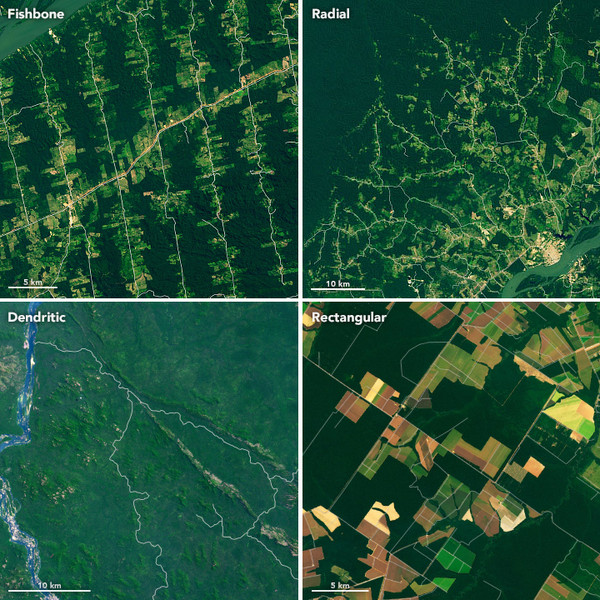
Amazon deforestation patterns
Pollution
- Fertilizer and manure runoff add nitrogen and phosphorus to water.
- That causes eutrophication. Algae grow fast, then die, decomposition uses oxygen, and fish kills or dead zones can follow.
- Pesticides can harm nontarget species. DDT is the standard example because biomagnification caused eggshell thinning in predatory birds.
- Livestock waste pollutes water, and agriculture also adds methane and nitrous oxide to the atmosphere.
Soil degradation
- Clearing vegetation, overgrazing, and farming on exposed slopes increase erosion.
- Losing topsoil lowers fertility and can fill rivers or reservoirs with sediment.
- The Dust Bowl shows the chain clearly. Plowed grasslands plus drought led to wind erosion, farm failure, migration, and conservation reforms.
Water problems
Irrigation boosts yields, but it can also deplete rivers and aquifers. The Aral Sea shrank after rivers were diverted for cotton irrigation.
Salinization usually works like this:
- Irrigation adds water to dry soils.
- Evaporation removes the water.
- Salts stay behind.
- Repeated irrigation causes salt buildup.
- Yields fall.
Desertification
In drylands, drought plus overgrazing, deforestation, overcultivation, or poor irrigation can degrade land. The Sahel is the standard example because variable rainfall combined with livestock pressure and reduced mobility. Results include lower productivity, food insecurity, migration, and conflict.
Agricultural Practices That Alter Landscapes
Some practices are easy to spot because they physically reshape the land.
Slash and burn and shifting cultivation
Burning clears fields and ash briefly adds nutrients. This system can be sustainable with long fallow periods and low population density. When fallow time shrinks, it can cause deforestation, nutrient loss, and erosion.
Terracing
Terraces turn slopes into steps. That slows runoff, reduces erosion, and allows farming on steep land, like in the Andes or Southeast Asian rice terraces.
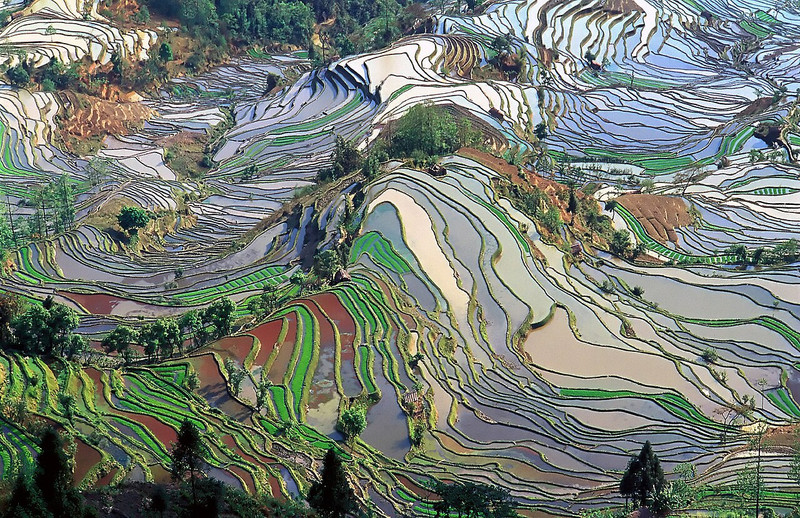
Rice terraces in Yuanyang, Yunnan, China
Terraces need major labor and upkeep, and failure can trigger erosion or landslides.
Irrigation
- Surface irrigation uses channels or flooding. Cheap, but loses lots of water.
- Sprinkler irrigation includes center-pivot systems that make circular fields.
- Drip irrigation delivers water to roots. Most efficient, but expensive.
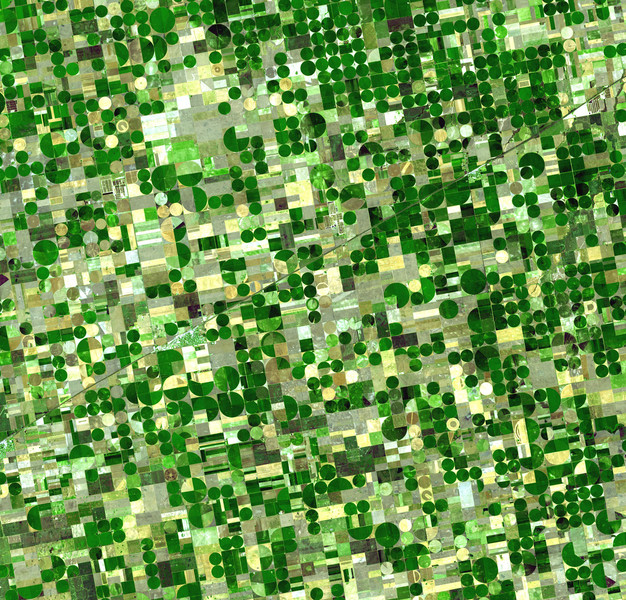
Center-pivot irrigation
That circular pattern is the visual clue for center-pivot sprinkler irrigation. Benefits include higher yields and more reliable harvests. Risks include depletion, waterlogging, salinization, and polluted runoff.
Deforestation, wetland drainage, and pastoral nomadism
- Deforestation expands farmland or pasture but increases habitat loss and carbon release.
- Wetland drainage creates farmland but removes flood storage, water filtration, habitat, and carbon storage. The Everglades is the standard example.
- Pastoral nomadism uses mobility to match herds with variable pasture. It is not automatically destructive. Overgrazing usually gets worse when animals are concentrated near wells or settlements.
Conservation and Societal Consequences
Because agriculture can degrade land and water, societies also develop ways to protect future productivity.
Conservation efforts
- Soil conservation includes contour plowing, terracing, strip cropping, cover crops, crop rotation, no-till, shelterbelts, and riparian buffers.
- Water conservation includes drip irrigation, canal lining, irrigation scheduling, and better drainage.
- Grazing management includes rotational grazing, adjusting herd size, and protecting migration routes.
These practices help, but they often require labor, money, land, or regulation.
Societal consequences
- Changing diets come from commercialization and trade. Food variety can increase, but diets may also become more standardized and meat-heavy.
- Feminization of agriculture happens when women take on more farm labor or management, often because of mechanization changes or male out-migration.
- Subsistence to commercial agriculture changes the purpose of farming. It encourages specialization, cash crops, larger farms, wage labor, and dependence on global prices and purchased inputs. That can raise incomes, but it can also increase debt, concentrate landownership, and weaken local food security.
Key Takeaways
Land Cover Change
Conversion of Earth’s surface from one cover type to another, such as forest or wetland to cropland or pasture
Soil Erosion
Removal of topsoil by wind or water, often accelerated by clearing vegetation, leaving fields bare, or cultivating unprotected slopes
Soil Degradation
Decline in soil quality and productivity through erosion, nutrient depletion, compaction, salinization, or other damage
Agricultural Pollution
Damage caused when sediment, fertilizers, pesticides, animal waste, salts, or other agricultural by-products move beyond their intended location
Eutrophication
Excess nutrients cause rapid algal or plant growth whose decomposition depletes dissolved oxygen and can create aquatic dead zones
Pesticides
Chemical or biological agents used to control agricultural pests that may also harm nontarget species and contaminate soil or water
Biomagnification
Increase in the concentration of a persistent pollutant at successively higher trophic levels of a food chain
Groundwater Depletion
Decline of groundwater when withdrawals exceed natural aquifer recharge, lowering the water table
Soil Salinization
Accumulation of soluble salts in soil to levels that reduce plant growth, especially under irrigation in dry climates
Desertification
Degradation of productive land in dry environments until it becomes less fertile and more desert-like
Carrying Capacity
The population an environment can support over time without long-term degradation
Slash-and-Burn Agriculture
Land-clearing technique in which vegetation is cut, dried, and burned to clear a field and release nutrients as ash
Shifting Cultivation
Agricultural system in which a plot is cultivated briefly, left fallow to recover, and replaced temporarily by another plot
Terracing
Conversion of a slope into level steps that make steep land cultivable while slowing runoff and erosion
Irrigation
Artificial application of water to crops to support farming where rainfall is insufficient, seasonal, or unreliable
Surface Irrigation
Irrigation in which water flows across fields through channels, furrows, or flooding
Sprinkler Irrigation
Irrigation in which a pressurized system distributes water through the air over crops
Center-Pivot Irrigation
Sprinkler irrigation using a rotating arm around a central point, producing circular fields visible from above
Drip Irrigation
Irrigation that delivers small quantities of water near plant roots through tubes or emitters, limiting evaporation
Deforestation
Clearing or removal of forests, often to convert land into cropland, plantations, or livestock pasture
Wetland Drainage
Removal or control of water through ditches, tiles, levees, or pumping to convert wetlands into cropland or pasture
Pastoral Nomadism
Subsistence livelihood in which people move with domesticated livestock in search of pasture and water
Overgrazing
Grazing that removes vegetation faster than it can regrow, exposing and compacting soil and increasing erosion
Contour Plowing
Cultivating along lines of equal elevation rather than directly down a slope to slow runoff and erosion
Strip Cropping
Planting alternating bands of crops or protective vegetation to interrupt runoff and wind erosion
Cover Cropping
Planting crops between primary harvests to keep soil covered, add organic matter, and sometimes fix nitrogen
Crop Rotation
Growing different crops in sequence to vary nutrient demands, interrupt pest cycles, and maintain soil fertility
Conservation Tillage; No-Till Farming
Farming that reduces soil disturbance and leaves crop residue on the surface to limit erosion and moisture loss
Shelterbelts; Windbreaks
Rows of trees or shrubs planted to reduce wind speed and protect soil from wind erosion
Riparian Buffers
Vegetated areas beside streams that trap sediment and nutrients before they enter the water
Rotational Grazing
Dividing pasture into sections and moving livestock among them so grazed vegetation can recover
Dietary Transition
Shift toward diets with more meat, dairy, vegetable oils, sugar, and processed foods as income, urbanization, and commercialization increase
Feminization of Agriculture
Increase in women’s responsibility for farm labor or management, often as men migrate elsewhere for wage work
Subsistence Agriculture
Agricultural production mainly for the farmer’s household or local community
Commercial Agriculture
Agricultural production of crops or livestock mainly for sale and profit
Conservation Efforts
Managed practices that protect soil, water, vegetation, and ecosystems while maintaining agricultural productivity
Notes
Land Cover Change
Conversion of Earth’s surface from one cover type to another, such as forest or wetland to cropland or pasture
Soil Erosion
Removal of topsoil by wind or water, often accelerated by clearing vegetation, leaving fields bare, or cultivating unprotected slopes
Soil Degradation
Decline in soil quality and productivity through erosion, nutrient depletion, compaction, salinization, or other damage
Agricultural Pollution
Damage caused when sediment, fertilizers, pesticides, animal waste, salts, or other agricultural by-products move beyond their intended location
Eutrophication
Excess nutrients cause rapid algal or plant growth whose decomposition depletes dissolved oxygen and can create aquatic dead zones
Pesticides
Chemical or biological agents used to control agricultural pests that may also harm nontarget species and contaminate soil or water
Biomagnification
Increase in the concentration of a persistent pollutant at successively higher trophic levels of a food chain
Groundwater Depletion
Decline of groundwater when withdrawals exceed natural aquifer recharge, lowering the water table
Soil Salinization
Accumulation of soluble salts in soil to levels that reduce plant growth, especially under irrigation in dry climates
Desertification
Degradation of productive land in dry environments until it becomes less fertile and more desert-like
Carrying Capacity
The population an environment can support over time without long-term degradation
Slash-and-Burn Agriculture
Land-clearing technique in which vegetation is cut, dried, and burned to clear a field and release nutrients as ash
Shifting Cultivation
Agricultural system in which a plot is cultivated briefly, left fallow to recover, and replaced temporarily by another plot
Terracing
Conversion of a slope into level steps that make steep land cultivable while slowing runoff and erosion
Irrigation
Artificial application of water to crops to support farming where rainfall is insufficient, seasonal, or unreliable
Surface Irrigation
Irrigation in which water flows across fields through channels, furrows, or flooding
Sprinkler Irrigation
Irrigation in which a pressurized system distributes water through the air over crops
Center-Pivot Irrigation
Sprinkler irrigation using a rotating arm around a central point, producing circular fields visible from above
Drip Irrigation
Irrigation that delivers small quantities of water near plant roots through tubes or emitters, limiting evaporation
Deforestation
Clearing or removal of forests, often to convert land into cropland, plantations, or livestock pasture
Wetland Drainage
Removal or control of water through ditches, tiles, levees, or pumping to convert wetlands into cropland or pasture
Pastoral Nomadism
Subsistence livelihood in which people move with domesticated livestock in search of pasture and water
Overgrazing
Grazing that removes vegetation faster than it can regrow, exposing and compacting soil and increasing erosion
Contour Plowing
Cultivating along lines of equal elevation rather than directly down a slope to slow runoff and erosion
Strip Cropping
Planting alternating bands of crops or protective vegetation to interrupt runoff and wind erosion
Cover Cropping
Planting crops between primary harvests to keep soil covered, add organic matter, and sometimes fix nitrogen
Crop Rotation
Growing different crops in sequence to vary nutrient demands, interrupt pest cycles, and maintain soil fertility
Conservation Tillage; No-Till Farming
Farming that reduces soil disturbance and leaves crop residue on the surface to limit erosion and moisture loss
Shelterbelts; Windbreaks
Rows of trees or shrubs planted to reduce wind speed and protect soil from wind erosion
Riparian Buffers
Vegetated areas beside streams that trap sediment and nutrients before they enter the water
Rotational Grazing
Dividing pasture into sections and moving livestock among them so grazed vegetation can recover
Dietary Transition
Shift toward diets with more meat, dairy, vegetable oils, sugar, and processed foods as income, urbanization, and commercialization increase
Feminization of Agriculture
Increase in women’s responsibility for farm labor or management, often as men migrate elsewhere for wage work
Subsistence Agriculture
Agricultural production mainly for the farmer’s household or local community
Commercial Agriculture
Agricultural production of crops or livestock mainly for sale and profit
Conservation Efforts
Managed practices that protect soil, water, vegetation, and ecosystems while maintaining agricultural productivity
