Topic 5.9 Notes – The Global System of Agriculture
What the Global System of Agriculture Is
Global agriculture works as one interconnected system. Food is often grown in one place, processed in another, shipped through another, and eaten somewhere far away.
Regions specialize because places differ in climate, soils, labor, capital, and market access. That is why tropical regions grow coffee, cocoa, and bananas, while mechanized temperate regions often export wheat, maize, and soybeans. Specialization creates interdependence.
The map below gives you a quick visual of that interdependence through major agricultural trade flows between world regions.
- Producing regions depend on buyers, imported inputs, roads, ports, and trade access.
- Consuming regions depend on distant producers for food, feed, fibers, and ingredients.
- Agricultural goods often act as commodities, which means raw or primary products bought and sold on world markets.
- Export commodities or cash crops are grown mainly for sale outside the region or country.
- Subsistence crops are grown mainly for direct local use.
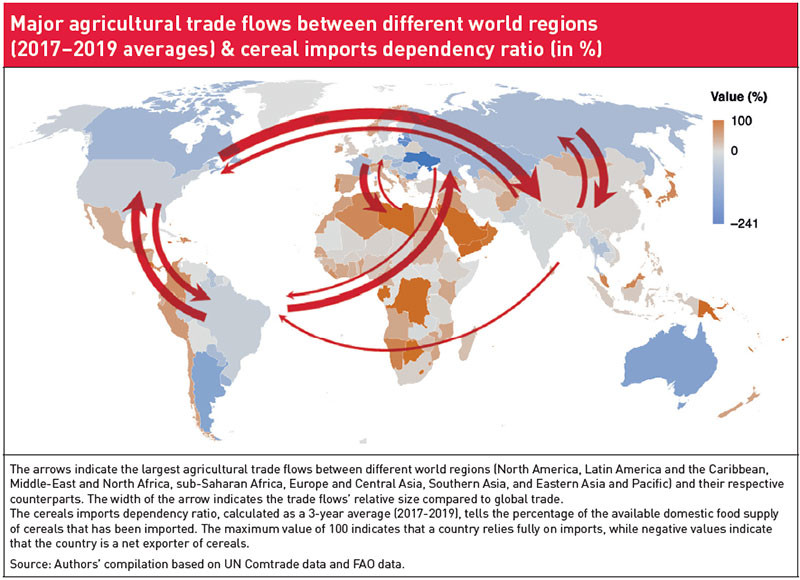
Global agricultural trade flows
One easy mix-up: export dependence is not the same as monoculture. A country can rely heavily on cocoa exports even if many farmers also grow food crops.
Supply Chains and Commodity Chains
A supply chain shows how a product moves. In agriculture, the full chain usually goes like this:
- Inputs
- Production
- Collection
- Processing
- Storage
- Transportation
- Manufacturing, packaging, branding
- Wholesale or retail
- Consumption
Inputs and production
Before food is even grown, farms need seeds, fertilizer, pesticides, machinery, fuel, feed, and credit. Production happens on farms, ranches, plantations, fishing operations, and aquaculture sites.
Collection through transport
Products from many small producers are often gathered by co-ops, brokers, or purchasing firms. Then they move into silos, warehouses, or refrigerated storage and travel by truck, rail, barge, ship, or air.
Processing to final sale
Initial processing includes drying, milling, slaughtering, or crushing. More value gets added later through roasting coffee, grinding cocoa, packaging, branding, and retail sale.
- Supply chain emphasizes logistics and movement.
- Commodity chain emphasizes the stages a product passes through.
- Value chain emphasizes where profit and value are added.
A food distribution network is not one straight line. It is many connected chains with alternate routes and markets.
Cocoa from Côte d’Ivoire
Cocoa is a great example because it clearly links local farming to global consumption.
- Small farmers grow cocoa beans.
- Beans are fermented and dried.
- Buyers and co-ops aggregate them.
- They move by road to Abidjan and San-Pédro.
- They are exported for grinding and chocolate manufacturing.
The big idea is that the highest value is often captured in processing, branding, and retail, not by the farmer.
Export Commodity Dependence
Some countries rely heavily on one or a few agricultural exports for foreign exchange and national income. This often comes from good growing conditions, colonial trade patterns, limited diversification, and strong world demand.
Examples you should know:
- Côte d’Ivoire and Ghana with cocoa
- Honduras or Ecuador with bananas
- Ethiopia with coffee
Benefits include jobs, export earnings, tax revenue, infrastructure investment, and global market access.
Vulnerabilities include:
- world price swings
- drought, floods, pests, and plant disease
- changing consumer demand
- new competitors
- disruption at one port, processor, or major buyer
A country can export cash crops and still import staple foods. That means export dependence and food-import dependence are different. Diversification lowers risk by spreading income across more crops, industries, and trade partners.
What Shapes Global Food Distribution
Political relationships
Governments shape what crosses borders and at what cost through trade agreements, tariffs, quotas, export bans, subsidies, sanctions, customs rules, and food-safety regulations.
Russia’s 2022 invasion of Ukraine disrupted wheat, maize, and oilseed exports through Black Sea ports. That mattered far beyond Ukraine because global grain markets are connected.
Infrastructure
Food needs systems to move.
- roads, railways, ports, bridges
- grain elevators, warehouses, mills, slaughterhouses, packing plants
- electricity, fuel, logistics systems
The cold chain means refrigerated transport and storage for perishables like meat, dairy, fruit, vegetables, and flowers. Weak infrastructure raises costs and spoilage.
Patterns of world trade
Trade follows clear patterns.
- Tropical producers export coffee, cocoa, bananas, and palm oil.
- Mechanized grain belts export wheat, maize, soybeans, and livestock products.
- Nearby countries trade a lot because distance costs less.
- Former colonial ties and regional trade blocs still shape routes.
- Different seasons between hemispheres support year-round produce trade.
Disruptions and Ripple Effects
Because the system is connected, one problem can spread fast.
- A drought, war, disease outbreak, or transport breakdown reduces supply.
- Less reaches world markets.
- Importers compete for what remains or switch suppliers.
- Prices rise.
- Related products rise too.
- Farmers elsewhere may plant more in response.
A soybean disruption affects more than soybeans. Soy is used for vegetable oil and livestock feed, so meat and dairy costs can rise too.
Effects depend on position in the network. Export-dependent producers, import-dependent consumers, processors, retailers, and governments all feel the shock differently. Local farms, national policies, regional trade corridors, and global markets are all tied together.
Key Takeaways
Global System of Agriculture
The worldwide network through which agricultural products are produced, processed, transported, exchanged, and consumed
Agricultural Commodity
A raw material or primary agricultural product that can be bought and sold
Export Commodity
A commodity produced primarily or substantially for sale outside the country where it is grown
Cash Crop
An agricultural product grown for sale rather than mainly for direct consumption by its producer
Subsistence Crop
A crop grown mainly for direct consumption by the producer’s household or local community
Monoculture
Cultivation of a single crop over a large area or repeatedly on the same land
Spatial Specialization
The concentration of production in places suited to particular products by their physical and economic conditions
Supply Chain / Global Agricultural Supply Chain
The network of people, firms, activities, infrastructure, and resources moving an agricultural product from its source to its final user, crossing borders when global
Commodity Chain
The connected sequence of stages and locations through which a particular commodity passes from inputs and production to final consumption
Value Chain
A commodity chain emphasizing how economic value is added through successive stages such as processing, packaging, branding, and retailing
Food Distribution Network
Many interconnected supply chains, transportation routes, markets, firms, and institutions that distribute food
Interdependence
A condition in which two or more places rely on one another within a shared system
Export Commodity Dependence / Commodity Dependence
A national or regional condition in which export earnings rely heavily on one or a few commodities
Food Import Dependence
Reliance on food produced in other countries to supply a population
Economic Diversification
Expansion into a wider range of crops, products, services, or trading partners to reduce reliance on a single commodity
Trade Agreement
An agreement that sets trade rules between participating countries and may reduce barriers to agricultural exchange
Tariff
A tax on imported goods that raises their cost and can protect domestic producers
Import Quota
A government limit on the quantity of a good that may be imported
Agricultural Subsidy
Government support that lowers costs for domestic agricultural producers and affects their competitiveness in trade
Cold Chain
The refrigerated system that keeps perishable goods within a safe temperature range during storage and transportation
Notes
Global System of Agriculture
The worldwide network through which agricultural products are produced, processed, transported, exchanged, and consumed
Agricultural Commodity
A raw material or primary agricultural product that can be bought and sold
Export Commodity
A commodity produced primarily or substantially for sale outside the country where it is grown
Cash Crop
An agricultural product grown for sale rather than mainly for direct consumption by its producer
Subsistence Crop
A crop grown mainly for direct consumption by the producer’s household or local community
Monoculture
Cultivation of a single crop over a large area or repeatedly on the same land
Spatial Specialization
The concentration of production in places suited to particular products by their physical and economic conditions
Supply Chain / Global Agricultural Supply Chain
The network of people, firms, activities, infrastructure, and resources moving an agricultural product from its source to its final user, crossing borders when global
Commodity Chain
The connected sequence of stages and locations through which a particular commodity passes from inputs and production to final consumption
Value Chain
A commodity chain emphasizing how economic value is added through successive stages such as processing, packaging, branding, and retailing
Food Distribution Network
Many interconnected supply chains, transportation routes, markets, firms, and institutions that distribute food
Interdependence
A condition in which two or more places rely on one another within a shared system
Export Commodity Dependence / Commodity Dependence
A national or regional condition in which export earnings rely heavily on one or a few commodities
Food Import Dependence
Reliance on food produced in other countries to supply a population
Economic Diversification
Expansion into a wider range of crops, products, services, or trading partners to reduce reliance on a single commodity
Trade Agreement
An agreement that sets trade rules between participating countries and may reduce barriers to agricultural exchange
Tariff
A tax on imported goods that raises their cost and can protect domestic producers
Import Quota
A government limit on the quantity of a good that may be imported
Agricultural Subsidy
Government support that lowers costs for domestic agricultural producers and affects their competitiveness in trade
Cold Chain
The refrigerated system that keeps perishable goods within a safe temperature range during storage and transportation
