Topic 7.6 Notes – Trade and the World Economy
What Trade and the World Economy Are
Trade means exchanging goods and services across borders. Exports go out of a country. Imports come in.
- A trade surplus happens when exports are worth more than imports.
- A trade deficit happens when imports are worth more than exports.
- A deficit alone does not prove weakness. A country may still be strong if it attracts investment or imports useful inputs.
The world economy is bigger than shipping products. It includes the movement of goods, services, capital (money for investment), and even financial risk. A phone might be designed in California, use parts from East Asia, be assembled in China or Vietnam, financed through New York or London, and sold worldwide.
That creates interdependence. Countries rely on each other for markets, labor, energy, credit, and investment. That link connects core, semiperiphery, and periphery places, but it does not make them equal. Power and profits are still uneven.
One clear example is global food trade, where major flows connect North America, Europe, East Asia, and parts of Africa and Southwest Asia.
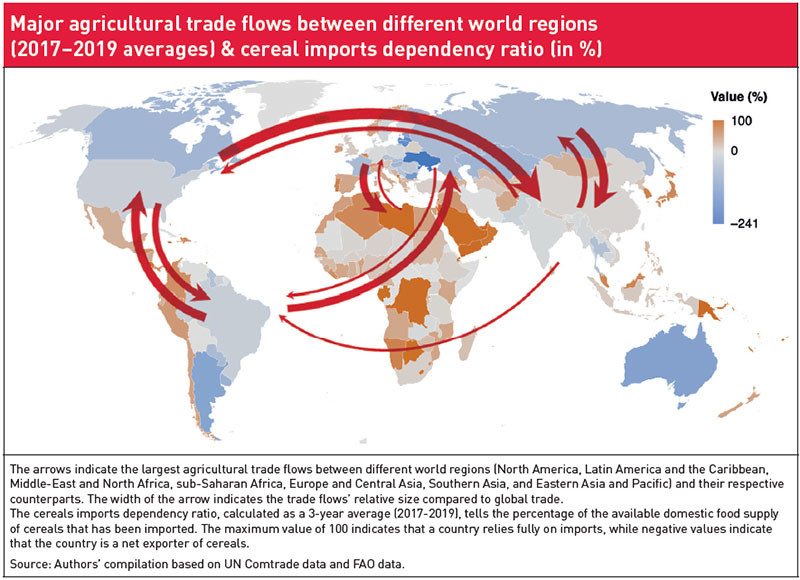
Major agricultural trade flows
Geographically, trade often grows:
- Ports and logistics hubs
- Border zones with cross-border industry
- Global cities that manage finance
- Export regions focused on one product or resource
It also makes places vulnerable to shocks far away.
Why Trade Happens
Trade usually rests on two ideas. One explains why two places fit together. The other explains why each place specializes.
Complementarity
Complementarity means one place has a surplus and another has demand for it. There has to be a geographic match between supply and demand.
- Classic example: Southwest Asian oil and Japan. Oil producers have supply. Japan has strong demand but limited oil reserves.
- This creates the potential for trade, not a guarantee. Distance, conflict, tariffs, transport cost, or other suppliers can block it.
Comparative advantage
Comparative advantage means a country specializes in what it can produce at a lower opportunity cost.
- This is different from absolute advantage, which means producing more with the same resources.
- A country can be best at producing everything and still gain from trade if it gives up less to make one product than another country does.
The exam loves this distinction. Look for relative efficiency, not total output. Comparative advantage leads to specialization and gains from trade, but some workers and regions lose when industries shift.
Telling them apart
- Complementarity = why two places match up for trade
- Comparative advantage = why each place specializes in certain goods
Free Trade, Neoliberalism, and Trade Blocs
Late 20th century globalization grew with neoliberalism, which favors markets, privatization, deregulation, fewer trade barriers, and openness to foreign direct investment.
Free trade means fewer tariffs, quotas, and barriers. No country is fully barrier-free.
Supporters argue free trade brings:
- lower prices
- more competition
- more investment
- more growth
Critics point to:
- job loss
- weaker labor and environmental protections
- inequality
- dependence on foreign firms
Major organizations and agreements
| Group | What it does |
|---|---|
| European Union | A common market with movement of goods, services, capital, and people; many members use the euro; strong supranational power |
| WTO | Global trade rules, dispute settlement, negotiations; founded 1995 |
| Mercosur | South American trade bloc; core members are Argentina, Brazil, Paraguay, Uruguay |
| OPEC | Oil producers coordinate output to influence prices; not a free trade bloc |
NAFTA and USMCA
NAFTA began in 1994 and was replaced by USMCA in 2020.
It increased North American trade and integrated production, especially in automobiles, where parts may cross borders several times. Maquiladoras in northern Mexico grew under these cross-border manufacturing networks.
Results were mixed:
- lower prices and more investment
- job displacement in some regions
- low wages and environmental pressure in some border zones
How Governments Shape Trade
Even in a global economy, governments still shape trade at every scale. They build ports, roads, and border crossings, negotiate agreements, regulate investment, and protect industries.
Tariffs and protectionism
A tariff is a tax on imports. It raises the price of foreign goods.
For an ad valorem tariff, the tax is a percent of value:
If a good is worth $500 and the tariff is 20%, the tariff is $100.
Tariffs can:
- protect domestic producers
- raise government revenue
- pressure rival countries
They can also:
- raise prices for consumers
- hurt businesses that need imported parts
- trigger retaliation
Other trade tools
- Import quotas limit how much can enter
- Subsidies lower costs for domestic producers
- Embargoes and sanctions restrict trade for political reasons
- Safety and product regulations can act as non-tariff barriers
- Export incentives help domestic firms compete abroad
Interdependence, Crises, and Uneven Consequences
The same networks that spread trade also spread crises. The 2008 global financial crisis spread through international lending and investment networks, showing how connected economies are.
Debt crises and international lending
A debt crisis happens when a borrower, often a government, struggles to repay.
Greece is the classic example. Its sovereign debt crisis spread across the Eurozone, leading to austerity and assistance from European institutions and the IMF.
- The IMF helps countries with balance-of-payments or currency problems and often requires structural adjustment policies
- The World Bank is different. It focuses more on long-term development than crisis stabilization
Microlending
Microlending gives very small loans to people shut out of normal banking.
- Classic example: Grameen Bank in Bangladesh, started by Muhammad Yunus
- Benefits include small business growth, higher household income, and more economic participation by women
- Limits matter too. Microloans do not solve poverty by themselves
Geographic consequences
Trade and finance create clear spatial patterns:
- Deindustrialization in older manufacturing regions
- Growth of export zones, border cities, ports, and logistics hubs
- Different winners and losers depending on place and scale
Key Takeaways
International Trade
The exchange of goods and services across state boundaries
Exports vs. Imports
Exports are goods and services sold to another country; imports are goods and services purchased from another country
Trade Surplus vs. Trade Deficit
A trade surplus occurs when exports exceed imports in value; a trade deficit occurs when imports exceed exports
Complementarity
A trade relationship in which one place's supply of a good, resource, or service corresponds to another place's effective demand
Opportunity Cost
What must be given up to produce one additional unit of something
Comparative Advantage
The ability to produce a good or service at a lower opportunity cost than another producer
Absolute Advantage
The ability to produce more of a good than another producer using the same resources
Neoliberalism
An economic approach favoring markets, private enterprise, competition, and international trade while reducing state ownership and many government restrictions
Trade Liberalization
The reduction of tariffs, quotas, and other barriers to international exchange
Deregulation
The removal or reduction of government rules affecting businesses and markets
Privatization
The transfer of state-owned enterprises or services to private ownership
Foreign Direct Investment (FDI)
Investment in which a firm acquires or establishes productive operations in another country
Free Trade
The movement of goods and services across borders with few tariffs, quotas, or comparable restrictions
Free Trade Agreement
An agreement among states to reduce tariffs and other barriers to trade between them
Regional Trade Bloc
A group of states that coordinates trade policy or reduces trade barriers within a geographic region
Free Trade Area
An arrangement that reduces internal trade barriers while generally allowing each member to retain its own trade policy toward nonmembers
Customs Union
A free trade area whose members also adopt a common external trade policy
Common Market / Single Market
An integrated market that facilitates movement of goods, services, labor, and capital among members
European Union (EU)
A European regional organization whose single market and institutions promote economic and political integration among member states
World Trade Organization (WTO)
The global organization that administers trade agreements, hosts negotiations, monitors policies, and provides procedures for resolving trade disputes
Mercosur
A South American trade bloc established in 1991 to reduce internal barriers, coordinate trade policy, and develop a common regional market
Organization of the Petroleum Exporting Countries (OPEC)
An intergovernmental commodity organization whose oil-exporting members coordinate petroleum policies and may use production targets to influence supply and prices
Maquiladoras
Mexican factories that import materials or components, assemble or process products, and export the output
Tariff
A tax imposed on an imported good, often used to protect domestic producers, raise revenue, or pressure another government
Ad Valorem Tariff
A tariff calculated as a percentage of an imported product's value: product value × tariff rate
Import Quota
A government limit on the amount of a product that may be imported
Subsidy
Government support that lowers costs for selected domestic producers
Embargoes and Sanctions
Government measures that prohibit or restrict trade for political or security purposes
Protectionism
The use of tariffs, quotas, subsidies, or other trade barriers to shelter domestic economic activity
Economic Interdependence
A condition in which the economic activities and well-being of places depend on conditions and decisions elsewhere
Financial Contagion
The cross-border spread of financial instability through connected credit, investment, banking, and trade networks
Global Financial Crisis of 2008
A crisis originating in the United States housing and financial sectors that spread globally through connected banks, investments, credit, and trade
Debt Crisis
A crisis in which a government or other major borrower cannot meet repayment obligations without extraordinary assistance or severe adjustment
Sovereign Debt Crisis
A debt crisis involving debt owed or guaranteed by a national government
Greek Sovereign Debt Crisis
The crisis revealed in 2009 in which Greece's government debt threatened the wider Eurozone and led to conditional assistance from European institutions and the IMF.
International Monetary Fund (IMF)
An international institution that lends to member countries facing serious balance-of-payments or currency problems and provides policy advice
Balance-of-Payments Problem
A situation in which a country cannot obtain enough foreign currency to meet international obligations or maintain confidence in its currency and financial system
Structural Adjustment Policies
Market-oriented policy changes attached to some international loans to restructure an economy, such as spending cuts, privatization, deregulation, or trade liberalization
World Bank
An international lending institution focused more on long-term development projects and poverty reduction than on short-term currency or balance-of-payments crises
Microlending / Microcredit
Very small loans to individuals or small enterprises that generally lack access to conventional banks or acceptable collateral
Deindustrialization
The decline of industrial activity and employment in a place as production relocates, foreign competition increases, or technology changes
North American Free Trade Agreement (NAFTA)
A 1994 agreement among Canada, Mexico, and the United States that reduced trade barriers and integrated North American production and trade
United States–Mexico–Canada Agreement (USMCA)
The trade agreement among Canada, Mexico, and the United States that replaced NAFTA in 2020
Notes
International Trade
The exchange of goods and services across state boundaries
Exports vs. Imports
Exports are goods and services sold to another country; imports are goods and services purchased from another country
Trade Surplus vs. Trade Deficit
A trade surplus occurs when exports exceed imports in value; a trade deficit occurs when imports exceed exports
Complementarity
A trade relationship in which one place's supply of a good, resource, or service corresponds to another place's effective demand
Opportunity Cost
What must be given up to produce one additional unit of something
Comparative Advantage
The ability to produce a good or service at a lower opportunity cost than another producer
Absolute Advantage
The ability to produce more of a good than another producer using the same resources
Neoliberalism
An economic approach favoring markets, private enterprise, competition, and international trade while reducing state ownership and many government restrictions
Trade Liberalization
The reduction of tariffs, quotas, and other barriers to international exchange
Deregulation
The removal or reduction of government rules affecting businesses and markets
Privatization
The transfer of state-owned enterprises or services to private ownership
Foreign Direct Investment (FDI)
Investment in which a firm acquires or establishes productive operations in another country
Free Trade
The movement of goods and services across borders with few tariffs, quotas, or comparable restrictions
Free Trade Agreement
An agreement among states to reduce tariffs and other barriers to trade between them
Regional Trade Bloc
A group of states that coordinates trade policy or reduces trade barriers within a geographic region
Free Trade Area
An arrangement that reduces internal trade barriers while generally allowing each member to retain its own trade policy toward nonmembers
Customs Union
A free trade area whose members also adopt a common external trade policy
Common Market / Single Market
An integrated market that facilitates movement of goods, services, labor, and capital among members
European Union (EU)
A European regional organization whose single market and institutions promote economic and political integration among member states
World Trade Organization (WTO)
The global organization that administers trade agreements, hosts negotiations, monitors policies, and provides procedures for resolving trade disputes
Mercosur
A South American trade bloc established in 1991 to reduce internal barriers, coordinate trade policy, and develop a common regional market
Organization of the Petroleum Exporting Countries (OPEC)
An intergovernmental commodity organization whose oil-exporting members coordinate petroleum policies and may use production targets to influence supply and prices
Maquiladoras
Mexican factories that import materials or components, assemble or process products, and export the output
Tariff
A tax imposed on an imported good, often used to protect domestic producers, raise revenue, or pressure another government
Ad Valorem Tariff
A tariff calculated as a percentage of an imported product's value: product value × tariff rate
Import Quota
A government limit on the amount of a product that may be imported
Subsidy
Government support that lowers costs for selected domestic producers
Embargoes and Sanctions
Government measures that prohibit or restrict trade for political or security purposes
Protectionism
The use of tariffs, quotas, subsidies, or other trade barriers to shelter domestic economic activity
Economic Interdependence
A condition in which the economic activities and well-being of places depend on conditions and decisions elsewhere
Financial Contagion
The cross-border spread of financial instability through connected credit, investment, banking, and trade networks
Global Financial Crisis of 2008
A crisis originating in the United States housing and financial sectors that spread globally through connected banks, investments, credit, and trade
Debt Crisis
A crisis in which a government or other major borrower cannot meet repayment obligations without extraordinary assistance or severe adjustment
Sovereign Debt Crisis
A debt crisis involving debt owed or guaranteed by a national government
Greek Sovereign Debt Crisis
The crisis revealed in 2009 in which Greece's government debt threatened the wider Eurozone and led to conditional assistance from European institutions and the IMF.
International Monetary Fund (IMF)
An international institution that lends to member countries facing serious balance-of-payments or currency problems and provides policy advice
Balance-of-Payments Problem
A situation in which a country cannot obtain enough foreign currency to meet international obligations or maintain confidence in its currency and financial system
Structural Adjustment Policies
Market-oriented policy changes attached to some international loans to restructure an economy, such as spending cuts, privatization, deregulation, or trade liberalization
World Bank
An international lending institution focused more on long-term development projects and poverty reduction than on short-term currency or balance-of-payments crises
Microlending / Microcredit
Very small loans to individuals or small enterprises that generally lack access to conventional banks or acceptable collateral
Deindustrialization
The decline of industrial activity and employment in a place as production relocates, foreign competition increases, or technology changes
North American Free Trade Agreement (NAFTA)
A 1994 agreement among Canada, Mexico, and the United States that reduced trade barriers and integrated North American production and trade
United States–Mexico–Canada Agreement (USMCA)
The trade agreement among Canada, Mexico, and the United States that replaced NAFTA in 2020
