Topic 6.11 Notes – Challenges of Urban Sustainability
What Urban Sustainability Is
Urban sustainability means meeting present needs without undermining future generations. In cities, that always connects three dimensions:
- Environmental sustainability deals with pollution, resource use, ecosystems, and hazard resilience.
- Economic sustainability asks whether housing, infrastructure, and services can be maintained over time without huge costs.
- Social sustainability asks who gets access to clean water, sanitation, housing, transportation, and healthy environments.
Cities concentrate people, jobs, transportation, consumption, and infrastructure. That can make transit, utilities, and services more efficient per person. It also concentrates pollution, waste, and demand for water, land, and energy.
A core APHG idea here is scale. Urban problems usually happen across the whole metropolitan region, but government is split among cities, suburbs, counties, and special districts.
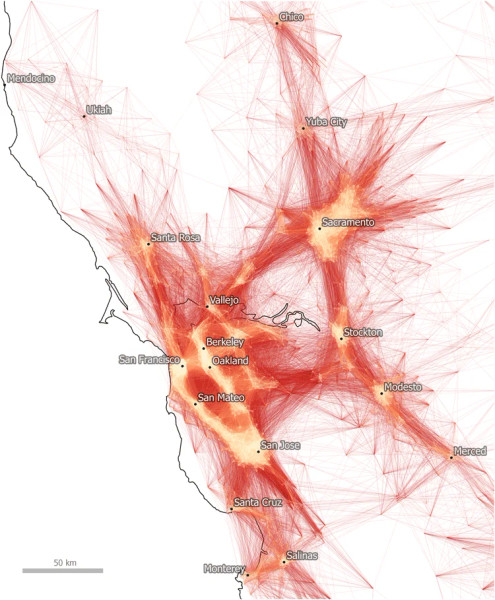
Regional commuting patterns in Northern California
This kind of regional map helps show why scale matters. Daily movement connects the Bay Area, Sacramento, Stockton, Modesto, and nearby cities across one wider urban system. So every policy has to be judged by one question: does it match the scale of the problem and actually reduce it without creating a new problem somewhere else?
Major Urban Sustainability Challenges
Suburban sprawl
Sprawl is low-density growth spreading outward onto rural or undeveloped land. It is different from compact growth inside the city.
- Causes include cheaper land at the fringe, highways, car ownership, single-use zoning, and demand for large-lot housing.
- Effects include automobile dependence, longer commutes, more fossil-fuel use, greenhouse gas emissions, air pollution, impervious surfaces, habitat fragmentation, farmland loss, and higher infrastructure costs.
Visual clues often show up on maps or photos as cul-de-sacs, subdivisions, strip malls, edge cities, and giant parking lots. This aerial view highlights the first two especially clearly.
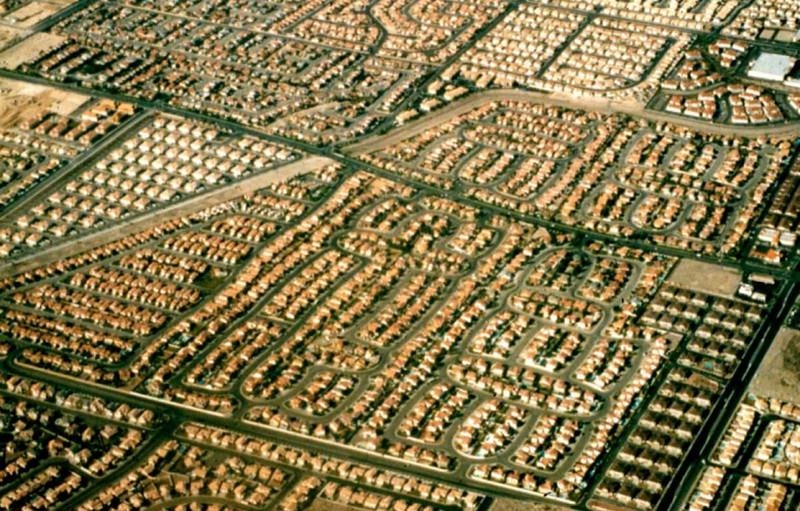
Suburban sprawl
Sanitation and waste
Sanitation means safe collection and treatment of sewage, wastewater, stormwater, and solid waste.
- Problems happen when rapid growth overwhelms sewer systems or when informal settlements lack service.
- Common issues include untreated sewage, blocked drains, open burning, and combined sewer overflows during heavy rain.
- Effects include water contamination, waterborne disease, flooding, and dirty air.
Air and water quality
Cities pollute air through vehicles, industry, power generation, construction, and waste burning.
Major air pollutants to know:
- Particulate matter
- Nitrogen oxides
- Sulfur dioxide
- Carbon monoxide
- Ground-level ozone
Los Angeles and Mexico City are standard examples because basin topography and inversions can trap smog.
Water pollution comes from sewage, industrial discharge, landfill leakage, and stormwater runoff carrying oil, metals, sediment, fertilizers, and plastics. The watershed idea matters a lot here. Upstream actions affect downstream places.
Climate change, ecological footprints, and energy use
Cities contribute to climate change through transportation, electricity, heating and cooling, industry, and consumption. The urban heat island is related but separate. It is extra heat caused by pavement, dark surfaces, dense buildings, and low vegetation.
An ecological footprint is the land and water needed to supply resources and absorb waste. A city’s footprint is far larger than its built area.
Urban form matters:
- Sprawl raises transportation energy use.
- Compact development can lower per-capita energy demand.
Main Policy Responses
Regional planning
Regional planning coordinates land use, transportation, housing, water, sewer, and environmental protection across jurisdictions. It works best for commuting regions, airsheds, and watersheds. Standard example: Portland Metro, Oregon.
Brownfield remediation and redevelopment
A brownfield is previously developed industrial or commercial land with actual or possible contamination.
- Investigate former site uses
- Test contamination
- Clean up, remove, cap, or contain pollutants
- Reuse the site
This helps by reusing inner-city land, reducing greenfield development, restoring tax base, and cutting pollution. Standard example: Lower Lea Valley and London 2012 Olympic Park.
Urban growth boundaries
An urban growth boundary is a legal line limiting outward expansion and pushing growth inward through infill and compact development. It works best when enforced region-wide through zoning and infrastructure policy. Standard example: Portland.
Farmland protection policies
These protect farmland near cities from being converted to development.
| Tool | What it does |
|---|---|
| Agricultural zoning | Limits nonfarm development |
| Conservation easements | Permanently restrict development |
| Purchase of development rights | Pays owners to give up development rights |
| Transfer of development rights | Shifts growth to designated areas |
| Agricultural-use tax assessment | Taxes land as farmland, not future development land |
Standard example: British Columbia Agricultural Land Reserve.
When These Responses Are Effective
Policies work best under specific conditions:
- Regional planning needs legal authority, funding, and cooperation. It is weak if suburbs can ignore it.
- Brownfield redevelopment needs cleanup money, clear liability rules, transit access, and community participation. Limits include high costs and possible gentrification.
- Urban growth boundaries need enough housing and transit inside the boundary. Limits include higher housing prices and leapfrog development beyond the regulated area.
- Farmland protection works best when land is protected in large connected areas and growth is redirected elsewhere.
The biggest pattern is that no single policy solves urban sustainability by itself.
How to Evaluate a Policy on the Exam
- Identify the challenge first. Is it sprawl, sanitation, pollution, climate risk, ecological footprint, or energy use?
- Match the response to the scale. Some problems are citywide, some are metro-wide, and some follow the watershed.
- State the main benefit clearly. Less sprawl, cleaner land, protected farmland, lower infrastructure costs, more compact growth.
- Add the trade-off or condition. Think enforcement, funding, affordability, displacement, or problem shifting.
A strong AP-style conclusion sounds like this: a policy is effective if implemented regionally and paired with housing, transit, and infrastructure, and less effective if governance is fragmented, underfunded, or inequitable.
Key Takeaways
Urban Sustainability
A city and its metropolitan region meeting present social and economic needs while conserving resources, maintaining environmental quality, and preserving future generations’ ability to meet their needs
Suburban Sprawl
Low-density outward expansion of urban development across formerly rural, agricultural, or undeveloped land, usually with separated land uses and automobile dependence
Urban Sanitation
The safe collection, treatment, and disposal of human waste, wastewater, solid waste, and stormwater
Urban Heat-Island Effect
The higher temperatures of urban areas compared with nearby rural areas because of dark and dense built surfaces, limited vegetation, and waste heat
Climate-Change Mitigation vs. Adaptation
Mitigation reduces the causes of climate change; adaptation reduces vulnerability to its effects
Ecological Footprint
The biologically productive land and water needed to supply a population’s consumed resources and absorb its wastes under prevailing technology
Regional Planning
Coordination of land use, transportation, housing, infrastructure, environmental protection, and development across multiple metropolitan jurisdictions
Brownfield
A former or underused industrial or commercial property whose reuse is complicated by actual or possible contamination
Brownfield Remediation
Assessment, containment, removal, or treatment of contamination so that a brownfield can be safely reused
Brownfield Redevelopment
Returning a brownfield to productive use after addressing its contamination, thereby reusing urban land and infrastructure instead of peripheral land
Greenfield
Previously undeveloped land, often agricultural or natural land, that may be converted to urban development
Urban Growth Boundary
A legally established line inside which urban development is permitted or encouraged and outside which it is restricted
Farmland Protection Policies
Policies intended to prevent agricultural land near cities from being converted to residential, commercial, or industrial development
Notes
Urban Sustainability
A city and its metropolitan region meeting present social and economic needs while conserving resources, maintaining environmental quality, and preserving future generations’ ability to meet their needs
Suburban Sprawl
Low-density outward expansion of urban development across formerly rural, agricultural, or undeveloped land, usually with separated land uses and automobile dependence
Urban Sanitation
The safe collection, treatment, and disposal of human waste, wastewater, solid waste, and stormwater
Urban Heat-Island Effect
The higher temperatures of urban areas compared with nearby rural areas because of dark and dense built surfaces, limited vegetation, and waste heat
Climate-Change Mitigation vs. Adaptation
Mitigation reduces the causes of climate change; adaptation reduces vulnerability to its effects
Ecological Footprint
The biologically productive land and water needed to supply a population’s consumed resources and absorb its wastes under prevailing technology
Regional Planning
Coordination of land use, transportation, housing, infrastructure, environmental protection, and development across multiple metropolitan jurisdictions
Brownfield
A former or underused industrial or commercial property whose reuse is complicated by actual or possible contamination
Brownfield Remediation
Assessment, containment, removal, or treatment of contamination so that a brownfield can be safely reused
Brownfield Redevelopment
Returning a brownfield to productive use after addressing its contamination, thereby reusing urban land and infrastructure instead of peripheral land
Greenfield
Previously undeveloped land, often agricultural or natural land, that may be converted to urban development
Urban Growth Boundary
A legally established line inside which urban development is permitted or encouraged and outside which it is restricted
Farmland Protection Policies
Policies intended to prevent agricultural land near cities from being converted to residential, commercial, or industrial development
