Topic 3.4 Notes – Types of Diffusion
What Cultural Diffusion Is
Diffusion means the spread of a cultural trait, idea, practice, technology, or innovation across space over time. A trait can be a religion, food, slang word, music style, farming method, or business model.
A cultural hearth is the place where that trait begins. What matters here is the path from hearth to new places.
There are two broad types:
- Relocation diffusion: people move and bring the trait with them.
- Expansion diffusion: the trait spreads outward from the hearth as more people adopt it.
This basic diagram is a quick way to picture that difference before you get into the specific types of expansion diffusion.
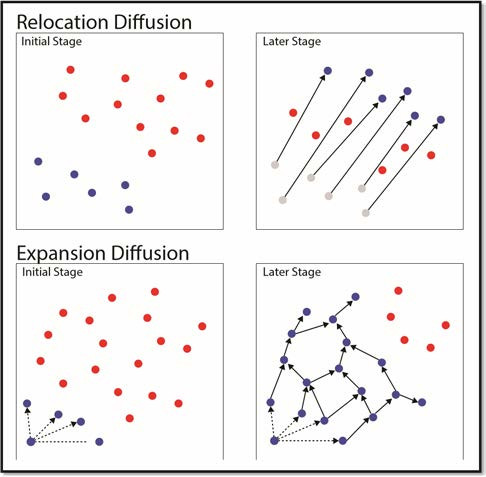
Relocation diffusion and expansion diffusion
Expansion has three forms:
- Contagious diffusion
- Hierarchical diffusion
- Stimulus diffusion
The exam loves this distinction. The same cultural trait can spread by more than one type depending on the stage. You identify the process from evidence like migration, direct contact, ranked adoption, or adaptation.
The Four Diffusion Types
Relocation diffusion
Relocation diffusion happens when people physically move and carry traits with them. Migration is the mechanism, whether voluntary or forced.
- The trait gets established in the destination because the carriers moved there.
- The source does not have to keep growing. It can stay the same or even decline. That is not what defines relocation.
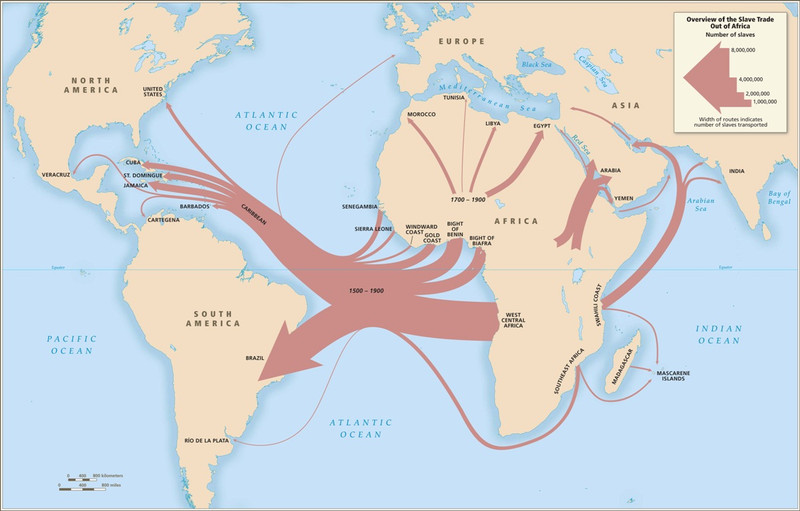
- Standard example: the Atlantic African diaspora carried language elements, foods, religious practices, and musical traditions to the Americas.
This map highlights that forced movement pattern out of Africa and into the Americas.
Map clue:
- arrows between origin and destination
- separated clusters linked to migration streams
Slave trade routes out of Africa
Contagious diffusion
Contagious diffusion is rapid spread through direct contact between neighboring people or places. It works like peer-to-peer transmission.
- No formal rank or status system controls it.
- It often spreads outward in waves from a hearth.
- Distance decay matters here. Nearby places usually adopt first.
Examples:
- slang
- rumors
- songs
- religious beliefs
- disease as an analogy for pattern
Hierarchical diffusion
Hierarchical diffusion moves through influential people, institutions, or places. Adoption follows rank, power, prestige, or city importance.
- It often leapfrogs over nearby places.
- Major cities may adopt first, then smaller cities later.
- It can be top-down or bottom-up, as long as a hierarchy is involved.
Examples:
- fashion spreading from Paris, Milan, London, or New York
- celebrity or influencer trends
- policies spreading through government levels
Stimulus diffusion
Stimulus diffusion happens when the core idea spreads, but the trait changes form. The receiving culture adapts it to fit local beliefs, resources, laws, or environment.
- The key word is adaptation.
- The idea stays recognizable, but the exact version changes.
Standard example:
- McDonald’s in India keeps the fast-food chain model but changes menu items, such as the McAloo Tikki, to fit local culture.
How to Tell the Types Apart
Here’s the cleanest way to separate them:
| Type | What to look for |
|---|---|
| Relocation | People physically moved the trait |
| Contagious | Neighboring spread, direct contact, outward wave |
| Hierarchical | Major cities, elites, institutions, celebrities adopt first |
| Stimulus | Clear modification with the core idea still present |
Important warnings:
- Fast spread alone does not prove contagious diffusion. If celebrities or major cities drive it, that points to hierarchical.
- Finding the same trait in two places does not prove any one type by itself.
How Diffusion Types Can Work Together
One trait often spreads in stages.
- Migrants introduce it through relocation diffusion.
- Neighbors copy it through contagious diffusion.
- Big cities or influential figures spread it wider through hierarchical diffusion.
- Local cultures reshape it through stimulus diffusion.
Scale matters too.
- Local spread may look contagious.
- Across a country’s city system, it may look hierarchical.
- Across countries, the original transfer may be relocation.
That’s a common AP move. You label the specific stage described, not the entire history of the trait.
Why This Matters on the Test
Most questions want you to classify the mechanism.
Watch for evidence words:
- carried, migrated, transported = relocation
- neighboring, direct contact, wave = contagious
- influential, major city, rank, celebrity = hierarchical
- adapted, modified, local version = stimulus
Strong answers explain why one fits the evidence. You may briefly rule out another if the prompt makes confusion likely.
Key Takeaways
Cultural Diffusion (Diffusion)
The spread of a cultural trait, idea, practice, technology, or innovation among people and across space over time
Cultural Hearth
The place or area from which a cultural trait originates and begins to spread
Relocation Diffusion
The spread of a cultural trait when people move and establish the trait in a new location
Expansion Diffusion
The outward spread of a trait to additional people or places while it continues to exist at its source
Contagious Diffusion
Rapid, widespread expansion through direct contact among individuals or neighboring places without following a formal hierarchy
Hierarchical Diffusion
Expansion through an ordered network, with adoption following levels of influence, power, prestige, authority, or connectivity rather than proximity
Stimulus Diffusion
Expansion in which an underlying idea spreads but adopters modify its specific form to fit local cultural or environmental conditions
Notes
Cultural Diffusion (Diffusion)
The spread of a cultural trait, idea, practice, technology, or innovation among people and across space over time
Cultural Hearth
The place or area from which a cultural trait originates and begins to spread
Relocation Diffusion
The spread of a cultural trait when people move and establish the trait in a new location
Expansion Diffusion
The outward spread of a trait to additional people or places while it continues to exist at its source
Contagious Diffusion
Rapid, widespread expansion through direct contact among individuals or neighboring places without following a formal hierarchy
Hierarchical Diffusion
Expansion through an ordered network, with adoption following levels of influence, power, prestige, authority, or connectivity rather than proximity
Stimulus Diffusion
Expansion in which an underlying idea spreads but adopters modify its specific form to fit local cultural or environmental conditions
