Topic 2.6 Notes – Malthusian Theory
What Malthusian Theory Is
Thomas Robert Malthus was a British scholar who published An Essay on the Principle of Population in 1798. He was trying to explain population growth by linking it to food supply.
Population change comes from fertility, mortality, and migration, but Malthus mainly focused on births, deaths, and food. His core claim was that population has the ability to grow faster than the food needed to support it.
- Population growth is geometric or exponential. It multiplies like 1, 2, 4, 8, 16.
- Food supply growth is arithmetic or linear. It adds like 1, 2, 3, 4, 5.
That difference is the whole theory. At first the gap is small. Over time, the population curve rises much faster, so population eventually outpaces food production and shortages appear.
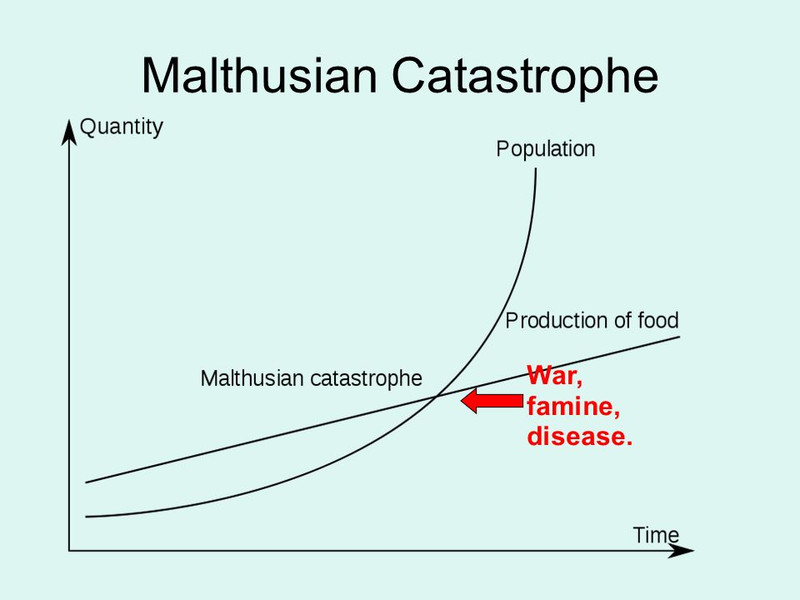
Malthusian catastrophe model
On the graph, the key moment is where the population curve crosses above the food line. Malthus argued that this is when checks like famine, disease, and war push population back down.
This is why AP questions use Malthus as a population-resource theory, not just a statement that “there are too many people.”
Carrying Capacity, Overpopulation, and the Malthusian Trap
Malthus’s idea leads straight into carrying capacity, which means the largest population an environment can support over time with available resources and technology.
A common mistake is mixing this up with density.
- A place can be dense and still have high carrying capacity if it has strong agriculture, infrastructure, trade, and technology.
- A place can have a smaller population and still be overpopulated if demand is greater than what the environment can sustain.
The Malthusian trap explains why gains may not last:
- Food supply improves.
- Living standards rise for a while.
- Population grows in response.
- Resources per person fall back toward subsistence.
A severe version is a Malthusian catastrophe or crisis. That means famine, disease, conflict, and mass death after resource shortages become extreme.
Carrying capacity can also change.
- It rises with technology, trade, and agricultural intensification.
- It falls with drought, soil loss, farmland loss, environmental degradation, and climate stress.
Checks on Population Growth
Malthus said population gets restrained by two kinds of checks.
Preventive checks
These reduce birth rates before a crisis happens.
- Malthus’s own examples were delayed marriage, celibacy, and moral restraint.
- Modern discussions may include contraception and family planning, though those fit better with neo-Malthusian thinking than with original Malthus.
The AP contrast is simple. Preventive checks lower fertility.
Positive checks
These raise death rates after pressure on resources gets worse.
- Famine and malnutrition
- Epidemics and disease
- Warfare
- Disasters worsened by poverty
The causal chain matters:
- Rapid population growth
- Less food per person
- More malnutrition and competition
- More disease and conflict
- Higher mortality
The AP trap here is the word “positive.” It does not mean good. It means added to mortality.
Why Malthus Was Criticized
Malthus correctly raised the population-resource problem, but many of his predictions did not happen the way he expected.
Agricultural and technological change
Food production rose much faster than Malthus predicted because of mechanization, fertilizers, pesticides, irrigation, refrigeration, and transportation.
A huge example is the Green Revolution, which increased crop yields in parts of Asia and Latin America.
Demographic transition
Malthus did not predict that birth rates would fall as societies urbanize and develop.
Lower fertility often comes from:
- women’s education
- contraception
- lower infant mortality
- urban living
- higher cost of children
Population growth can slow without famine or war.
Trade, transportation, and migration
Places do not have to depend only on local food. Imports, exports, and migration can reduce local population pressure.
Distribution and access
Famines can happen even when food exists overall, because people cannot access it.
The Great Irish Famine shows this. Potato blight caused crop failure, but poverty, unequal landholding, British policy, and weak relief made mortality much worse. That case partly fits Malthus, but it also shows that access and politics matter.
Other Theories You Compare to Malthus
- Neo-Malthusian theory updates Malthus for the modern world. It worries about food, water, energy, land, pollution, and biodiversity. A famous example is Paul Ehrlich’s The Population Bomb.
- Boserup’s population-pressure theory says population growth can push people to innovate and intensify agriculture. Examples include irrigation, terracing, multiple cropping, fertilizer, and high-yield seeds.
- Cornucopian theory says human creativity, technology, markets, and substitution can expand effective resources and solve scarcity.
In FRQs, the difference is sharp:
- Malthusian answer = growth outpaces resources
- Boserupian answer = growth drives intensification
- Cornucopian answer = innovation and markets solve scarcity
Key Takeaways
Thomas Robert Malthus
British economist and clergyman who published An Essay on the Principle of Population in 1798 and developed Malthusian theory
Malthusian Theory
Population can grow faster than food production, eventually causing shortages and increased mortality unless fertility declines
Geometric (Exponential) Population Growth vs. Arithmetic (Linear) Food Growth
Population compounds by a constant proportion, while food increases by equal amounts, causing population eventually to outpace food supply
Carrying Capacity
The largest population an environment can support over time with its available resources and technology
Malthusian Trap
The cycle in which increased food production encourages population growth that absorbs the gain and returns living standards toward subsistence
Malthusian Catastrophe (Malthusian Crisis)
A severe adjustment through mass hunger, disease, and death after population exceeds its resource base
Overpopulation
A condition in which a population’s demands exceed the sustainable capacity of its environment and resource system
Preventive Checks
Checks that lower fertility before severe shortages, such as delayed marriage, celibacy, moral restraint, or voluntary family-size limitation
Positive Checks
Checks that increase mortality, including famine, disease, warfare, and disasters worsened by poverty or inadequate resources
Neo-Malthusian Theory
A modern extension of Malthus that links population and consumption to finite food, water, energy, land, and environmental capacity
Boserup’s Population-Pressure Theory
Ester Boserup’s theory that population pressure stimulates agricultural innovation and intensification, expanding food production and carrying capacity
Agricultural Intensification
Increasing production from a given area of land by adding labor, technology, capital, or more frequent cultivation
Cornucopian Theory (Cornucopianism)
The view that creativity, technology, markets, conservation, and resource substitution can expand effective resources and postpone scarcity
Notes
Thomas Robert Malthus
British economist and clergyman who published An Essay on the Principle of Population in 1798 and developed Malthusian theory
Malthusian Theory
Population can grow faster than food production, eventually causing shortages and increased mortality unless fertility declines
Geometric (Exponential) Population Growth vs. Arithmetic (Linear) Food Growth
Population compounds by a constant proportion, while food increases by equal amounts, causing population eventually to outpace food supply
Carrying Capacity
The largest population an environment can support over time with its available resources and technology
Malthusian Trap
The cycle in which increased food production encourages population growth that absorbs the gain and returns living standards toward subsistence
Malthusian Catastrophe (Malthusian Crisis)
A severe adjustment through mass hunger, disease, and death after population exceeds its resource base
Overpopulation
A condition in which a population’s demands exceed the sustainable capacity of its environment and resource system
Preventive Checks
Checks that lower fertility before severe shortages, such as delayed marriage, celibacy, moral restraint, or voluntary family-size limitation
Positive Checks
Checks that increase mortality, including famine, disease, warfare, and disasters worsened by poverty or inadequate resources
Neo-Malthusian Theory
A modern extension of Malthus that links population and consumption to finite food, water, energy, land, and environmental capacity
Boserup’s Population-Pressure Theory
Ester Boserup’s theory that population pressure stimulates agricultural innovation and intensification, expanding food production and carrying capacity
Agricultural Intensification
Increasing production from a given area of land by adding labor, technology, capital, or more frequent cultivation
Cornucopian Theory (Cornucopianism)
The view that creativity, technology, markets, conservation, and resource substitution can expand effective resources and postpone scarcity
