Topic 4.10 Notes – Consequences of Centrifugal and Centripetal Forces
What Centripetal and Centrifugal Forces Are
At this scale, you’re judging effects on territorial unity, sovereignty, and loyalty to the central government.
- A centripetal force pulls people toward the state. It builds cohesion, legitimacy, cooperation, and stability.
- A centrifugal force pulls people away from the state. It deepens division, separatism, regionalism, and weak loyalty to the center.
The key AP move is explaining the mechanism. Language, religion, ethnicity, infrastructure, and government policy are not automatically one or the other. They depend on who feels included, who feels excluded, and at what scale.
A cross-border Kurdish population is a classic example of how the same identity can unify one group and divide several states.
- Kurdish identity is centripetal for Kurds as a nation, but centrifugal inside Turkey, Iraq, Iran, and Syria.
- Flemish identity unites Flanders, but divides Belgium.
Where the Forces Come From
These forces usually work through culture, politics, economics, and geography all at once.
Cultural forces
Shared language, religion, history, symbols, sports, holidays, and schools can make people feel like one political community. That is centripetal.
- Tanzania is the classic example. Swahili works as a lingua franca across many ethnic groups, so it strengthens national identity.
- Official language policies can turn centrifugal if minority languages are pushed aside. People may read that as exclusion, not unity.
Political forces
Government matters because people stay loyal when institutions feel legitimate and fair.
- Centripetal political forces include fair representation, security, functioning institutions, and sometimes federalism or devolution if they reduce conflict.
- Centrifugal political forces include corruption, repression, disputed elections, weak institutions, militias, and strong regional loyalties.
Belgium
Belgium shows both at once.
- Centrifugal because Dutch-speaking Flanders and French-speaking Wallonia have strong linguistic and regional identities.
- Centripetal because devolution/federalism gives regions power and keeps the state together.
The map highlights Belgium’s regional structure, including Brussels between the larger Dutch-speaking and French-speaking areas.
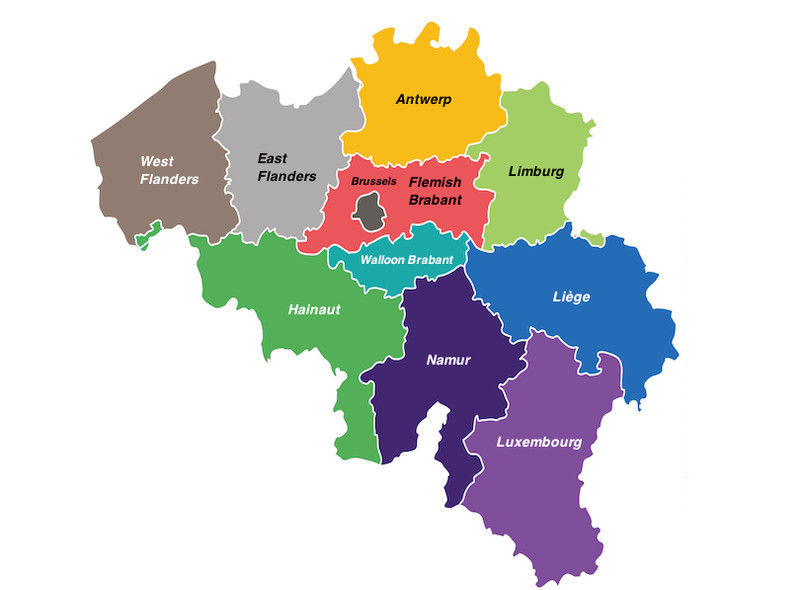
Belgium’s regions and provinces
Economic and infrastructure forces
Economic ties can bind regions together.
- Centripetal when trade, jobs, redistribution, roads, and services are shared broadly across regions.
- Centrifugal when development is uneven, peripheral regions are neglected, or wealthy regions resist sending tax money elsewhere.
- Canada shows how transportation, communication, and fiscal support help integrate provinces spread over huge distances.
Spatial and external forces
Distance and terrain shape how easy it is to govern.
- Mountains, islands, long distances, and fragmented territory can isolate peripheral regions and strengthen division.
- Roads, railways, and communication networks can reduce that isolation.
- External threats can unify a state, but outside support for separatists can intensify fragmentation.
Consequences of Centrifugal Forces
Failed states
A failed state has a central government that cannot control territory or provide basics like security, law, taxes, borders, and services. This is not the same as poverty or authoritarian rule.
- Standard example: Somalia after 1991, after Siad Barre’s collapse.
Uneven development
Regional inequality becomes centrifugal when people see it as favoritism or neglect.
- It can involve poor peripheral regions demanding change.
- It can also involve wealthy regions wanting more autonomy so they keep more of their wealth.
- This gets strongest when economic inequality overlaps with ethnic, linguistic, or religious regions.
Stateless nations
A stateless nation is a nation without its own sovereign state.
- Standard example: Kurds
- Don’t mix this up with a failed state. A stateless nation lacks a state of its own. A failed state has a state, but the government is weak.
Ethnic nationalist movements
These happen when an ethnic group claims nationhood and seeks rights, autonomy, devolution, secession, or irredentism. They do not have to be violent. Elections and referendums count too.
Consequences of Centripetal Forces
Ethnonationalism and national identity
Shared ethnicity, language, ancestry, or history can unify a state if most people identify with that nation. Civic nationalism can do the same through shared laws, institutions, and citizenship.
More equitable infrastructure development
When roads, schools, hospitals, electricity, water, and communications reach many regions, peripheries connect to markets and the state feels present. Infrastructure only works as centripetal when benefits are broadly shared.
Increased cultural cohesion
Common language, media, education, symbols, ceremonies, and institutions build a shared sense of membership. Cohesion does not require everyone to be culturally identical.
How to Explain It on the Exam
- Identify the force or condition.
- Name the group or region affected.
- Explain the mechanism using inclusion, exclusion, inequality, isolation, representation, or shared identity.
- State whether attachment to the state gets stronger or weaker.
- Connect it to a consequence.
A common map pattern is a distinct group concentrated in one region. That spatial clustering can support centrifugal pressure. If the same region is also underdeveloped, you can explain how uneven development may fuel resentment or separatism.
Key Takeaways
Centripetal Force
A process that strengthens identification with the state, increases cooperation, and helps hold the state together
Centrifugal Force
A process that weakens identification with the state, intensifies internal divisions, and may pull the state apart
Failed State / State Failure
A sovereign state whose central government cannot exercise effective authority over much of its territory or perform essential functions
Uneven Development
The unequal distribution of wealth, employment, infrastructure, investment, and public services among regions
Stateless Nation
A nation with a shared identity and homeland that does not possess an independent sovereign state of its own
Ethnic Nationalist Movement / Ethnonationalist Movement
A political movement claiming that an ethnic group constitutes a nation and should receive recognition, autonomy, territorial control, or statehood
Ethnonationalism
National belonging based on shared ethnicity, ancestry, language, history, or cultural tradition
Civic Nationalism
National belonging based on common citizenship, laws, institutions, and political values rather than primarily on ethnicity
More Equitable Infrastructure Development
The broader regional distribution of infrastructure and public services, reducing disparities and connecting peripheral populations to the state
Cultural Cohesion
The degree to which people share practices, institutions, symbols, and membership in the same political community
Notes
Centripetal Force
A process that strengthens identification with the state, increases cooperation, and helps hold the state together
Centrifugal Force
A process that weakens identification with the state, intensifies internal divisions, and may pull the state apart
Failed State / State Failure
A sovereign state whose central government cannot exercise effective authority over much of its territory or perform essential functions
Uneven Development
The unequal distribution of wealth, employment, infrastructure, investment, and public services among regions
Stateless Nation
A nation with a shared identity and homeland that does not possess an independent sovereign state of its own
Ethnic Nationalist Movement / Ethnonationalist Movement
A political movement claiming that an ethnic group constitutes a nation and should receive recognition, autonomy, territorial control, or statehood
Ethnonationalism
National belonging based on shared ethnicity, ancestry, language, history, or cultural tradition
Civic Nationalism
National belonging based on common citizenship, laws, institutions, and political values rather than primarily on ethnicity
More Equitable Infrastructure Development
The broader regional distribution of infrastructure and public services, reducing disparities and connecting peripheral populations to the state
Cultural Cohesion
The degree to which people share practices, institutions, symbols, and membership in the same political community
