Topic 6.2 Notes – Cities Across the World
What Urbanization and Suburbanization Are
Urbanization means an increasing percentage of a country’s population lives in urban areas. Urban growth means the number of urban residents gets bigger. A country can have urban growth without much urbanization if it was already highly urban.
Suburbanization is the outward movement of people and development from the central city into surrounding areas. That includes:
- homes
- jobs
- shopping
- schools
- hospitals
- other services
The central city and CBD used to be the main focus of jobs and services in a metro area. As metropolitan areas grow, that dominance often weakens.
Here’s the process chain APHG wants you to see:
- Urbanization enlarges cities.
- Suburbanization pushes growth outward.
- Decentralization shifts jobs and services away from downtown.
- Sprawl and new land-use patterns appear.
That last step matters a lot on tests. You usually need to connect the process to the map pattern or landscape, not just define the word.
Very Large Cities Around the World
These very large urban centers are not spread evenly across the world. The biggest clusters appear in Asia, with additional concentrations in Latin America, Africa, Europe, and North America.
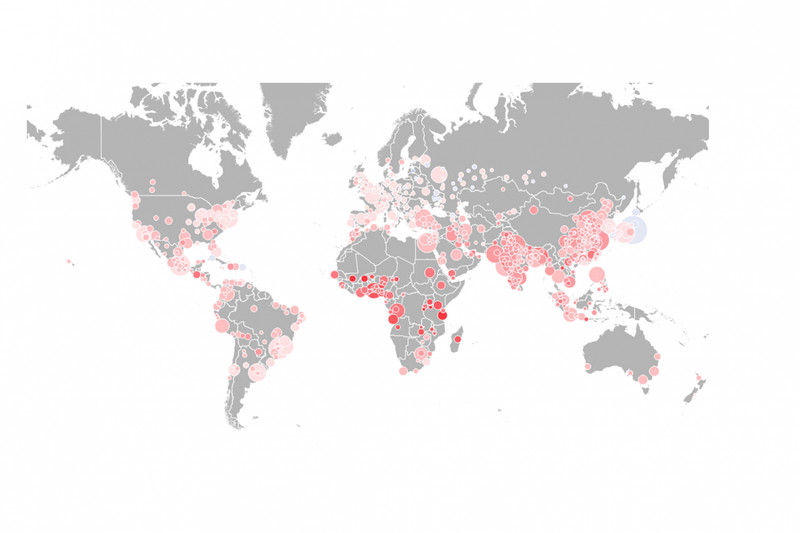
Global distribution of major urban agglomerations
Megacity
A megacity has more than 10 million people in its urban agglomeration. That usually means the built-up urban area or metro area, not just the city proper, because legal boundaries vary a lot.
- Standard examples: Mumbai, São Paulo, Tokyo
- A city’s ranking can change depending on whether a source uses city proper, built-up area, or metro area
Metacity
A metacity has more than 20 million people.
- Every metacity is also a megacity
- Most megacities are not metacities
- Standard examples: Delhi and Tokyo
Where they are concentrated and why
On the map, the densest clusters are in East, South, and Southeast Asia. Today, the fastest growth of giant cities is concentrated in the semiperiphery and periphery, especially Asia, plus parts of Latin America and Africa. Earlier major-city growth centered more in Europe, North America, and Japan.
Why they grow:
- Rural-to-urban migration brings people seeking jobs, schools, health care, and safety
- Natural increase adds population when births exceed deaths
- Demographic momentum keeps growth going because many residents are young
- Economic restructuring concentrates manufacturing and services in major metros
- Transportation and communication links connect cities to markets
- Government investment and political centralization pull institutions and jobs into major cities
Why they matter
Huge cities create agglomeration benefits such as large labor pools, specialized services, and major transportation hubs. They can also face infrastructure deficits when housing, sanitation, water, and transit do not keep up, leading to congestion, overcrowding, pollution, and unequal access.
Outward Metropolitan Growth
As giant cities expand, growth often shifts outward inside the metro area.
Decentralization
Decentralization is the redistribution of people, jobs, commerce, and services away from the traditional CBD into multiple nodes. This creates a polycentric metro area.
- commuting becomes suburb-to-suburb, not only suburb-to-downtown
- driven by highways, cars, logistics networks, and telecommunications
Urban sprawl
Urban sprawl is low-density, dispersed, automobile-dependent outward growth onto rural land.
The image below shows a classic sprawl pattern with curving streets, cul-de-sacs, and separated subdivisions spreading across the metropolitan fringe.
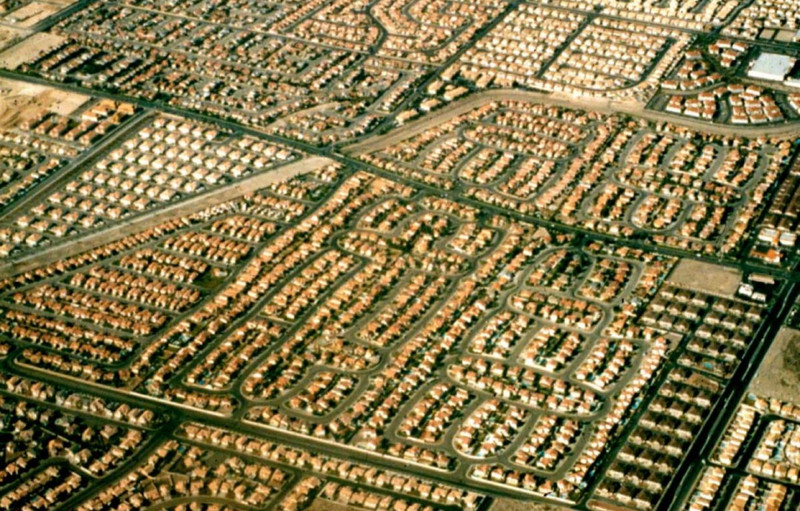
Low-density suburban sprawl
Not all suburbanization is sprawl. A compact rail-based suburb is suburban, but it is not sprawling.
Key traits:
- separated land uses
- leapfrog development
- cul-de-sacs
- large lots
- shopping strips
- parking lots
Causes and effects:
| Causes | Effects |
|---|---|
| cheap fringe land, highways, zoning, minimum lot sizes, parking requirements, fragmented local governments | farmland loss, habitat fragmentation, traffic, air pollution, greenhouse emissions, expensive infrastructure, weak transit viability |
Edge Cities, Exurbs, and Boomburbs
These are all products of suburbanization and decentralization, but each has a different pattern.
Edge cities
Edge cities are major suburban concentrations of offices, retail, services, and entertainment, often at highway intersections. They act like secondary business districts.
- standard example: Tysons, Virginia
- clue: job and shopping node outside downtown
Exurbs
Exurbs are low-density residential communities beyond the continuously built-up suburbs, but still tied to the metro area by commuting.
- semi-rural landscape
- large lots and scattered subdivisions
- clue: outer commuter zone
Boomburbs
Boomburbs are large, fast-growing suburban municipalities with big populations but suburban form and no dominant historic downtown.
- standard example: Mesa, Arizona
- clue: an entire suburban city grew rapidly
Comparing Cities Across Space and Time
In core countries, suburbanization often took off after mass car ownership and slower central-city growth. In the semiperiphery and periphery, urbanization and suburbanization often happen at the same time that total metro populations are still growing fast.
Categories can also change over time:
- an exurb can become a suburb
- a highway interchange can become an edge city
- a suburb can become a boomburb
The biggest global pattern to lock in is this: the fastest current growth of megacities and metacities is outside the traditional core.
Key Takeaways
Urbanization vs. Urban Growth
Urbanization increases the percentage of a population living in urban places; urban growth increases the absolute number of urban residents
Megacity
An urban agglomeration with more than 10 million people
Metacity
An urban agglomeration with more than 20 million people; every metacity is also a megacity
Suburbanization
The outward movement of population and development from a central city and the resulting growth of surrounding suburban areas
Decentralization
The redistribution of people, employment, commerce, and services from the central city toward multiple locations across the metropolitan region
Urban Sprawl
Rapid outward expansion of low-density, dispersed, usually automobile-dependent development onto rural land at the urban fringe
Edge City
A major peripheral concentration of employment, shopping, services, and entertainment, usually located near major highway intersections
Exurb
A low-density, semi-rural residential community beyond the continuously built-up suburbs but economically and socially tied to the metropolitan area
Boomburb
A large, rapidly growing suburban city with a predominantly suburban form and usually no dense, dominant downtown
Notes
Urbanization vs. Urban Growth
Urbanization increases the percentage of a population living in urban places; urban growth increases the absolute number of urban residents
Megacity
An urban agglomeration with more than 10 million people
Metacity
An urban agglomeration with more than 20 million people; every metacity is also a megacity
Suburbanization
The outward movement of population and development from a central city and the resulting growth of surrounding suburban areas
Decentralization
The redistribution of people, employment, commerce, and services from the central city toward multiple locations across the metropolitan region
Urban Sprawl
Rapid outward expansion of low-density, dispersed, usually automobile-dependent development onto rural land at the urban fringe
Edge City
A major peripheral concentration of employment, shopping, services, and entertainment, usually located near major highway intersections
Exurb
A low-density, semi-rural residential community beyond the continuously built-up suburbs but economically and socially tied to the metropolitan area
Boomburb
A large, rapidly growing suburban city with a predominantly suburban form and usually no dense, dominant downtown
