Topic 7.1 Notes – The Industrial Revolution
What the Industrial Revolution Was
Before factories, most goods were made through the cottage industry or domestic system. That meant artisans or families made goods by hand at home, often using raw materials supplied by merchants. Production was slow, scattered, and limited by human labor.
The big change was the factory system. Workers, machines, energy, and managers were brought together in one place. That let owners supervise labor closely, divide tasks into smaller steps, and produce far more goods.
- Mechanization meant machines replaced much hand labor.
- Division of labor meant each worker did one specialized task instead of making the whole product.
- This made mass production possible, so factories could turn out large amounts of standardized goods.
One term students mix up a lot:
| Term | Meaning |
|---|---|
| Industrial Revolution | The original historical turning point that began in Britain |
| Industrialization | The broader process of factory-based manufacturing spreading to other places |
Industrialization eventually raised living standards in many places, but the gains were uneven and early conditions were often brutal.
Why It Began in Great Britain
Britain industrialized first because it had the full combination of conditions, not one magic cause.
New technologies
Textiles led the way because inventions removed the biggest hand-production bottlenecks. One of the clearest examples is the spinning jenny.
- Spinning jenny, water frame, and power loom sped up spinning and weaving.
- Early mills used waterpower, so they first clustered near rivers and fast streams.
- James Watt’s steam engine made factories less tied to rivers and also helped mining.
- Steamships and railroads cut transport costs and connected factories to wider markets.
- Iron production expanded by using coke from coal. Steel mattered more later in the Second Industrial Revolution, which is related but not the original start.
Natural resources and geography
- Coal was the main early energy source.
- Iron ore supplied machinery, tools, rails, and infrastructure.
- Britain’s rivers, canals, ports, and compact size made moving heavy goods cheaper.
A common AP trap is saying coal caused industrialization by itself. Coal helped a lot, but technology, labor, investment, and markets had to be there too.
Agriculture, labor, and capital
The Second Agricultural Revolution increased food supply through crop rotation, selective breeding, and better tools.
- More food supported population growth.
- The enclosure movement displaced some rural families, pushing them toward wage labor.
- Merchants, banks, and investors supplied capital.
- Britain also had strong domestic and overseas markets.
How Industrialization Spread and Where It Concentrated
Industrialization began in Britain, then diffused unevenly.
- Manchester became a major textile center.
- Liverpool grew as a port tied to Atlantic trade.
- It spread early to Belgium, northern France, German territories like the Ruhr, and the northeastern United States.
- Later it reached Russia and Japan. Japan’s Meiji Restoration is the classic state-led example.
Heavy industry stayed near coal, iron, labor, and transport because moving bulky raw materials was expensive. By 1900, the main industrial core was still northwestern Europe and northeastern North America. This map of U.S. manufacturing in 1900 gives you a good example of that concentration, especially in the Northeast and around the Great Lakes.
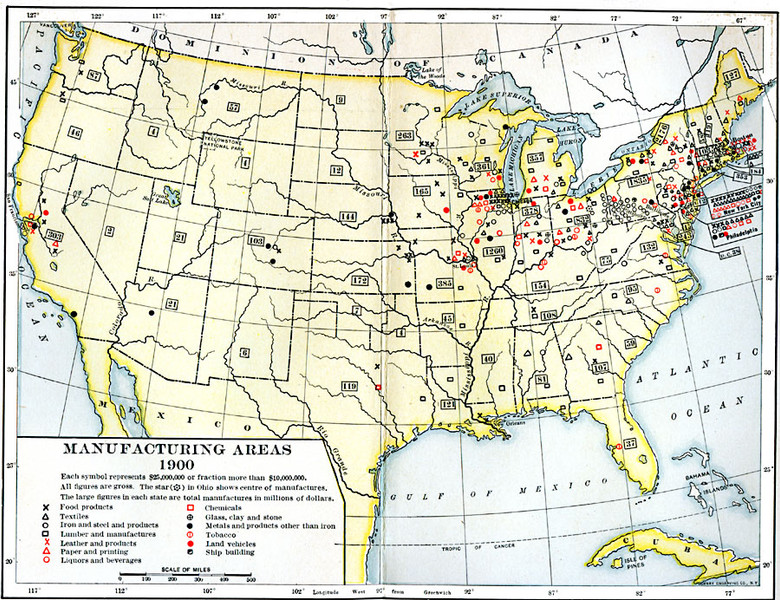
U.S. manufacturing areas, 1900
What Industrialization Changed in Population, Cities, and Class Structure
Industrialization and better agriculture increased food supplies, so mortality declined and population grew. At the same time, factory jobs pulled people into cities, and rural displacement pushed them out of the countryside.
Industrial cities grew around mills, mines, ports, and rail hubs. You can usually spot one by smokestacks, crowded worker housing, warehouses, rail lines, and pollution.
That kind of landscape helps explain why urban life changed so quickly during industrialization.
Class structure changed too:
- Bourgeoisie = factory owners, merchants, investors
- Middle class = managers, engineers, clerks, professionals
- Proletariat = wage workers in factories, mines, and transport
Factory work ran on clocks, supervision, and repetitive tasks. Women and children worked heavily in early industry, especially textiles, often for lower wages. Over time, unions, labor laws, and public-health reforms improved conditions.
Industrialization, Imperialism, and Uneven Development
Industrialization increased the demand for raw materials and markets, which helped drive imperialism.
- Factories produced more goods.
- Manufacturers needed more cotton, rubber, metals, and other inputs.
- Industrial states sought secure supplies and buyers.
- Colonies were reorganized to export raw materials and import manufactured goods.
The standard case is British textiles. British mills used cotton from the American South, India, and Egypt. In India, British machine-made cloth undercut local hand-textile production while India supplied raw cotton.
Colonial railroads often ran from mines or plantations to ports. That pattern shows an extractive economy built to move resources outward, not to develop balanced local industry. Steamships, railroads, weapons, and communications also made empires easier to control.
Key Takeaways
Industrial Revolution
The late-1700s transformation, beginning in Great Britain, from agriculture and hand production to machine-powered factories, fossil-fuel energy, and large-scale manufacturing
Industrialization
The growing importance of mechanized manufacturing and the resulting reorganization of labor, settlement, transportation, social classes, and connections between places
Cottage Industry / Domestic System
A preindustrial system in which merchants supplied raw materials to rural households that made goods by hand for later collection and sale
Factory System
A production system that concentrates workers, machinery, energy, and supervision in one location for faster, larger-scale output
Mass Production
The manufacture of large quantities of standardized goods, generally using machinery and a division of labor
Second Industrial Revolution
The later industrial expansion beginning around 1870, associated with steel, electricity, petroleum, chemicals, and internal-combustion technology
Industrial Capitalist Class / Bourgeoisie
Factory owners, major merchants, investors, and business leaders who owned productive property and accumulated profits
Middle Class
Managers, professionals, engineers, clerks, shopkeepers, and other salaried or independent workers whose numbers expanded with industrialization
Industrial Working Class / Proletariat
Workers dependent primarily on wages from factory, mining, transportation, and related industrial labor
Social Stratification
The division of society into ranked groups based on characteristics such as wealth, income, occupation, and power
Colonialism
The establishment and maintenance of political control over another territory and its people, often involving direct administration and economic exploitation
Imperialism
The policy or process by which a state extends political, military, or economic power over other places, with or without direct colonial rule
Geographically Uneven Development
Unequal economic growth among places caused partly by differences in when and how they industrialized or were incorporated into industrial systems
Notes
Industrial Revolution
The late-1700s transformation, beginning in Great Britain, from agriculture and hand production to machine-powered factories, fossil-fuel energy, and large-scale manufacturing
Industrialization
The growing importance of mechanized manufacturing and the resulting reorganization of labor, settlement, transportation, social classes, and connections between places
Cottage Industry / Domestic System
A preindustrial system in which merchants supplied raw materials to rural households that made goods by hand for later collection and sale
Factory System
A production system that concentrates workers, machinery, energy, and supervision in one location for faster, larger-scale output
Mass Production
The manufacture of large quantities of standardized goods, generally using machinery and a division of labor
Second Industrial Revolution
The later industrial expansion beginning around 1870, associated with steel, electricity, petroleum, chemicals, and internal-combustion technology
Industrial Capitalist Class / Bourgeoisie
Factory owners, major merchants, investors, and business leaders who owned productive property and accumulated profits
Middle Class
Managers, professionals, engineers, clerks, shopkeepers, and other salaried or independent workers whose numbers expanded with industrialization
Industrial Working Class / Proletariat
Workers dependent primarily on wages from factory, mining, transportation, and related industrial labor
Social Stratification
The division of society into ranked groups based on characteristics such as wealth, income, occupation, and power
Colonialism
The establishment and maintenance of political control over another territory and its people, often involving direct administration and economic exploitation
Imperialism
The policy or process by which a state extends political, military, or economic power over other places, with or without direct colonial rule
Geographically Uneven Development
Unequal economic growth among places caused partly by differences in when and how they industrialized or were incorporated into industrial systems
