Topic 2.2 Notes – Consequences of Population Distribution
What Population Distribution and Density Do
Distribution means the spatial pattern of people. Density means the number of people in an area. In 2.1, you learned arithmetic, physiological, and agricultural density as measurements. Here, those measurements start to matter because they shape real outcomes.
The key APHG idea is that the same density can create different consequences if the distribution is different. A country can have a low national density but still have very crowded cities.
- Uneven distribution matters as much as density itself because people may cluster in a few places and leave huge areas lightly settled.
- Scale matters because national averages can hide local reality.
Australia is the classic example. On this map, the population is concentrated along the coasts, with especially heavy clustering in the southeast and east.
- Australia has low arithmetic density overall.
- Most Australians live in coastal cities, especially in the southeast and east.
- The interior is very sparsely populated.
- That means coastal cities deal with urban concentration problems, while the interior deals with distance and isolation.
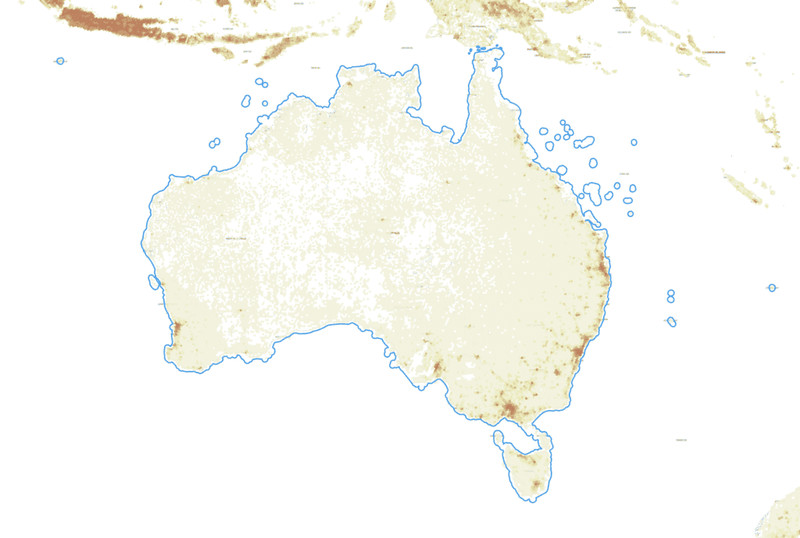
Population distribution in Australia
On the exam, don’t stop at “dense” or “sparse.” You want pattern → mechanism → consequence.
Political, Economic, and Social Consequences
Population patterns shape society because governments, businesses, and communities all respond to where people are.
Political consequences
- Representation often follows population size and location. In the U.S., the Census is used for reapportionment of House seats among states.
- Redistricting happens within states because districts must reflect population shifts.
- Governments also place roads, schools, hospitals, and emergency services based on where people live.
- Sparse regions often cost more per person to serve because facilities are far apart.
- If ethnic, religious, or linguistic groups are territorially clustered, they can gain more political influence in that area.
Economic consequences
Dense areas often produce agglomeration benefits. Firms like being near workers, customers, suppliers, and transport.
- Benefits include:
- Large labor pools
- Large consumer markets
- Easier transport and communication
- A cumulative pull where firms attract workers and workers attract more firms
Dense areas also create costs:
- High land prices
- Congestion
- Long commutes
- Pollution-control costs
- Housing shortages and sometimes unemployment
Sparse areas usually have:
- Smaller labor pools
- Fewer customers
- High infrastructure costs
But low density can still support agriculture, mining, forestry, and energy production, since those need land or resource access more than huge markets.
Social consequences
Dense places can support:
- Hospitals
- Universities
- Transit
- Cultural institutions
- More diverse social interaction
One citywide density number can hide huge neighborhood inequality. Some neighborhoods have strong services; others have overcrowding, sanitation problems, or informal settlements.
A common APHG contrast:
- In dense places, poor medical access often comes from overload
- In sparse places, poor medical access often comes from distance and too few users to support facilities
Provision of Services
Services include medical care, emergency response, education, water, sewer, electricity, communications, and public transportation. Two variables control service delivery: number of users and distance between users.
- Concentrated populations can support specialized hospitals, universities, and mass transit because many users are nearby.
- Compact settlement often lowers per-capita infrastructure cost because networks serve more people in less space.
- If population grows faster than capacity, you get crowded schools, longer wait times, congestion, unreliable utilities, and waste problems.
- Sparse populations face long travel distances, slower emergency response, and high cost per resident.
Australia gives the standard example again. The Royal Flying Doctor Service exists because rural populations are too dispersed for normal hospital access. In places where settlements are spread far apart, even emergency medical care may depend on air service.

Royal Flying Doctor Service in remote Australia
Environmental Consequences and Carrying Capacity
Carrying capacity is the maximum population an environment can support sustainably. Sustainability matters because short-term survival by draining groundwater or degrading soil does not count as long-term support.
Dense or concentrated settlement can intensify:
- Land conversion
- Habitat fragmentation
- Water demand
- Pollution and waste
- Urban heat island effects
- Flood risk
Dense settlement can also reduce per-capita land use and make transit and infrastructure more efficient.
Sparse settlement can still damage environments through roads, pipelines, sprawl, mining, and resource extraction.
Carrying capacity changes with:
- Resource base
- Technology
- Consumption levels
- Infrastructure and governance
- Trade
- Environmental change
Overshoot happens when demand exceeds sustainable support capacity. Results can include shortages, water stress, higher prices, pollution, and out-migration.
Two examples show why density alone is not enough:
- The Netherlands has high density, but trade, technology, and infrastructure help support that population.
- Drylands may face severe pressure even at low density because water is limited.
Physiological density is especially useful here because it shows pressure on arable land, though it is still only an indicator.
How to Explain Consequences on the Exam
Build the explanation in this order:
- Identify the pattern: concentrated, dispersed, dense, sparse, uneven
- Name the mechanism: demand, distance, market size, infrastructure cost, political apportionment, resource pressure
- State the consequence: political, economic, social, environmental
- Add the condition: wealth, planning, technology, governance, consumption, scale
Key Takeaways
Carrying Capacity
The maximum population an environment can support sustainably given its resources, technology, consumption, and systems of production and distribution
Notes
Carrying Capacity
The maximum population an environment can support sustainably given its resources, technology, consumption, and systems of production and distribution
