Topic 2.10 Notes – Causes of Migration
What Causes Migration
Migration means a long-term or permanent relocation from an origin to a destination. Immigration is moving into a place. Emigration is moving out of a place. Commuting, tourism, and other short-term movement are circulation, so they do not belong here.
Geographers explain migration with four connected ideas.
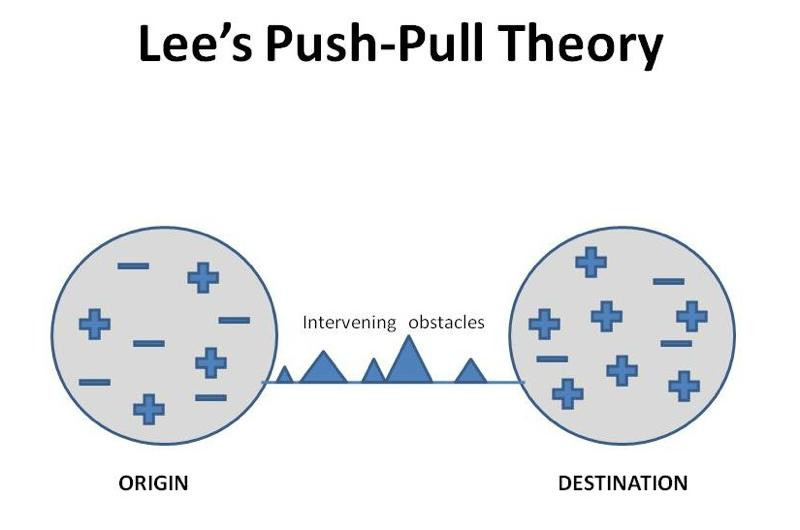
Push-pull model of migration
- Push factors are conditions at the origin that encourage people to leave.
- Pull factors are conditions at the destination that attract people there.
- Intervening obstacles are barriers between origin and destination that make moving harder, riskier, or more expensive.
- Intervening opportunities are appealing places along the way that cause migrants to stop short or change destinations.
These labels are relational. Unemployment in the home country is a push. Jobs in the destination are a pull. The same issue changes meaning depending on where it is in the migration flow. Also, migration almost never has one cause. A person might be pushed by drought, pulled by jobs, slowed by border controls, and redirected by family in a closer city.
Push and pull also do not mean forced vs voluntary. Someone can be strongly pushed and still choose among several destinations.
Types of Migration Causes
Cultural causes
Culture shapes migration through identity, language, religion, education, and family ties.
- Pushes include discrimination, ethnic tension, religious persecution, social exclusion, and restrictions on language or religion.
- Pulls include religious freedom, schools, relatives, ethnic enclaves, and shared language or religion.
Chain migration happens when family or community networks lower the cost and uncertainty of moving. Earlier migrants help with housing, jobs, information, and support.
A classic example is the Great Migration of Black Americans out of the South. Jim Crow laws and racial violence pushed people out. Northern and western cities such as Chicago and Detroit pulled them with factory jobs and more freedom.
Demographic causes
Demographic factors come from population size and structure.
- Pushes include rapid population growth, labor surplus, land scarcity, and pressure on housing or services.
- Pulls include labor shortages, aging populations, low fertility, and family already living at the destination.
Young adults migrate more often because they are most likely to be looking for work, education, or a place to start families.
Economic causes
Economic causes are some of the most common.
- Pushes include unemployment, underemployment, low wages, farm loss, high cost of living, and unequal access to land or credit.
- Pulls include jobs, better pay, housing, land, education, and upward mobility.
A common AP nuance is that migrants often move because of relative opportunity, not absolute poverty. The poorest people may not have enough money to move at all.
The Dust Bowl shows categories working together. Drought and soil erosion hurt farming. That environmental damage created economic push factors through crop failure, debt, and job loss. California pulled migrants with the hope of agricultural work.
Environmental causes
Environmental migration can be sudden or gradual.
- Pushes include drought, floods, hurricanes, earthquakes, wildfires, desertification, sea-level rise, pollution, and falling farm productivity.
- Pulls include safer conditions, fertile land, reliable water, and favorable climate.
Hurricane Katrina displaced many residents of New Orleans. The storm mattered, but so did unequal access to transportation, housing, and recovery aid. That is why environmental causes often connect to economic and social vulnerability.
Political causes
Political causes come from power, conflict, law, and rights.
- Pushes include war, persecution, repression, discriminatory laws, conscription, and land seizure.
- Pulls include peace, stability, asylum, legal protection, and immigration policies that admit workers or reunite families.
The Syrian civil war beginning in 2011 pushed people out through violence and repression. Neighboring countries and parts of Europe pulled migrants with safety and protection.
Intervening Obstacles and Intervening Opportunities
Migration is shaped by what happens between origin and destination.
Obstacles include:
- distance and distance decay
- deserts, mountains, oceans, dangerous routes
- travel costs, documents, temporary housing
- borders, visas, checkpoints, quotas, enforcement
- language barriers and anti-migrant hostility
- age, illness, or dependent family members
For Syrians heading toward Europe, the Mediterranean Sea, high travel costs, and border controls all acted as obstacles.
Intervening opportunities are substitute destinations:
- a nearer city with jobs
- a transit country offering asylum or legal residence
- family ties in an intermediate stop
Turkey worked as an intervening opportunity for some Syrians who stayed there instead of continuing to Europe. The key distinction is simple. An obstacle blocks or limits movement. An opportunity redirects it.
How to Explain Migration on the Exam
When you explain a migration pattern, build the cause clearly:
- Identify the flow
Say who is moving and from where to where. - Locate the factor
Is it at the origin, destination, or between them? - Classify it
Cultural, demographic, economic, environmental, or political. - Explain the link
Show how it increased, reduced, blocked, or redirected migration. - Add interaction when needed
Many migrations combine categories.
Scale also matters:
- Global = development gaps, labor demand, political stability
- Regional or national = war, drought, unemployment, policy
- Local or household = family networks, money, age, transportation access
Strong AP phrasing sounds like this: “Drought acted as an environmental push factor because it reduced agricultural productivity, which created economic pressure through crop failure and farm loss.”
Key Takeaways
Migration
The long-term or permanent relocation of people from one place of residence to another
Push Factor
A condition at an origin that encourages people to leave
Pull Factor
A condition that attracts people to a particular destination
Cultural Factor
A migration cause arising from language, religion, ethnicity, family relationships, education, social practices, or group identity
Demographic Factor
A migration cause arising from a population’s size, composition, or rate of change
Economic Factor
A migration cause involving employment, income, land, housing, or access to economic opportunity
Environmental Factor
A migration cause involving natural hazards, resource availability, climate, or environmental change
Political Factor
A migration cause involving government, law, conflict, security, rights, or public policy
Intervening Obstacle
A barrier between an origin and possible destination that makes migration more difficult, expensive, dangerous, or impossible
Intervening Opportunity
An attractive alternative between an origin and an intended destination that redirects or ends the migration
Distance Decay
The tendency for migration to become less likely as distance increases, other things being equal
Immigration
Migration into a place
Emigration
Migration out of a place
Circulation
Short-term movement, such as commuting or tourism, that does not involve a change of residence
Notes
Migration
The long-term or permanent relocation of people from one place of residence to another
Push Factor
A condition at an origin that encourages people to leave
Pull Factor
A condition that attracts people to a particular destination
Cultural Factor
A migration cause arising from language, religion, ethnicity, family relationships, education, social practices, or group identity
Demographic Factor
A migration cause arising from a population’s size, composition, or rate of change
Economic Factor
A migration cause involving employment, income, land, housing, or access to economic opportunity
Environmental Factor
A migration cause involving natural hazards, resource availability, climate, or environmental change
Political Factor
A migration cause involving government, law, conflict, security, rights, or public policy
Intervening Obstacle
A barrier between an origin and possible destination that makes migration more difficult, expensive, dangerous, or impossible
Intervening Opportunity
An attractive alternative between an origin and an intended destination that redirects or ends the migration
Distance Decay
The tendency for migration to become less likely as distance increases, other things being equal
Immigration
Migration into a place
Emigration
Migration out of a place
Circulation
Short-term movement, such as commuting or tourism, that does not involve a change of residence
