Topic 6.3 Notes – Cities and Globalization
What World Cities Are
A world city or global city is an urban center with influence that reaches far beyond its own country. What matters is what the city does, not just how many people live there.
- World cities have global economic, political, or cultural influence.
- They work as command-and-control centers. Decisions made there affect factories, markets, governments, and consumers far away.
- They are nodes in globalization, meaning they organize flows of:
- capital and investment
- goods
- people
- information
- technology
- culture
The classic top examples are New York, London, and Tokyo. This map helps you see how those cities sit within a wider network of major metropolitan economies.
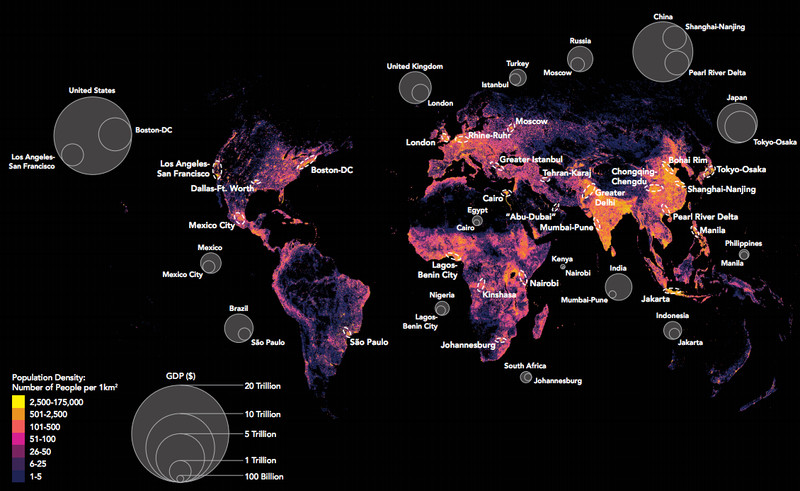
Major global metropolitan regions
Important distinctions
These labels are easy to mix up, so keep them separate. The image includes several very large metro regions, which is useful here because size alone does not make a city a world city.
| Term | Defined by |
|---|---|
| World city | global influence and connectivity |
| Megacity | population of 10 million or more |
| Capital city | political status as seat of government |
| Primate city | dominance within one country's urban system |
A city can be several of these at once, or only one.
- New York and Tokyo are both megacities and world cities.
- Geneva has strong global influence through diplomacy even with a smaller population.
- New York is a world city even though it is not the U.S. national capital.
The World Urban Hierarchy
Cities are ranked by their functional reach. That ranking is called the urban hierarchy.
The full hierarchy runs like this:
- World/global level
- Continental/regional level
- National level
- Local level
There are only a few cities at the top and many more at the bottom. The pattern looks like a pyramid. This settlement hierarchy diagram shows the same basic idea in visual form, moving from many small settlements to fewer large ones.
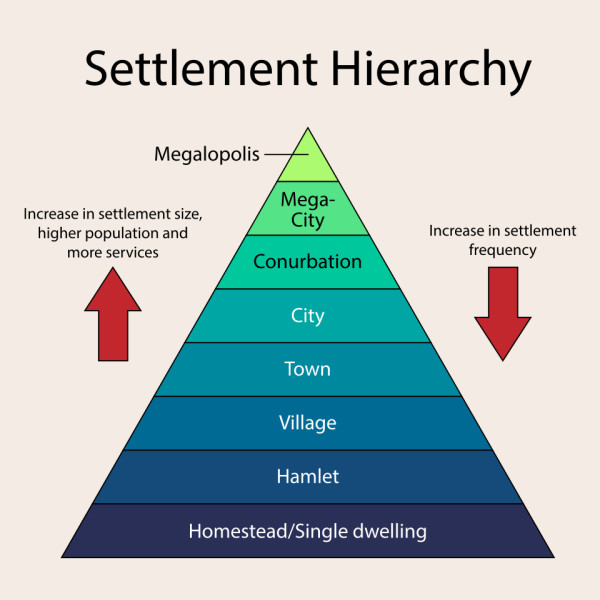
Settlement hierarchy pyramid
Ranking labels
- Alpha cities have the strongest global influence and connectivity.
- Beta cities have major international links but less command power.
- Gamma cities have more limited or specialized global roles.
What rankings look at
- headquarters of transnational corporations
- advanced producer services like law, banking, insurance, advertising, consulting, and IT
- stock exchanges and finance
- international organizations and diplomacy
- major airports, ports, and telecom links
Examples you should know:
- New York and London are leading alpha cities.
- Singapore, Hong Kong, Shanghai, Dubai, São Paulo, and Mumbai are major global or regional players.
- Brussels and Geneva matter a lot politically.
One AP-style trap is using only one measure. A busy airport shows movement, but airport traffic does not automatically equal global command.
Cities as Nodes and Linkages in Global Networks
The hierarchy tells you which cities have more reach. The network tells you how that reach happens.
A node is a point where flows are coordinated or transferred. A linkage is the connection between nodes.
Major flows include:
- capital and investment
- goods and raw materials
- business services
- information and digital communication
- migrants, tourists, students, and corporate workers
- technology and cultural products
- diplomatic and political activity
Types of linkages
- Transportation links like airline routes, shipping lanes, and rail
- Economic links like trade, finance, and office networks
- Political links like embassies and international institutions
- Cultural links like media, education, and entertainment
Maps usually show the densest connections among North America, Europe, and East Asia. Cities such as Dubai act as bridge cities linking larger regions. A city may be more connected to a faraway global city than to a nearby small town. London, for example, can be tied more tightly to New York, Hong Kong, and Singapore than to nearby smaller places.
How Cities Drive and Mediate Globalization
Cities do not just receive globalization. They help produce and steer it.
The self-reinforcing process
- Strong infrastructure and institutions develop.
- Firms and skilled workers cluster there.
- Connectivity and services increase.
- More investment follows.
- The city rises in the hierarchy.
This happens because of agglomeration benefits. Firms want to be near banks, lawyers, consultants, clients, regulators, airports, ports, and skilled labor.
Mediation across scales
Cities mediate globalization because they shape and filter flows.
- Economic mediation: TNC headquarters coordinate production and investment across countries. New York and London are major command centers.
- Political mediation: Washington, D.C., Brussels, and Geneva shape policy and diplomacy.
- Cultural mediation: Los Angeles, Paris, Mumbai, and Seoul spread film, fashion, media, and ideas.
- Migration mediation: diaspora networks connect origin and destination cities.
Singapore is the classic example because it combines a port, airport, finance, and regional gateway near the Strait of Malacca.
Why Global Urban Influence Is Uneven
Not all cities are equally globalized. Their global role depends on several factors:
- infrastructure
- government policy and openness to trade
- political stability
- education and skilled labor
- historical trade and colonial ties
- strategic location
A gateway connects a country or region to the wider world. A hub redistributes passengers, freight, capital, or information.
- Singapore and Dubai are major transportation hubs.
- São Paulo is a gateway connecting Brazil to global networks.
World cities also depend on their hinterlands. They need smaller cities, labor markets, production zones, transport corridors, and resource regions. The hierarchy can change over time as cities gain or lose connections.
Globalization becomes visible in the city itself through CBDs, corporate towers, ports, airports, diplomatic districts, multinational firms, and diverse neighborhoods.
Key Takeaways
Globalization
Increasing integration and interdependence of places through flows of capital, goods, services, people, information, technology, and culture
World City (Global City)
An urban center with worldwide economic, political, or cultural influence that coordinates decisions and flows affecting distant places
Advanced Producer Services
Specialized business services such as accounting, law, advertising, insurance, consulting, and information technology that support global firms
World Urban Hierarchy
A ranking of cities by the importance and geographic reach of their functions, with globally influential world cities at the top
Alpha City
A city with the highest level of global connectivity and influence across major economic, political, transportation, and cultural functions
Beta City
A city with substantial international connections but less global command than an alpha city, often linking a national or large regional economy to the world
Gamma City
A city participating in global networks through limited or specialized international functions while retaining stronger national or regional roles
Global Urban Network
A system of cities connected by transportation, corporate, financial, migration, digital, and institutional linkages and flows
Node
A point where flows originate, terminate, transfer, or are coordinated; cities serve as nodes in global networks
Linkage
A connection between nodes, such as an airline route, shipping lane, corporate relationship, financial transaction, or digital communication
Flow
The movement of capital, goods, services, people, information, technology, culture, or decisions through a network
Agglomeration
The clustering of firms and institutions to gain advantages from proximity to skilled workers, clients, infrastructure, finance, and specialized services
Mediation of Global Processes
The organization, shaping, channeling, or transmission of global activity between places and geographic scales
Gateway Function
A city’s role in channeling capital, trade, people, information, or technology between a country or region and the wider world
Megacity
An urban agglomeration with at least 10 million inhabitants; defined by population rather than global influence
Notes
Globalization
Increasing integration and interdependence of places through flows of capital, goods, services, people, information, technology, and culture
World City (Global City)
An urban center with worldwide economic, political, or cultural influence that coordinates decisions and flows affecting distant places
Advanced Producer Services
Specialized business services such as accounting, law, advertising, insurance, consulting, and information technology that support global firms
World Urban Hierarchy
A ranking of cities by the importance and geographic reach of their functions, with globally influential world cities at the top
Alpha City
A city with the highest level of global connectivity and influence across major economic, political, transportation, and cultural functions
Beta City
A city with substantial international connections but less global command than an alpha city, often linking a national or large regional economy to the world
Gamma City
A city participating in global networks through limited or specialized international functions while retaining stronger national or regional roles
Global Urban Network
A system of cities connected by transportation, corporate, financial, migration, digital, and institutional linkages and flows
Node
A point where flows originate, terminate, transfer, or are coordinated; cities serve as nodes in global networks
Linkage
A connection between nodes, such as an airline route, shipping lane, corporate relationship, financial transaction, or digital communication
Flow
The movement of capital, goods, services, people, information, technology, culture, or decisions through a network
Agglomeration
The clustering of firms and institutions to gain advantages from proximity to skilled workers, clients, infrastructure, finance, and specialized services
Mediation of Global Processes
The organization, shaping, channeling, or transmission of global activity between places and geographic scales
Gateway Function
A city’s role in channeling capital, trade, people, information, or technology between a country or region and the wider world
Megacity
An urban agglomeration with at least 10 million inhabitants; defined by population rather than global influence
