Topic 6.1 Notes – The Origin and Influences of Urbanization
What Urbanization and Suburbanization Are
An urban settlement is a large, dense, concentrated place where most people do nonfarm work. Cities have specialized jobs, services, institutions, and infrastructure like roads, schools, hospitals, and utilities.
A quick APHG reminder. Urban does not have one worldwide population cutoff. Countries define it differently, so always think in terms of density, concentration, and nonagricultural activity.
- Urbanization means the percentage of people living in urban areas increases.
- Urban growth means the number of urban residents increases.
- Those are related, but they are not the same.
- A country can have urban growth without much urbanization if the rural population is also growing fast.
Urbanization can happen through several processes:
- Rural-to-urban migration as people move to cities for jobs and services
- International migration into cities
- Natural increase when births in urban areas exceed deaths
- Annexation or expansion of city boundaries
- Reclassification when a place gets counted as urban
Suburbanization is different. It means people, jobs, and businesses move outward from the central city into nearby suburbs. Those suburbs are still part of the larger urban area.
Why Cities Started and Why They Formed Where They Did
Cities first became possible when agriculture produced a surplus. Once enough food existed, not everyone had to farm. Some people could become rulers, merchants, priests, craftspeople, or soldiers.
This early city development is the first urban revolution. Major hearths appeared in Mesopotamia, the Nile Valley, Indus Valley, northern China, Mesoamerica, and the Andean region.
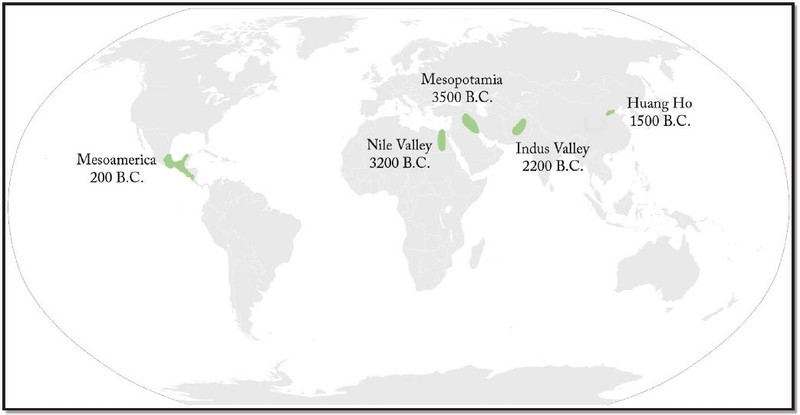
Five early urban hearths with approximate dates (the Andean hearth is not shown)
Cities needed more than food:
- occupational specialization
- trade
- political or religious authority
- storage systems
- social classes
- infrastructure and defense
A standard example is Ur in Mesopotamia. Irrigated farming supported food surplus, and the city became a center of religion, administration, and trade.
Site and situation
Site means the physical characteristics of the place itself. Think water supply, fertile soil, harbor, hill, river crossing, minerals, or flood risk. Site often explains why a city started there.
Situation means the city’s relative location compared with other places and networks. Think markets, ports, railroads, highways, borders, labor, and investment. Situation often explains why a city later grew.
Chicago
Chicago is the classic example because it shows both ideas clearly.
- Site: on Lake Michigan, near the Chicago River, with a low portage
- Situation: connected the Great Lakes to interior U.S. markets
The Illinois and Michigan Canal and later railroads improved Chicago’s access, which turned it into a huge transport and trade center.
Main Drivers of Urbanization
Cities grow because several forces reinforce each other.
Transportation
Transportation often works like this:
- A new route or facility improves accessibility.
- Firms locate there.
- Jobs increase.
- Migrants arrive.
- Housing and services expand.
- More investment follows.
Break-of-bulk points matter a lot. Ports, rail terminals, and river crossings create jobs because goods must be transferred there. Know canals, railroads, streetcars, highways, container ports, and air travel.
Communication
Telegraph, telephone, internet, and fiber optics help cities coordinate trade, finance, and government. They can strengthen major cities, but they can also let some activities spread outward into suburbs.
Population growth, migration, economic development, policy
- Natural increase adds urban residents from within the city.
- Migration brings people in, especially rural-to-urban and international migrants.
- Industrialization drove the second urban revolution by concentrating factory jobs in cities.
- Agglomeration economies mean firms cluster to share labor, suppliers, infrastructure, and information.
- Deindustrialization can slow growth or cause decline.
- Government policy shapes growth through capitals, zoning, infrastructure, annexation, subsidies, and migration policy.
Examples you should know:
- Shenzhen grew fast after China made it a Special Economic Zone near Hong Kong.
- Brasília was a planned capital created by government decision.
What Drives Suburbanization
Suburbanization means residences, businesses, and services shift outward to the urban fringe.
Major causes include:
- early streetcars and commuter rail
- later automobiles and highways
- larger or cheaper land
- lower-density preferences
- jobs moving outward
- expansion of schools and utilities
- mortgage and tax policy
- telecommunications
The classic U.S. case came after World War II:
- Levittown showed mass-produced suburban housing.
- Federally backed mortgages made homeownership easier.
- The Federal-Aid Highway Act of 1956 made commuting easier and sped outward growth.
This pattern is not universal. In some countries, wealthy groups stay in central locations and poorer residents live on the edge.
How to Explain Urban Growth on the Exam
Strong AP answers show interaction, not isolated facts. A city usually grows because several causes connect.
Good phrasing sounds like this: transportation improved a city’s situation, which attracted firms, which created jobs, which drew migrants.
Change over time matters too:
- Early cities depended on farm surplus, water, defense, and trade.
- Industrial cities grew through coal, factories, railroads, and ports.
- Contemporary cities grow through highways, airports, telecommunications, services, and global investment.
A common FRQ mistake is listing site, situation, migration, and policy without showing the chain of cause and effect.
Key Takeaways
Urban Settlement
A concentrated settlement with a relatively large, dense population and predominantly nonagricultural economic activity
Suburbanization
The outward movement of people, economic activities, and development from a central city into surrounding communities
First Urban Revolution
The long transition from agricultural villages to the first cities, enabled by food surpluses, specialization, trade, and organized authority
Site
The physical characteristics at or immediately around a settlement’s location, such as landforms, water, climate, soils, resources, and terrain
Situation
A settlement’s location relative to other places and its accessibility within networks of transportation, trade, communication, resources, and markets
Urban Function
The principal role a settlement performs, such as trade, transportation, manufacturing, administration, defense, or resource extraction
Break-of-Bulk Point
A location where goods are transferred from one mode of transportation to another, often generating storage, processing, trade, and urban employment
Second Urban Revolution
The rapid industrial-era expansion of cities driven by factory employment, industrial concentration, declining demand for farm labor, and rural-to-urban migration
Agglomeration Advantages
Cost and productivity benefits firms gain by clustering near shared labor, suppliers, transportation, markets, information, and other firms
Urbanization
The process by which an increasing share of a population lives in urban settlements
Urban Growth
An increase in the absolute number of people living in urban settlements
Notes
Urban Settlement
A concentrated settlement with a relatively large, dense population and predominantly nonagricultural economic activity
Suburbanization
The outward movement of people, economic activities, and development from a central city into surrounding communities
First Urban Revolution
The long transition from agricultural villages to the first cities, enabled by food surpluses, specialization, trade, and organized authority
Site
The physical characteristics at or immediately around a settlement’s location, such as landforms, water, climate, soils, resources, and terrain
Situation
A settlement’s location relative to other places and its accessibility within networks of transportation, trade, communication, resources, and markets
Urban Function
The principal role a settlement performs, such as trade, transportation, manufacturing, administration, defense, or resource extraction
Break-of-Bulk Point
A location where goods are transferred from one mode of transportation to another, often generating storage, processing, trade, and urban employment
Second Urban Revolution
The rapid industrial-era expansion of cities driven by factory employment, industrial concentration, declining demand for farm labor, and rural-to-urban migration
Agglomeration Advantages
Cost and productivity benefits firms gain by clustering near shared labor, suppliers, transportation, markets, information, and other firms
Urbanization
The process by which an increasing share of a population lives in urban settlements
Urban Growth
An increase in the absolute number of people living in urban settlements
