Topic 5.6 Notes – Agricultural Production Regions
What Agricultural Production Regions Are
Agricultural production regions are broad areas defined by dominant farming systems. That means we’re classifying regions by the main pattern you see across a map, not saying every farm in that region works the same way.
This world map gives you the big picture. AP Human Geography groups agriculture into major regional patterns like pastoral nomadism, shifting cultivation, intensive subsistence, plantation agriculture, mixed crop-livestock, dairy, grain, and ranching.
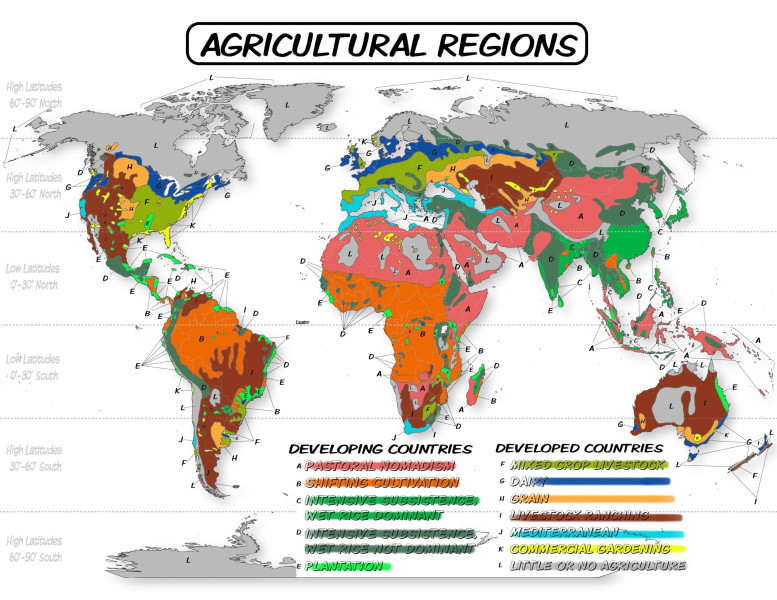
Global agricultural production regions
What matters most here is economic purpose and land-use intensity. Physical geography and culture still matter a lot, since climate, water, and food traditions affect farming. This topic zooms in on the economic side.
Two distinctions have to stay separate in your head every time:
- Subsistence vs. commercial asks why food is produced. Is it mainly to feed the household, or mainly to sell?
- Intensive vs. extensive asks how much input per unit of land is being used.
A common mistake is using farm size as the shortcut. Don’t. A small farm can be commercial, and a large farm can still be subsistence-oriented.
The Main Agricultural Categories
These categories connect, but they are not the same thing.
Subsistence and commercial agriculture
- Subsistence agriculture produces mainly for household or local community use. It often has small scale, household labor, low capital, and weak market ties, but the defining feature is purpose of production.
- Commercial agriculture produces mainly for sale. Farmers respond to prices, transportation, processing, and demand. It often becomes specialized and mechanized because markets reward efficiency.
- Many farms sit on a continuum. A household might eat some rice and sell the rest.
- Commercialization usually grows with better transportation, urban demand, credit, development, and government policy.
Intensive and extensive agriculture
- Intensive agriculture uses high labor and/or capital per hectare. The goal is high output or high value from limited land.
- Extensive agriculture uses lower labor/capital per hectare across larger areas.
- Intensive does not mean large. Extensive does not mean low output. The question is input per unit of land.
The four common combinations
| Combination | Example | Why it fits |
|---|---|---|
| Intensive subsistence | Wet-rice farming in South, Southeast, and East Asia | Small plots, heavy labor, irrigation, terracing, multiple cropping |
| Extensive subsistence | Shifting cultivation; pastoral nomadism in the Sahel | Large areas, lower inputs per hectare, production mainly for survival |
| Intensive commercial | Market gardening, horticulture, plantations | High-value crops, strong market ties, lots of labor/capital |
| Extensive commercial | Grain farming in the Great Plains; ranching in Argentina or Australia | Large land areas, mechanized or spread-out production, goods for sale |
Monoculture and Monocropping
Commercial specialization often creates landscapes dominated by one crop.
- Monoculture means one crop species dominates an area.
- Monocropping means the same crop is grown repeatedly on the same land over time.
AP often treats them together because both show specialization in one crop.
Why do this?
- standardized machinery
- bulk processing
- easier selling into commodity markets
- lower average costs
Examples include wheat belts, sugarcane plantations, tea estates, and oil palm regions.
The tradeoff is risk. One pest, one disease, one drought, or one price drop can hit the whole farm system. Repeated monocropping can also reduce soil fertility and biodiversity.
How Land Cost Shapes Agricultural Intensity
Land closer to a market is usually more accessible and more expensive. Land farther away is usually cheaper. That’s bid-rent logic.
The basic relationship is:
A farmer growing high-value or perishable products can afford expensive land because quick access matters a lot. That’s why you often see:
- market gardening, dairy, flowers, vegetables closer to cities
- grain farming and ranching farther away
Perishability matters a lot. Lettuce and milk need speed. Wheat and cattle can handle distance better.
The graph here shows that same idea in Von Thünen terms. Intensive cultivation can pay higher locational rent near the market, and extensive cultivation becomes more competitive farther away.
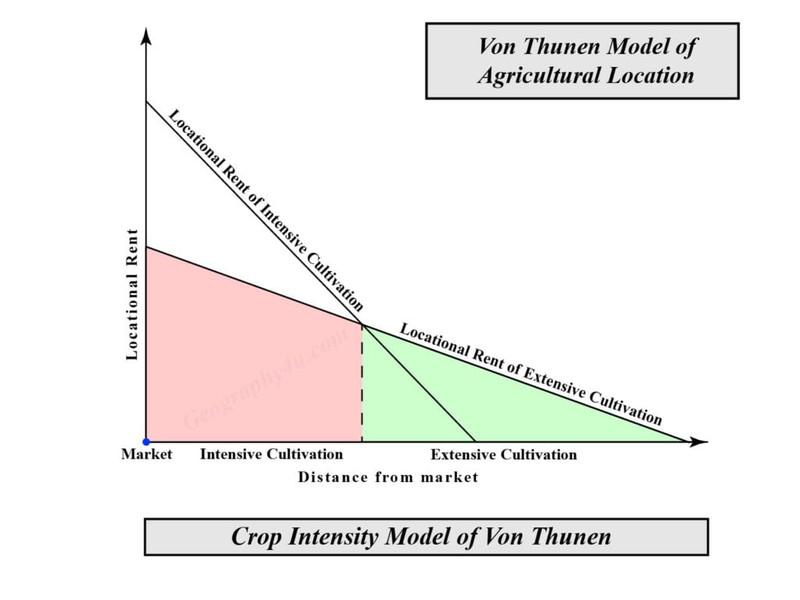
Von Thünen crop intensity model
Limits and Exam Clues
Real landscapes do not form perfect rings.
Bid-rent is simplified because actual farming patterns are also shaped by:
- climate, soil, water, aridity
- refrigeration and transportation networks
- multiple cities, ports, and processing plants
- subsidies, zoning, taxes, water rights, trade policy
- historical landholding and cultural preferences
- urban land uses that can outbid farming near city centers
Landscape clues help, but no single clue proves the answer:
- Commercial clues include large uniform fields, specialized machinery, grain elevators, processing facilities, export links.
- Subsistence clues include household labor, local consumption, small irregular plots.
- Small plots alone are tricky because intensive commercial horticulture can also look small-scale.
Key Takeaways
Agricultural Production Region
An area characterized by a dominant farming system, such as subsistence or commercial and intensive or extensive agriculture
Subsistence Agriculture
Agriculture that produces food primarily for the farmer’s household or local community rather than for sale in distant markets
Commercial Agriculture
Agriculture that produces crops or livestock primarily for sale and profit in local, national, or global markets
Monoculture vs. Monocropping
Monoculture grows one crop species across an area; monocropping repeatedly grows the same crop on the same land over successive seasons
Intensive Farming
Farming that applies high levels of labor, capital, or other inputs per unit of land to obtain high output or value from a limited area
Extensive Farming
Farming that applies relatively low levels of labor or capital per unit of land and spreads production across a large area
Bid-Rent Theory
The theory that affordable land rent generally declines as distance from a market increases, so high-value intensive uses outbid extensive uses for accessible land
Notes
Agricultural Production Region
An area characterized by a dominant farming system, such as subsistence or commercial and intensive or extensive agriculture
Subsistence Agriculture
Agriculture that produces food primarily for the farmer’s household or local community rather than for sale in distant markets
Commercial Agriculture
Agriculture that produces crops or livestock primarily for sale and profit in local, national, or global markets
Monoculture vs. Monocropping
Monoculture grows one crop species across an area; monocropping repeatedly grows the same crop on the same land over successive seasons
Intensive Farming
Farming that applies high levels of labor, capital, or other inputs per unit of land to obtain high output or value from a limited area
Extensive Farming
Farming that applies relatively low levels of labor or capital per unit of land and spreads production across a large area
Bid-Rent Theory
The theory that affordable land rent generally declines as distance from a market increases, so high-value intensive uses outbid extensive uses for accessible land
