Topic 7.5 Notes – Theories of Development
What Development Theories Explain
Development means more than economic growth. It includes health, education, infrastructure, opportunity, and standard of living. So yes, indicators like GDP or GNI per capita, HDI, literacy, life expectancy, and infant mortality help show how developed a place is, but this topic is about why those patterns exist across space.
These four theories give different answers:
- Rostow explains development as an internal, national process that moves through stages.
- World-systems theory explains development through unequal roles in the global economy.
- Dependency theory explains underdevelopment through outside control and unequal dependence.
- Commodity dependence explains vulnerability when an economy relies on one or a few exports.
The biggest contrast to lock in is this. Rostow looks inside a country and sees a path forward. Wallerstein and dependency look at global power and see unequal relationships shaping outcomes. Commodity dependence narrows in on export structure and price risk.
The Four Theories of Development
Rostow’s Stages of Economic Growth
Walt W. Rostow published this model in 1960. He argued that countries move through five linear stages toward industrialization and mass consumption. His unit of analysis is the state, so he is mainly asking how a national economy changes over time.
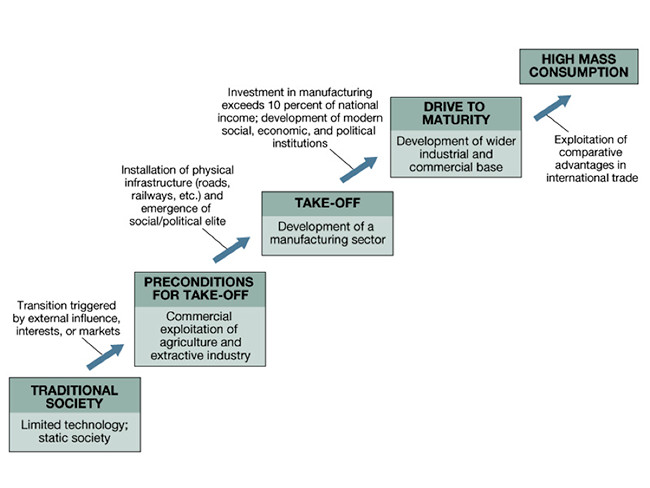
Rostow’s five stages of economic growth
- Traditional society
Primary-sector work dominates, especially subsistence farming. Productivity and infrastructure are low.
- Preconditions for takeoff
Roads, ports, schools, banks, and investment begin to expand. Agriculture becomes more productive, which frees workers and capital for other sectors.
- Takeoff
Industrialization becomes rapid and self-sustaining. Manufacturing grows, cities expand, and urbanization speeds up. Great Britain is the classic example.
- Drive to maturity
Industry diversifies, technology spreads, skilled labor grows, and services become more important.
- Age of high mass consumption
High incomes, widespread consumer goods, and a dominant service sector. The U.S., Canada, Japan, and much of Western Europe are common examples.
South Korea often fits parts of this model, though not perfectly.
Wallerstein’s World-Systems Theory
Immanuel Wallerstein saw one capitalist world economy with an unequal division of labor. Countries do not develop separately. They develop in relation to each other.
The map below shows the classic core, semi-periphery, and periphery pattern that this theory describes.
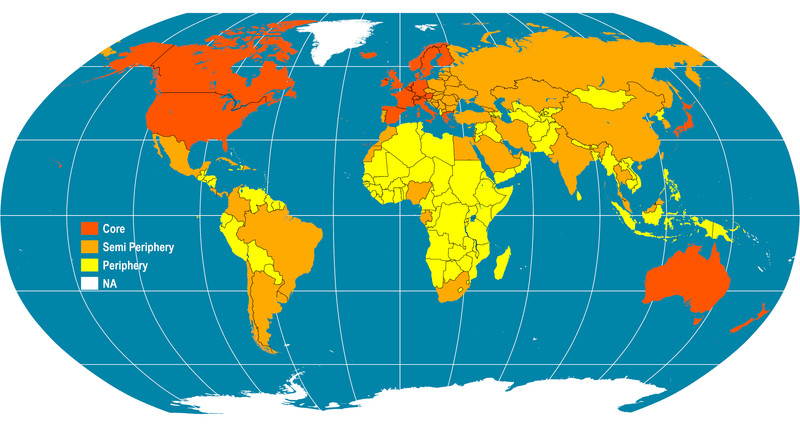
World-systems core, semi-periphery, and periphery
- Core
High-value manufacturing, finance, technology, and political power. Examples include the U.S., Japan, and Western Europe.
- Semi-periphery
In-between position. Some manufacturing and influence, but less control than the core. Examples include China, India, Brazil, Mexico, and South Africa.
- Periphery
Raw materials, low-wage labor, and externally controlled production. Many are former colonies.
A common AP example is copper from Zambia. Zambia may mine it, but more profit is often captured in refining, manufacturing, branding, and finance elsewhere.
Dependency Theory
Dependency theory says underdevelopment is produced, not just inherited from an earlier stage. Poorer countries can stay poor because they depend on wealthier countries, firms, lenders, and markets.
This grew out of colonialism and neocolonialism, where outside powers still shape economies after formal empire ends. Key ideas include foreign ownership, profit repatriation, export dependence, and outside control of technology and capital.
The cycle works like this:
- Export raw materials or low-value goods
- Earn low or unstable returns
- Lack money for diversification, education, and infrastructure
- Keep relying on outside capital and markets
Commodity Dependence
Commodity dependence is a more specific idea. A country relies heavily on one or a few primary commodity exports such as coffee, cocoa, copper, oil, or timber.
- Zambia and copper
- Venezuela and petroleum
The problem is vulnerability. Prices swing, export income rises and falls, and the economy may stay narrow instead of diversifying. If little processing happens locally, most value added is captured elsewhere.
How These Theories Explain Uneven Development
All four theories explain uneven development, but they point to different causes.
- Rostow says development comes from internal structural change over time.
- World-systems says core development is tied to lower-value roles in the periphery.
- Dependency says outside control blocks full development.
- Commodity dependence says narrow specialization creates instability and discourages diversification.
The same country can fit more than one lens. Commodity exports might look like a foundation for takeoff in Rostow, but in dependency or world-systems they may look like a trap that keeps value and power elsewhere.
Strengths, Limits, and Common AP Comparisons
| Theory | Strengths | Limits |
|---|---|---|
| Rostow | Clear stages; explains shift from primary to secondary to tertiary sectors | Eurocentric; assumes one path; downplays colonialism, inequality, deindustrialization, environmental limits |
| World-systems | Great for global inequality, colonial legacy, core-periphery patterns | Oversimplifies countries; categories can change; can understate policy and agency |
| Dependency | Strong on foreign ownership, profit flows, and neocolonialism | Can understate domestic governance and why NICs like South Korea or Taiwan industrialized |
| Commodity dependence | Concrete explanation for instability and export vulnerability | Outcomes vary with governance, diversification, and revenue management |
The exam shortcut is simple:
- Linear stages = Rostow
- Core / semi-periphery / periphery = Wallerstein
- Outside control causing underdevelopment = dependency
- One or few export reliance = commodity dependence
Key Takeaways
Rostow’s Stages of Economic Growth (Modernization Model)
A linear model in which countries develop through five stages as investment, technology, industrialization, productivity, and consumption increase
Rostow Stage 1: Traditional Society
An economy dominated by subsistence agriculture, primary-sector work, limited technology, low productivity, and little infrastructure
Rostow Stage 2: Preconditions for Takeoff
Investment, infrastructure, institutions, agricultural surpluses, and emerging industries prepare an economy for sustained industrial growth
Rostow Stage 3: Takeoff
Rapid, self-sustaining industrialization in which expanding industries stimulate broader investment, urbanization, and structural change
Rostow Stage 4: Drive to Maturity
Industrialization diversifies, technology and skilled labor expand, productivity rises, and the economy produces a broad range of goods and services
Rostow Stage 5: Age of High Mass Consumption
A diversified, high-productivity economy characterized by extensive service employment, high incomes, and mass demand for consumer goods and services
Wallerstein’s World-Systems Theory (World System Theory)
A theory that explains uneven development through a capitalist world economy divided into unequal core, semi-periphery, and periphery positions
Core
The powerful world-system position specializing in high-value production, finance, technology, management, and advanced services
Semi-Periphery
The intermediate world-system position that is influenced by the core while exercising economic influence over peripheral areas
Periphery
The less powerful world-system position commonly supplying raw materials, low-wage labor, or low-value goods under relatively unfavorable terms
Global Division of Labor
The spatial organization of the world economy in which places perform different production roles, from resource extraction to high-value finance and technology
Unequal Exchange
An exchange in which powerful locations retain more value and profit by controlling high-value stages while less powerful locations supply labor or raw materials
Dependency Theory
A theory that unequal reliance on wealthier countries, foreign firms, markets, capital, and technology can transfer wealth outward and reproduce underdevelopment
Neocolonialism
Indirect economic or political control by foreign governments, firms, or lenders after formal colonial rule has ended
Commodity Dependence
Heavy reliance on exporting a small number of primary commodities, making an economy vulnerable to volatile prices and a narrow revenue base
Enclave Economy
An export-oriented mine, plantation, or oil field strongly linked to foreign markets but weakly connected to the rest of the national economy
Notes
Rostow’s Stages of Economic Growth (Modernization Model)
A linear model in which countries develop through five stages as investment, technology, industrialization, productivity, and consumption increase
Rostow Stage 1: Traditional Society
An economy dominated by subsistence agriculture, primary-sector work, limited technology, low productivity, and little infrastructure
Rostow Stage 2: Preconditions for Takeoff
Investment, infrastructure, institutions, agricultural surpluses, and emerging industries prepare an economy for sustained industrial growth
Rostow Stage 3: Takeoff
Rapid, self-sustaining industrialization in which expanding industries stimulate broader investment, urbanization, and structural change
Rostow Stage 4: Drive to Maturity
Industrialization diversifies, technology and skilled labor expand, productivity rises, and the economy produces a broad range of goods and services
Rostow Stage 5: Age of High Mass Consumption
A diversified, high-productivity economy characterized by extensive service employment, high incomes, and mass demand for consumer goods and services
Wallerstein’s World-Systems Theory (World System Theory)
A theory that explains uneven development through a capitalist world economy divided into unequal core, semi-periphery, and periphery positions
Core
The powerful world-system position specializing in high-value production, finance, technology, management, and advanced services
Semi-Periphery
The intermediate world-system position that is influenced by the core while exercising economic influence over peripheral areas
Periphery
The less powerful world-system position commonly supplying raw materials, low-wage labor, or low-value goods under relatively unfavorable terms
Global Division of Labor
The spatial organization of the world economy in which places perform different production roles, from resource extraction to high-value finance and technology
Unequal Exchange
An exchange in which powerful locations retain more value and profit by controlling high-value stages while less powerful locations supply labor or raw materials
Dependency Theory
A theory that unequal reliance on wealthier countries, foreign firms, markets, capital, and technology can transfer wealth outward and reproduce underdevelopment
Neocolonialism
Indirect economic or political control by foreign governments, firms, or lenders after formal colonial rule has ended
Commodity Dependence
Heavy reliance on exporting a small number of primary commodities, making an economy vulnerable to volatile prices and a narrow revenue base
Enclave Economy
An export-oriented mine, plantation, or oil field strongly linked to foreign markets but weakly connected to the rest of the national economy
