Topic 7.7 Notes – Changes as a Result of the World Economy
What Changes in the World Economy Are
The biggest idea is global production networks. One country often does not make an entire product anymore. A phone might be designed in the United States, use parts from East Asia, be assembled in China or Vietnam, and sold worldwide.
That shift did not erase the old core-periphery pattern. It changed its form.
- Core regions still tend to control the highest-value work like design, finance, research, and branding.
- Semiperiphery and periphery often gain lower-wage manufacturing, assembly, or extraction jobs.
- This creates interdependence. A disruption in one place can affect jobs and production far away.
This world map is a useful quick visual of the core, semiperiphery, and periphery pattern.
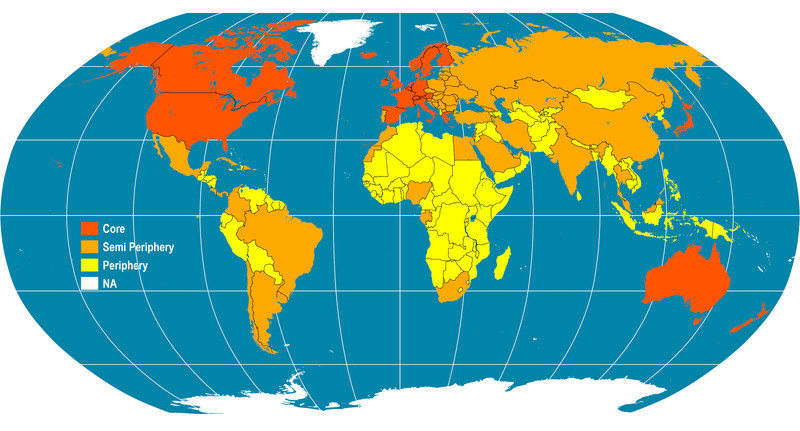
Core, semiperiphery, and periphery world map
Why did this happen?
- Better transportation and communication made it easier to move parts, money, and information fast.
- Trade liberalization reduced tariffs and other barriers, so goods and capital could cross borders more easily.
- Transnational corporations coordinate production across countries and choose locations strategically.
- Firms look at wages, regulations, and market access when deciding where each stage should happen.
Vocabulary that gets mixed up
- Outsourcing means hiring another company to do work.
- Offshoring means moving work to another country.
- Economic restructuring means a major change in how and where an economy works.
- Deindustrialization means manufacturing jobs or activity decline, especially in older core regions.
- Interdependence means places depend more on economic decisions and events elsewhere.
New Patterns of Production and Labor
Once firms could split production across space, an international division of labor formed. Different countries specialize in different steps.
| Region | Common roles |
|---|---|
| Core | headquarters, finance, R&D, design, marketing |
| NICs / semiperiphery | manufacturing, technical services, advanced industry |
| Periphery | labor-intensive assembly, garments, extraction |
The new international division of labor means manufacturing is no longer concentrated mainly in the old core.
Newly industrialized countries
NICs industrialized quickly through manufacturing and exports. Standard examples are South Korea, Taiwan, Singapore, Hong Kong, and China. Some move up the value chain from simple assembly to advanced manufacturing and services.
Special manufacturing zones
Governments built special zones to attract investment.
- SEZ = special economic zone with different rules to attract business.
- FTZ = free-trade zone, often near ports, airports, or borders, where tariffs and customs rules are reduced.
- EPZ = export-processing zone focused on making goods for export.
Named examples
- Shenzhen became the classic SEZ. State support, foreign investment, and proximity to Hong Kong helped turn it into a huge manufacturing and tech city. The Pearl River Delta map below helps place Shenzhen in the larger manufacturing region linked to Hong Kong, Guangzhou, and other nearby cities.
- Maquiladoras in Mexico are border assembly plants tied closely to the U.S. market.
- Bangladesh’s garment industry shows export growth built on low wages. The Rana Plaza collapse in 2013 became a major symbol of labor risk in global supply chains.
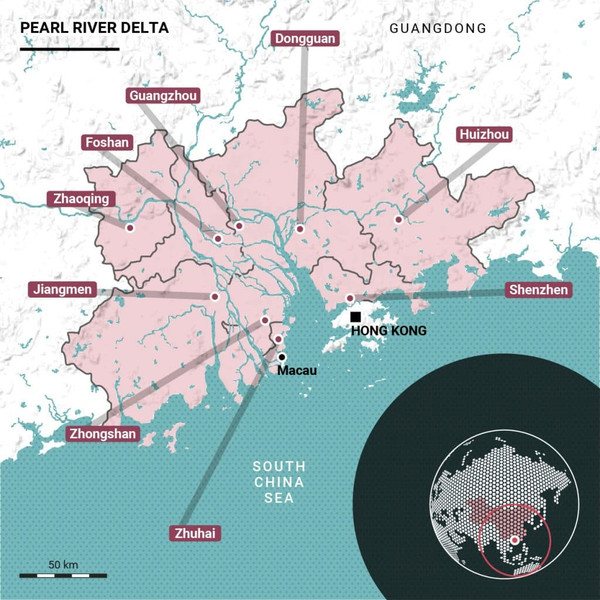
Pearl River Delta manufacturing region
How Production Changed Inside Firms
These global shifts also changed how companies make things.
- Fordist production used assembly lines, standardized goods, large inventories, and vertical integration.
- Post-Fordist production uses flexibility, smaller runs, more variety, outsourcing, subcontracting, and dispersed networks.
Just-in-time delivery
- Parts are ordered to arrive right before they are needed.
- Firms store less inventory.
- Costs and waste go down.
- The system depends on reliable transportation, information, and suppliers.
Toyota is the classic example. The weakness is easy to test. If one port closes or one supplier fails, production elsewhere can stop.
Scale and clustering
- Economies of scale mean larger output lowers average cost, so production often concentrates in big firms or plants.
- Agglomeration means related firms cluster together to share workers, suppliers, infrastructure, ideas, and capital. Silicon Valley is the standard example.
- Agglomeration can build through cumulative causation, then run into high costs, congestion, and other diseconomies.
Geographic Consequences of These Changes
In older core regions, this often shows up as deindustrialization.
- Classic example is the U.S. Rust Belt, plus older industrial areas in the UK and western Europe.
- Causes include automation, foreign competition, relocation to cheaper regions, and aging infrastructure.
- Effects include structural unemployment, brownfields, out-migration, lower tax revenue, and greater inequality.
Receiving zones often gain:
- formal-sector jobs
- export earnings and FDI
- infrastructure
- urbanization
- more jobs for women
But they may also face low wages, unsafe conditions, pollution, dependence on TNCs, and profit repatriation.
A new factory can create a multiplier effect. It hires workers directly, then supports suppliers, stores, and services through more local spending. After a closure, the negative multiplier helps explain why one factory loss can damage a whole town. Leakages weaken the multiplier when profits or spending leave the area.
A growth pole is concentrated investment meant to spark wider regional development. Forward and backward linkages connect the leading industry to buyers and suppliers. Shenzhen and Silicon Valley both work as examples. The catch is that growth often stays concentrated and increases regional inequality.
Key Takeaways
Economic Interdependence
Condition in which the economic prospects of workers, firms, cities, and countries increasingly depend on decisions and events elsewhere
Outsourcing
Contracting work formerly performed within a firm to a separate company, whether domestic or foreign
Offshoring
Moving work to another country, either to a firm’s own facility or to an independent contractor
Labor Arbitrage
Locating labor-intensive operations where comparable work can be obtained at a lower cost
Economic Restructuring
A substantial change in an economy’s sectoral or spatial organization, such as shifts toward services, automation, or relocated production
Deindustrialization
The relative decline of manufacturing as a source of employment and economic activity, even when manufacturing output remains high
Newly Industrialized Country (NIC)
A country experiencing rapid manufacturing growth and a transition away from dependence on agriculture or raw-material production
International Division of Labor (New International Division of Labor)
The geographic specialization of economic tasks among countries, with different stages of production assigned according to cost, skill, and other advantages
Special Economic Zone (SEZ)
A designated area where regulations differ from the rest of the country to encourage investment, enterprise, trade, or development
Free-Trade Zone (FTZ)
A bounded area where goods may be imported, stored, processed, assembled, or re-exported with reduced tariffs or simplified customs procedures
Export-Processing Zone (EPZ)
A zone where imported components are manufactured or assembled into goods intended primarily for export
Maquiladora
A Mexican export-processing plant, often near the United States border, that assembles imported components for export
Fordist Production
Standardized mass production using assembly lines, large factories, repetitive specialized tasks, and large inventories
Post-Fordist Production
Flexible, automated, and geographically dispersed production using varied products, subcontracting, smaller inventories, and global networks
Just-in-Time Delivery
An inventory system in which parts and materials arrive shortly before production needs them, minimizing stored inventory
Economies of Scale
Reductions in average production cost that occur as output increases and fixed costs are spread across more units
Agglomeration
The spatial clustering of related economic activities and institutions
Agglomeration Economies
Cost and productivity advantages firms gain by clustering near shared workers, suppliers, infrastructure, services, and knowledge
Multiplier Effect
The additional employment, income, and spending generated when an initial economic investment circulates through a regional economy
Tertiarization
An increase in the relative importance of tertiary, quaternary, and quinary service activities in an economy
High-Technology Industries
Industries dependent on scientific research, advanced engineering, skilled labor, and continuing innovation
Growth Pole
A concentration of investment and economic activity intended or expected to stimulate development in a wider region
Notes
Economic Interdependence
Condition in which the economic prospects of workers, firms, cities, and countries increasingly depend on decisions and events elsewhere
Outsourcing
Contracting work formerly performed within a firm to a separate company, whether domestic or foreign
Offshoring
Moving work to another country, either to a firm’s own facility or to an independent contractor
Labor Arbitrage
Locating labor-intensive operations where comparable work can be obtained at a lower cost
Economic Restructuring
A substantial change in an economy’s sectoral or spatial organization, such as shifts toward services, automation, or relocated production
Deindustrialization
The relative decline of manufacturing as a source of employment and economic activity, even when manufacturing output remains high
Newly Industrialized Country (NIC)
A country experiencing rapid manufacturing growth and a transition away from dependence on agriculture or raw-material production
International Division of Labor (New International Division of Labor)
The geographic specialization of economic tasks among countries, with different stages of production assigned according to cost, skill, and other advantages
Special Economic Zone (SEZ)
A designated area where regulations differ from the rest of the country to encourage investment, enterprise, trade, or development
Free-Trade Zone (FTZ)
A bounded area where goods may be imported, stored, processed, assembled, or re-exported with reduced tariffs or simplified customs procedures
Export-Processing Zone (EPZ)
A zone where imported components are manufactured or assembled into goods intended primarily for export
Maquiladora
A Mexican export-processing plant, often near the United States border, that assembles imported components for export
Fordist Production
Standardized mass production using assembly lines, large factories, repetitive specialized tasks, and large inventories
Post-Fordist Production
Flexible, automated, and geographically dispersed production using varied products, subcontracting, smaller inventories, and global networks
Just-in-Time Delivery
An inventory system in which parts and materials arrive shortly before production needs them, minimizing stored inventory
Economies of Scale
Reductions in average production cost that occur as output increases and fixed costs are spread across more units
Agglomeration
The spatial clustering of related economic activities and institutions
Agglomeration Economies
Cost and productivity advantages firms gain by clustering near shared workers, suppliers, infrastructure, services, and knowledge
Multiplier Effect
The additional employment, income, and spending generated when an initial economic investment circulates through a regional economy
Tertiarization
An increase in the relative importance of tertiary, quaternary, and quinary service activities in an economy
High-Technology Industries
Industries dependent on scientific research, advanced engineering, skilled labor, and continuing innovation
Growth Pole
A concentration of investment and economic activity intended or expected to stimulate development in a wider region
