Topic 3.3 Notes – Cultural Patterns
What Cultural Patterns Are
A cultural pattern is the spatial arrangement of a cultural trait across places. Geographers care about where traits cluster and what that does to a place.
- The core traits here are language, religion, ethnicity, and gender.
- Culture turns space into place because people give locations identity through language, symbols, buildings, rituals, and daily habits.
- On the AP exam, you usually need to do three things:
- identify where a trait is concentrated
- point to landscape evidence that shows it
- explain whether it acts as a centripetal force (unity) or centrifugal force (division)
Scale matters a lot. Canada can look mostly English-speaking on a national map, then very mixed once you zoom in to Quebec or Montreal. Also, these traits overlap, but they are not the same map. A language region does not automatically match a religion or ethnicity region.
Common Cultural Patterns on the Landscape
Different traits spread in different ways, so you’ll see a few common patterns.
Broad regional concentration
One trait dominates a large continuous area.
- French in Quebec gives the province a strong Francophone identity.
- Hinduism in much of northern India shapes sacred cities, rituals, and public life.
- Spanish toponyms across the U.S. Southwest, like Los Angeles and San Francisco, show lasting cultural influence.
Enclaves and neighborhoods
A minority group can cluster inside a larger region.
- An ethnic enclave is a concentrated area where a group maintains businesses, institutions, and support networks.
- Chinatowns in San Francisco and New York are classic examples. Chinese-language signs, restaurants, temples, festivals, and community groups make the landscape culturally distinct.
Transition zones and mixed regions
Some boundaries are gradual instead of sharp.
- Brussels sits within Belgium’s larger Dutch-French language divide and helps show how mixed cultural regions can form.
- Bosnia and Herzegovina shows overlapping ethnic and religious identities rather than one clean cultural region.
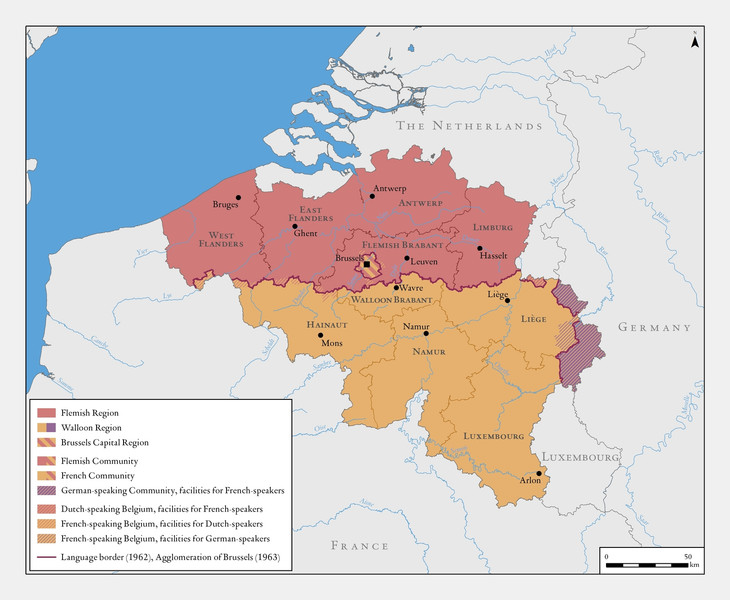
Belgium’s language regions
Dispersed and diaspora patterns
Some groups are scattered across many places instead of occupying one homeland.
- A diaspora keeps ties to a remembered homeland while also building identity in new places.
- That identity works at multiple scales, from neighborhood to global network.
Landscape evidence
You should also be able to connect these patterns to visible clues on the landscape. A sacred city like Varanasi, with temples and ritual activity along the Ganges, is a good example of how religion becomes visible in place.
- Language shows up in signs, school language, media, government documents, and place names.
- Religion shows up in churches, mosques, temples, shrines, cemeteries, pilgrimage sites, food practices, and business-closure patterns.
- Ethnicity shows up in neighborhood businesses, festivals, community organizations, and regional symbols.
- Gender shows up in use of public space, workplace patterns, religious space organization, and transit arrangements.
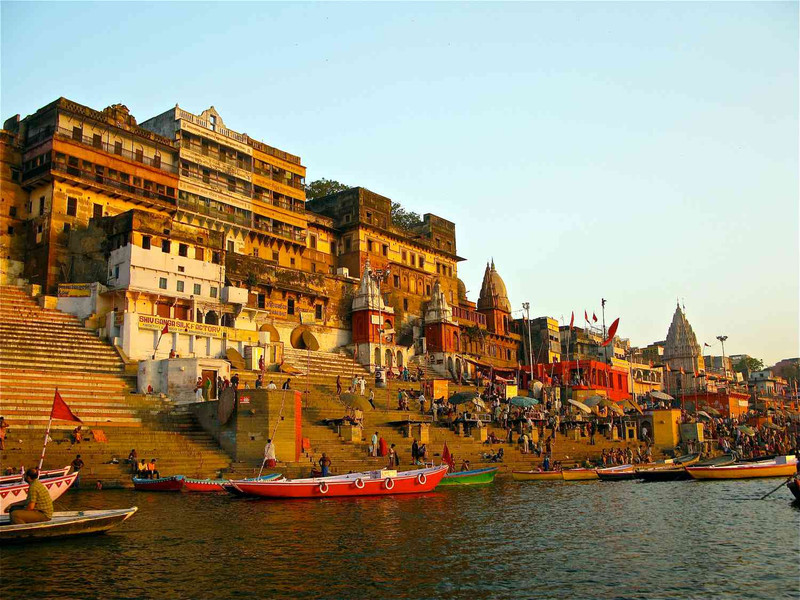
Varanasi ghats on the Ganges River
How Cultural Patterns Create Place
A sense of place is the meaning and emotional attachment people feel toward a location. Language, sacred sites, foods, architecture, festivals, and memory all build that feeling. The same place can feel like belonging to one group and exclusion to another, so sense of place is subjective and contested.
Placemaking is the process of creating or reinforcing that identity.
- Formal placemaking includes bilingual signs, street renaming, heritage districts, and sacred-site protection.
- Informal placemaking includes festivals, murals, worship, markets, and clustering of culturally specific businesses.
Examples you should know:
- Quebec uses French signs, schools, and media to reinforce Francophone identity.
- Chinatowns are ethnic placemaking in action.
- Catalonia uses Catalan language and symbols to express regional identity.
The global cultural landscape is the world as a mosaic of connected but distinctive places. Big cities often contain multilingual districts, enclaves, and multiple religions at once, so broad maps usually hide local diversity.
Centripetal and Centrifugal Effects of Culture
Shared culture can pull people together or push them apart.
- Centripetal forces create unity. A strong example is Bahasa Indonesia, which helps unify a country with many local languages.
- Centrifugal forces create division when cultural differences connect to inequality, territory, or political recognition.
- Belgium’s Flemish-Walloon language divide is centrifugal.
- Catalan identity can unify Catalonia internally but divide Spain nationally.
A trait is not permanently one or the other. French is centripetal within Quebec but can be centrifugal at the scale of Canada.
Exam formula
- Identify the cultural trait.
- Identify the group or place affected.
- State the scale.
- Explain the result, such as cohesion, autonomy pressure, exclusion, or conflict.
Reading Maps and Images of Cultural Patterns
Always ask what is actually being mapped. “Language” might mean official language, home language, or majority language, and those give different patterns.
Look for:
- concentration
- boundaries
- transition zones
- enclaves
- overlap
- exceptions
Be careful with evidence.
- Signs and toponyms show language presence, not total population.
- A mosque or temple shows religious presence, not exact percentage.
- A culturally distinct street may suggest an enclave, but you need supporting evidence.
The best geographic explanation says where the pattern is and why it matters.
Key Takeaways
Cultural Pattern
The spatial arrangement of cultural traits and identities, especially language, religion, ethnicity, and gender
Cultural Region
An area associated with one or more shared cultural characteristics, whose strength may vary within the region
Language
A system of communication and a major carrier of culture and identity
Toponym
A place name that can preserve evidence of a place’s settlement, governance, cultural influence, or identity
Religion
Organized beliefs and practices concerning sacred or spiritual matters
Ethnicity
Identity based on a perceived shared cultural heritage, such as ancestry, language, religion, traditions, homeland, or collective memory
Ethnic Enclave
An area where an ethnic group is spatially concentrated and maintains associated institutions, businesses, and cultural practices
Gender
Socially constructed identities, roles, expectations, and relationships associated with masculinity, femininity, and other gender identities
Sense of Place
The meaning, identity, and emotional attachment associated with a location
Placemaking
The process through which people create, reinforce, or reshape the identity and meaning of a space
Global Cultural Landscape
The worldwide mosaic of cultural forms and practices visible across places
Centripetal Force
A force that promotes unity, solidarity, or cohesion within a group, region, or state
Centrifugal Force
A force that promotes division, fragmentation, or separation within a group, region, or state
Notes
Cultural Pattern
The spatial arrangement of cultural traits and identities, especially language, religion, ethnicity, and gender
Cultural Region
An area associated with one or more shared cultural characteristics, whose strength may vary within the region
Language
A system of communication and a major carrier of culture and identity
Toponym
A place name that can preserve evidence of a place’s settlement, governance, cultural influence, or identity
Religion
Organized beliefs and practices concerning sacred or spiritual matters
Ethnicity
Identity based on a perceived shared cultural heritage, such as ancestry, language, religion, traditions, homeland, or collective memory
Ethnic Enclave
An area where an ethnic group is spatially concentrated and maintains associated institutions, businesses, and cultural practices
Gender
Socially constructed identities, roles, expectations, and relationships associated with masculinity, femininity, and other gender identities
Sense of Place
The meaning, identity, and emotional attachment associated with a location
Placemaking
The process through which people create, reinforce, or reshape the identity and meaning of a space
Global Cultural Landscape
The worldwide mosaic of cultural forms and practices visible across places
Centripetal Force
A force that promotes unity, solidarity, or cohesion within a group, region, or state
Centrifugal Force
A force that promotes division, fragmentation, or separation within a group, region, or state
