Topic 1.4 Notes – State Building in the Americas
How States in the Americas Built Power
States in the Americas developed independently from Afro-Eurasia, so the similarities matter. You still see cities, rulers, tribute, and sacred authority because large societies everywhere had to feed people, organize labor, and justify power.
Agriculture made all of that possible. Surplus food let some people stop farming full-time and become priests, warriors, artisans, and officials.
Different regions solved food problems differently:
- Mexica chinampas were raised fields built in shallow lake areas around Lake Texcoco. They produced huge harvests and supported Tenochtitlan.
- Inca terraces and irrigation turned steep Andean slopes into usable farmland and controlled water in mountain conditions.
- Mississippian maize cultivation in the Mississippi River valley supported dense populations and urban centers like Cahokia.
- Southwestern irrigation and drought-adapted farming helped communities survive in dry environments like Chaco and Mesa Verde.
The map below helps place some of the major Indigenous regions named in this unit, especially Mesoamerica, the Caribbean, and the Andes.
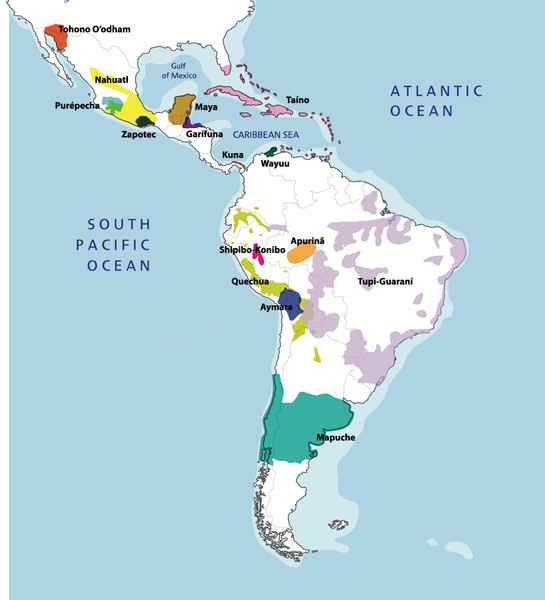
Indigenous regions of Latin America
Rulers then pulled resources out of society through tribute or labor obligations. They also claimed sacred authority. Many were seen as intermediaries with gods or ancestors, which made obedience feel religious as well as political.
Monumental building showed that power:
- Mesoamerica built pyramids and temples.
- Andes built roads, storehouses, and ceremonial centers.
- Cahokia built mounds and plazas.
- Chaco and Mesa Verde built Great Houses, kivas, cliff dwellings, and pueblos.
The pattern to remember is continuity, innovation, and diversity. American states kept older traditions, created new methods, and never followed one single model.
The Major Political Systems in the Americas
Maya city-states
The Maya were culturally connected but politically fragmented. They were not one empire. Sacred kings from elite dynasties ruled separate city-states, but those states shared hieroglyphic writing, calendars, religion, and stepped pyramids. In the Postclassic period, Chichén Itzá had been important earlier, and Mayapan was a major center in the 1200s to 1400s. The key continuity is that Maya civilization survived even without political unity.
Mexica Aztec Empire
The Mexica founded Tenochtitlan in 1325 on Lake Texcoco. In 1428, Tenochtitlan, Texcoco, and Tlacopan formed the Triple Alliance. Tenochtitlan soon dominated under rulers like Itzcoatl and Moctezuma I. This became a conquest-based tribute empire that usually ruled indirectly.
Inca state
The Inca were centered at Cusco. Expansion began under Pachacuti around 1438. Their empire, Tawantinsuyu or “land of the four quarters,” was more territorial and integrated than the Mexica empire. They ruled through provincial administration, labor obligations, and infrastructure.
Mississippian Cahokia
Cahokia was the largest urban center north of Mesoamerica. It was a major ceremonial and political center, though not a territorial empire. Its rulers likely held chiefly and religious authority.
Chaco Canyon and Mesa Verde
These were complex Ancestral Pueblo societies in the Southwest. They were highly organized, but historians still debate how centralized they were politically. They matter as examples of adaptation and later migration.
How the Mexica and Inca Ruled
These two get compared constantly because both built empires, but they governed differently.
| State | Main method |
|---|---|
| Mexica | Indirect tribute empire |
| Inca | More centralized labor-based empire |
Mexica rule
The huey tlatoani was the sacred and military ruler. Conquered local rulers usually stayed in place if they paid tribute. That tribute included maize, cotton cloth, cacao, feathers, military supplies, and luxury goods. Warfare kept tribute flowing and captured prisoners for sacrifice.
Tenochtitlan itself showed imperial power through causeways, canals, aqueducts, and the dike system around the capital.
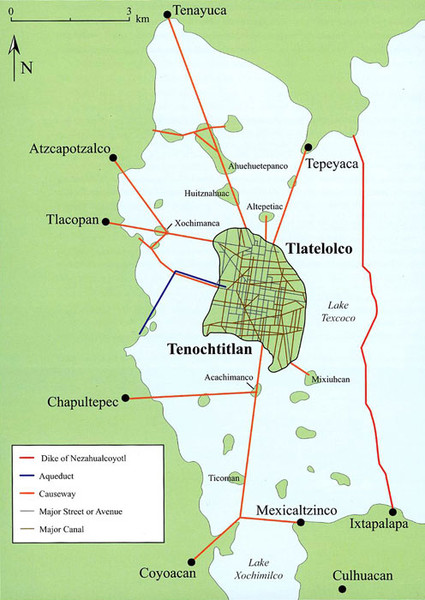
Map of Tenochtitlan and its infrastructure
That urban layout helped the Mexica control movement, transport goods, and project authority from their capital. Pochteca merchants helped with long-distance trade and also gathered intelligence. The Templo Mayor symbolized religious and political power, and the Codex Mendoza is a classic source for the tribute owed by conquered peoples.
Inca rule
The Sapa Inca claimed sacred authority through Inti, the sun god. The empire was organized into four regions around Cusco. The ayllu was the basic kinship and labor unit.
The mit’a required rotating labor for roads, terraces, temples, armies, and mining. Inca integration depended on:
- roads, suspension bridges, tambos, qullqas
- chasqui relay runners
- quipu for record keeping
- mitmaqkuna resettlement
- spread of Quechua
Change, Decline, and What to Compare
Expansion did not happen everywhere at once. The Mexica and Inca expanded late in the period. The Maya stayed fragmented. Cahokia declined by about 1350. Chaco and Mesa Verde saw migration and reorganization.
Decline usually had mixed causes:
- Cahokia faced flooding, deforestation, political conflict, and climate stress.
- Chaco and Mesa Verde faced drought, resource pressure, migration, and social change.
This reconstruction of Cahokia helps you picture the scale of the city at its height, before the environmental and political pressures that contributed to its decline.
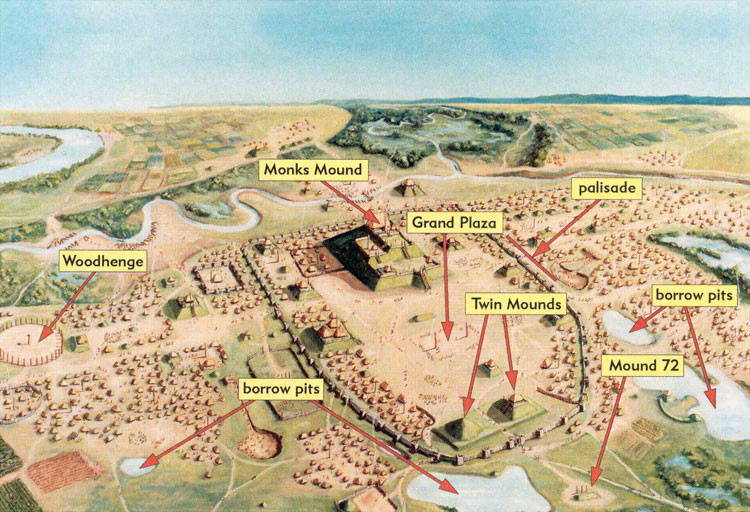
Reconstruction of Cahokia
Key Takeaways
Maya City-States
Independent, competing urban states ruled by sacred dynasties; shared Maya culture never produced a unified empire
K’uhul Ajaw
Maya “sacred king” who directed warfare, diplomacy, tribute, construction, and religious ceremonies
Mayapan
Influential thirteenth- and fourteenth-century Maya center governed through an elite confederation until its collapse around 1441
Mexica and Aztec
The Mexica founded Tenochtitlan and dominated the empire conventionally called the Aztec Empire
Altepetl
An independent city-state in the Basin of Mexico with its own ruler, community, and territory
Tenochtitlan
Mexica island capital founded in Lake Texcoco in 1325 and developed into the Aztec Empire’s political and ceremonial center
Triple Alliance
The 1428 alliance of Tenochtitlan, Texcoco, and Tlacopan that defeated Azcapotzalco and became the political foundation of the Aztec Empire
Itzcoatl
Mexica ruler who helped form the Triple Alliance in 1428 and began the empire’s sustained expansion
Moctezuma I
Mexica ruler after 1440 who continued the Triple Alliance’s conquest and consolidation
Huey Tlatoani
The Mexica “great speaker,” selected from the royal dynasty as supreme political, military, and religious ruler
Mexica Indirect Rule
Conquered communities usually kept local rulers and customs if they accepted Mexica supremacy and delivered tribute
Mexica Tribute System
Compulsory deliveries of goods from conquered provinces that supported Tenochtitlan’s rulers, temples, army, and population
Pochteca
Professional Mexica long-distance merchants who traded between regions and sometimes gathered political or military intelligence
Chinampas
Highly productive raised agricultural plots built from mud and vegetation in the shallow lakes around Tenochtitlan
Tawantinsuyu / Inca Empire
The Inca “land of the four quarters,” a territorially integrated Andean empire centered on Cusco
Pachacuti
Inca ruler who defeated the Chanca around 1438 and transformed the Cusco kingdom into the expanding Tawantinsuyu
Sapa Inca
The Inca emperor, whose claimed relationship with the sun god Inti gave sacred legitimacy to his rule
Suyus
The four large administrative regions of Tawantinsuyu, each oriented around the capital at Cusco
Mitmaqkuna
Communities resettled by the Inca to secure frontiers, spread skills, or weaken resistance
Ayllu
The basic Andean kinship and economic community that organized members’ access to land and reciprocal labor
Mit’a
Compulsory rotating labor owed by Andean households for state farming, armies, mining, textiles, and public works
Inca Road System
A state network of roads and suspension bridges that integrated provinces and moved officials, armies, labor, and information
Chasquis
Inca relay runners who carried messages and small objects along the imperial road system
Tambos
Inca roadside way stations that supplied lodging and support for officials and other authorized travelers
Qullqas
Inca storehouses holding food, clothing, weapons, and other supplies for armies, laborers, and emergency redistribution
Vertical Economy / Vertical Archipelago
Andean access to products from different elevations through exchange, migration, colonies, or political control
Terrace Agriculture
Level fields cut into Andean slopes to reduce erosion, manage water, and expand cultivable land
Quipu
Colored, knotted cords used by Inca specialists to record populations, labor obligations, and stored goods numerically
Mississippian Culture
Regional North American societies linked by maize agriculture, mound building, and trade and often governed by powerful chiefs, not one unified empire
Cahokia
Major Mississippian urban and ceremonial center near present-day St. Louis whose mounds show chiefly coordination of labor; declined and was largely abandoned by about 1350
Ancestral Pueblo Societies
Southwestern communities ancestral to modern Pueblo peoples that developed irrigation, pueblos, ceremonial spaces, and regional networks
Chaco Canyon
Ancestral Pueblo ceremonial and exchange center known for Great Houses, kivas, roads, and debated political centralization
Mesa Verde
Thirteenth-century Ancestral Pueblo communities known for cliff dwellings and abandoned amid drought, resource pressure, and social change
Cusco
Administrative and ceremonial capital of the Inca Empire and the center around which its four regions were organized
Quechua
Language spread by the Inca for imperial administration while local languages continued to be used
Notes
Maya City-States
Independent, competing urban states ruled by sacred dynasties; shared Maya culture never produced a unified empire
K’uhul Ajaw
Maya “sacred king” who directed warfare, diplomacy, tribute, construction, and religious ceremonies
Mayapan
Influential thirteenth- and fourteenth-century Maya center governed through an elite confederation until its collapse around 1441
Mexica and Aztec
The Mexica founded Tenochtitlan and dominated the empire conventionally called the Aztec Empire
Altepetl
An independent city-state in the Basin of Mexico with its own ruler, community, and territory
Tenochtitlan
Mexica island capital founded in Lake Texcoco in 1325 and developed into the Aztec Empire’s political and ceremonial center
Triple Alliance
The 1428 alliance of Tenochtitlan, Texcoco, and Tlacopan that defeated Azcapotzalco and became the political foundation of the Aztec Empire
Itzcoatl
Mexica ruler who helped form the Triple Alliance in 1428 and began the empire’s sustained expansion
Moctezuma I
Mexica ruler after 1440 who continued the Triple Alliance’s conquest and consolidation
Huey Tlatoani
The Mexica “great speaker,” selected from the royal dynasty as supreme political, military, and religious ruler
Mexica Indirect Rule
Conquered communities usually kept local rulers and customs if they accepted Mexica supremacy and delivered tribute
Mexica Tribute System
Compulsory deliveries of goods from conquered provinces that supported Tenochtitlan’s rulers, temples, army, and population
Pochteca
Professional Mexica long-distance merchants who traded between regions and sometimes gathered political or military intelligence
Chinampas
Highly productive raised agricultural plots built from mud and vegetation in the shallow lakes around Tenochtitlan
Tawantinsuyu / Inca Empire
The Inca “land of the four quarters,” a territorially integrated Andean empire centered on Cusco
Pachacuti
Inca ruler who defeated the Chanca around 1438 and transformed the Cusco kingdom into the expanding Tawantinsuyu
Sapa Inca
The Inca emperor, whose claimed relationship with the sun god Inti gave sacred legitimacy to his rule
Suyus
The four large administrative regions of Tawantinsuyu, each oriented around the capital at Cusco
Mitmaqkuna
Communities resettled by the Inca to secure frontiers, spread skills, or weaken resistance
Ayllu
The basic Andean kinship and economic community that organized members’ access to land and reciprocal labor
Mit’a
Compulsory rotating labor owed by Andean households for state farming, armies, mining, textiles, and public works
Inca Road System
A state network of roads and suspension bridges that integrated provinces and moved officials, armies, labor, and information
Chasquis
Inca relay runners who carried messages and small objects along the imperial road system
Tambos
Inca roadside way stations that supplied lodging and support for officials and other authorized travelers
Qullqas
Inca storehouses holding food, clothing, weapons, and other supplies for armies, laborers, and emergency redistribution
Vertical Economy / Vertical Archipelago
Andean access to products from different elevations through exchange, migration, colonies, or political control
Terrace Agriculture
Level fields cut into Andean slopes to reduce erosion, manage water, and expand cultivable land
Quipu
Colored, knotted cords used by Inca specialists to record populations, labor obligations, and stored goods numerically
Mississippian Culture
Regional North American societies linked by maize agriculture, mound building, and trade and often governed by powerful chiefs, not one unified empire
Cahokia
Major Mississippian urban and ceremonial center near present-day St. Louis whose mounds show chiefly coordination of labor; declined and was largely abandoned by about 1350
Ancestral Pueblo Societies
Southwestern communities ancestral to modern Pueblo peoples that developed irrigation, pueblos, ceremonial spaces, and regional networks
Chaco Canyon
Ancestral Pueblo ceremonial and exchange center known for Great Houses, kivas, roads, and debated political centralization
Mesa Verde
Thirteenth-century Ancestral Pueblo communities known for cliff dwellings and abandoned amid drought, resource pressure, and social change
Cusco
Administrative and ceremonial capital of the Inca Empire and the center around which its four regions were organized
Quechua
Language spread by the Inca for imperial administration while local languages continued to be used
