Topic 2.4 Notes – Trans-Saharan Trade Routes
How Trans-Saharan Trade Worked
This trade linked different environments that had different resources, which made exchange profitable. A map of the major routes helps make that network easier to picture.
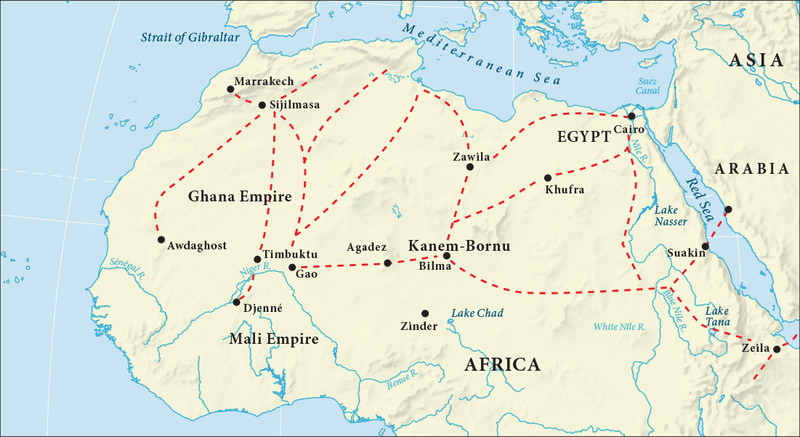
Major trans-Saharan trade routes
- The Sahara was a harsh desert barrier, but it was crossed by organized routes. Think of it as difficult to cross, not cut off from history.
- The Sahel sat just south of the Sahara. This transition zone became the meeting place between desert trade and West African farming societies.
- The Niger River and its inland delta supported farming, settlement, and trade cities, especially on the southern end of desert routes.
- This was a network, not one single road. Different routes connected different cities and markets.
Places to know
- Sijilmasa was a major northern trade center on the edge of the Sahara.
- Taghaza mattered because of its salt mines.
- Walata and Awdaghost were important desert trade centers.
- Timbuktu, Gao, and Djenne were major southern commercial cities tied to the Niger system.
- Niani was the political center associated with Mali.
What moved
The classic pattern was gold north, salt south, but that phrase is incomplete.
- Gold moved north from West Africa into North African and Islamic markets.
- Salt moved south from Saharan mines because West Africa needed it for diet and food preservation.
- Other goods included textiles, horses, copper, manufactured goods, books, enslaved people, ivory, leather, and kola nuts.
Why Trade Expanded After 1200
These causes reinforced each other. Better transport helped trade grow, and strong demand made those improvements worth using.
Transportation improvements
- The dromedary camel made long desert trips practical. It could carry heavy loads, go long distances without water, and move well on sand.
- Camel saddles improved control and carrying ability, so existing camel transport became more efficient.
- The AP distinction matters here. Camels and saddles were not new after 1200. Better use of older technology increased trade.
Caravan organization
- Caravans grouped merchants, guides, guards, handlers, and animals into one organized traveling unit.
- This reduced danger from raiders, getting lost, and running out of supplies.
- Guides were crucial because they knew wells, oases, seasons, and how much water animals needed.
Commercial practices and support
- Merchant partnerships, agents, contracts, and credit made long-distance trade more reliable.
- Arabic became important in trade records, communication, and scholarship.
- Oasis towns and trade cities gave merchants water, storage, lodging, animals, and market space.
How Mali Strengthened Trade
Mali is the empire example because it shows how trade and state power fed each other.
- Sundiata Keita is traditionally credited with founding Mali in the 1230s.
- Mali did not create trans-Saharan trade. It grew powerful by controlling valuable parts of it.
- Mali controlled territory linking gold regions to Sahelian markets.
- It taxed goods moving through its lands and protected merchants and markets where it had authority.
- Trade wealth paid for armies, officials, and imperial power.
- Mali also connected West African producers to Muslim merchant networks.
The key chain is worth memorizing. Trade brought tax revenue → tax revenue strengthened Mali → stronger rule made trade safer → safer trade increased trade.
Mansa Musa and Mali’s Place in Afro-Eurasia
Mansa Musa shows Mali’s wealth and global connections. This famous image from the Catalan Atlas helped spread that reputation far beyond West Africa.
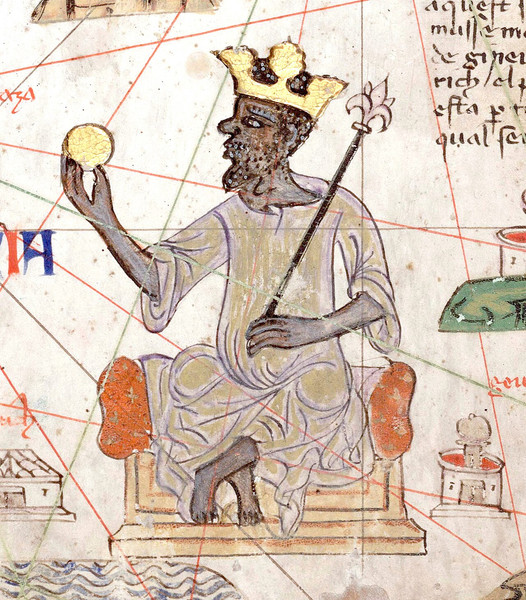
Mansa Musa in the Catalan Atlas, 1375
- He ruled in the early 1300s and made the hajj to Mecca in 1324-1325.
- Passing through Cairo, he displayed so much gold that reports say its value temporarily dropped there.
- His pilgrimage showed Mali’s wealth to the wider Islamic world and strengthened diplomatic, religious, and commercial ties.
- The Catalan Atlas of 1375 shows how famous Mali had become abroad.
Be careful here. Medieval numbers about his entourage are uncertain, and Mansa Musa did not create Mali’s wealth by himself. He represented wealth built from trade, taxation, and access to gold.
Effects of Trade Growth
Trade growth changed cities, states, religion, and communication.
- Timbuktu, Gao, and Djenne grew as trade and service centers.
- Mali became stronger through taxation and route control.
- Merchants, pilgrims, scholars, and diplomats carried ideas as well as goods.
- Islam spread mainly through trade contact and elite conversion, not military conquest.
- Timbuktu became famous for Islamic scholarship and manuscript culture.
- Arabic gained importance in trade and administration, but local languages and indigenous beliefs remained important.
Key Takeaways
Trans-Saharan Trade Network
Routes connecting West Africa to North Africa and wider Afro-Eurasian markets; trade volume and geographical reach expanded from 1200 to 1450
Sahel
Semiarid transition zone south of the Sahara where West African states and major southern trading centers developed
Maghreb
Northwestern Africa, whose markets connected trans-Saharan routes with Mediterranean and Islamic commercial networks
Dromedary Camel
Desert-adapted pack animal whose water endurance, padded feet, and carrying capacity made large-scale Saharan transportation practical
Camel Saddle
Device that distributed weight and secured riders or freight, making camel transport more efficient, stable, and capable of carrying larger loads
Caravan
Organized group of merchants, guides, guards, handlers, and pack animals traveling together to reduce risk and move goods across the Sahara
Gold–Salt Trade
Exchange in which West African gold generally moved north and valuable Saharan salt moved south through multiple merchants and markets
Mali Empire
Powerful West African empire that controlled and taxed commercial territory, protected markets and routes, and drew more people into Afro-Eurasian exchange
Sundiata Keita
Ruler traditionally credited with founding the Mali Empire in the 1230s after defeating regional rivals
Mansa Musa
Early-fourteenth-century ruler whose wealth and pilgrimage made Mali famous and demonstrated its integration into Islamic and trans-Saharan networks
Timbuktu
Commercial city near the Niger River where trans-Saharan and regional trade met; also a major center of Islamic learning and manuscripts
Mansa Musa’s Hajj
1324–1325 pilgrimage to Mecca that displayed Mali’s gold wealth and strengthened its connections with the Islamic and commercial worlds
Notes
Trans-Saharan Trade Network
Routes connecting West Africa to North Africa and wider Afro-Eurasian markets; trade volume and geographical reach expanded from 1200 to 1450
Sahel
Semiarid transition zone south of the Sahara where West African states and major southern trading centers developed
Maghreb
Northwestern Africa, whose markets connected trans-Saharan routes with Mediterranean and Islamic commercial networks
Dromedary Camel
Desert-adapted pack animal whose water endurance, padded feet, and carrying capacity made large-scale Saharan transportation practical
Camel Saddle
Device that distributed weight and secured riders or freight, making camel transport more efficient, stable, and capable of carrying larger loads
Caravan
Organized group of merchants, guides, guards, handlers, and pack animals traveling together to reduce risk and move goods across the Sahara
Gold–Salt Trade
Exchange in which West African gold generally moved north and valuable Saharan salt moved south through multiple merchants and markets
Mali Empire
Powerful West African empire that controlled and taxed commercial territory, protected markets and routes, and drew more people into Afro-Eurasian exchange
Sundiata Keita
Ruler traditionally credited with founding the Mali Empire in the 1230s after defeating regional rivals
Mansa Musa
Early-fourteenth-century ruler whose wealth and pilgrimage made Mali famous and demonstrated its integration into Islamic and trans-Saharan networks
Timbuktu
Commercial city near the Niger River where trans-Saharan and regional trade met; also a major center of Islamic learning and manuscripts
Mansa Musa’s Hajj
1324–1325 pilgrimage to Mecca that displayed Mali’s gold wealth and strengthened its connections with the Islamic and commercial worlds
