Topic 5.5 Notes – Technology of the Industrial Age
How Fossil Fuels Changed Production
Before industrialization, most work came from muscle power, wood, wind, and water. That meant production had hard limits. Animals needed food, forests could run out, wind was unreliable, and water-powered mills had to sit near strong rivers.
The big shift came when machines learned to turn coal, and later oil, into mechanical power. Fossil fuels held far more concentrated energy than older sources, so production could happen more continuously, in more places, and on a much larger scale.
A pattern AP loves here is that change was gradual. Waterwheels, animal labor, and hand labor did not vanish overnight. Old and new energy sources coexisted for a long time.
The cause-and-effect chain matters more than memorizing inventions. A coal mine like the one below helps connect the steps in that process.
- More energy meant more mining and extraction
- More extraction fed more manufacturing
- More manufacturing increased demand for transportation
- Better transportation expanded trade
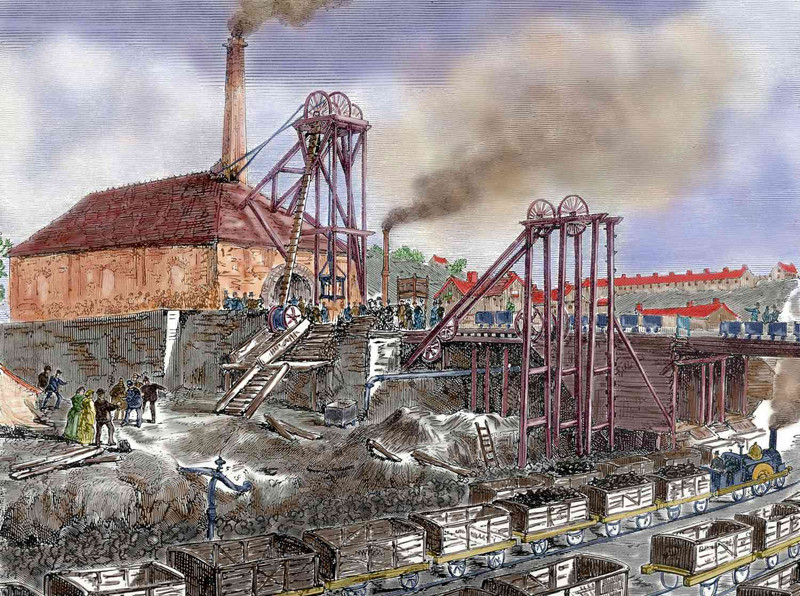
19th-century coal mining and industrial transport
The Machines and Networks That Powered the Industrial Age
The first major machine was the steam engine. It burned coal to heat water, and steam pressure moved pistons that created motion. Early British mines used it to pump water out of deep shafts. James Watt improved its efficiency, which made steam useful far beyond mining.
Steam engine
The coal-steam cycle is one of the most testable chains in this topic:
- More coal powered more steam engines
- Steam engines made deeper mining possible
- Deeper mining increased coal supply
- More coal supported more industry and transport
Factories used steam to run textile machines, pumps, and metalworking tools. That mattered because factories no longer had to sit directly beside rivers.
Internal combustion engine
The internal combustion engine burned fuel inside the engine’s cylinders, unlike steam engines that used an outside boiler. It was smaller and more mobile, which made petroleum more important. By 1900, steam still mattered more, but internal combustion began the shift toward oil.
Railroads, steamships, and telegraph
These worked as one system:
- Railroads moved heavy goods, workers, and settlers across land cheaply and quickly.
- Steamships made river and ocean travel faster and more regular, even against winds and currents.
- The telegraph sent messages through electrical signals in minutes instead of days or weeks.
Telegraph lines often ran beside railroads because trains needed fast communication for schedules and safety. In British India, railroads linked inland cotton and coal regions to Bombay, Calcutta, and Madras.
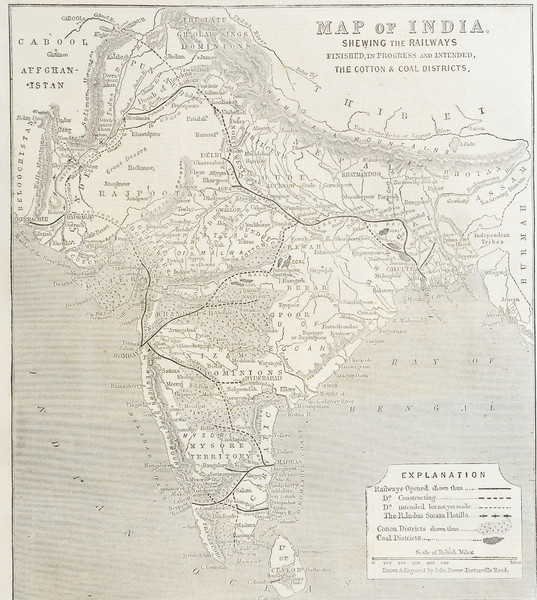
Railway map of British India
The transatlantic telegraph cable of 1866 linked Europe and North America.
The Second Industrial Revolution
This phase built on coal, iron, and steam. It did not replace them.
| Area | What changed | Why it mattered |
|---|---|---|
| Steel | Bessemer process by Henry Bessemer, 1856 | Cheap mass-produced steel for rails, bridges, ships, tools, and city buildings |
| Chemicals | Synthetic dyes, acids, alkalis, fertilizers, pharmaceuticals, explosives | New products and better mining, farming, and construction |
| Electricity | Generators, transmission, motors, lights | More flexible factory power and urban systems |
| Precision machinery | Standardized, interchangeable parts | Machines could build other machines more efficiently |
A classic chemical example is William Henry Perkin’s mauveine dye. One common confusion is Ford’s assembly line. That is mostly after 1900, so it is outside the main focus here.
How Technology Reshaped Extraction, Manufacturing, and Distribution
These changes fit together as one production system.
- Extraction grew through steam pumps, explosives, better tools, and transport, which opened deeper mines and interior resource zones.
- Manufacturing sped up because steam- and electric-powered machines increased output and regularity.
- Distribution changed because railroads and steamships lowered transport costs, and telegraphs coordinated prices, orders, and schedules.
This created more specialized economies. Raw materials, factories, workers, and markets no longer had to be in the same place. It also pulled interior regions into trade, migration, state power, and imperial control.
Uneven Spread and Historical Significance
Industrial technology spread unevenly. It was strongest first in Britain, western Europe, and the United States, then expanded in Germany, Russia, and Japan. Many other regions were drawn in mainly as raw-material suppliers or markets for manufactured goods.
These systems were expensive. Railroads, telegraphs, steamships, and electrical grids needed capital, technical skill, fuel, and constant maintenance.
The unintended consequences mattered too:
- Pollution
- Dangerous working conditions
- Heavy resource extraction
- Imperial expansion
Key Takeaways
Fossil Fuels Revolution
The shift to machines powered by vast stores of coal and oil, greatly increasing the usable energy available for production and transportation
Steam Engine
A machine that burns fuel to produce steam pressure and mechanical motion, powering mines, factories, locomotives, and ships
James Watt
Engineer whose fuel-efficiency and rotary-motion improvements made steam engines practical for many industrial uses; patented his separate condenser in 1769
Coal–Steam Cycle
Coal powered steam engines, while steam-powered pumps enabled deeper coal mining, creating a self-reinforcing increase in coal and steam use
Railroads
Steam-powered overland networks that lowered transportation costs and connected interior mines, farms, factories, cities, and ports
Steamships
Fossil-fuel-powered vessels that moved goods and passengers faster and more predictably, including upriver and against unfavorable winds
Telegraph
A system that transmitted electrically encoded messages through wires, allowing distant markets and transportation networks to coordinate within minutes
Internal Combustion Engine
An engine that burns fuel inside its cylinders; its increasing use of gasoline and diesel extended petroleum power to smaller, lighter, and more mobile machines
Second Industrial Revolution
The later phase of industrialization, emerging around 1870, marked by new production methods in steel, chemicals, electricity, and precision machinery
Bessemer Process
An 1856 process that forced air through molten iron to remove impurities, making large-scale, lower-cost steel production possible
Henry Bessemer
Inventor who patented the Bessemer process in 1856, helping make strong, inexpensive, mass-produced steel widely available
Chemical Industry
Large-scale industrial production of substances such as synthetic dyes, fertilizers, acids, pharmaceuticals, and explosives
William Henry Perkin
Chemist whose accidental development of the synthetic purple dye mauveine in 1856 helped establish the synthetic-dye industry
Electricity
An energy system in which generators converted mechanical energy into electricity, networks transmitted it, and motors and lighting applied it in factories and cities
Precision Machinery
Machine tools and manufacturing methods that produced standardized components to exact measurements, allowing efficient assembly and repair
Interchangeable Parts
Standardized components made to uniform measurements so one part could replace another without custom work by an artisan
Steel
An iron-based alloy whose cheaper mass production provided strong, durable material for railroads, bridges, ships, engines, and machinery
Notes
Fossil Fuels Revolution
The shift to machines powered by vast stores of coal and oil, greatly increasing the usable energy available for production and transportation
Steam Engine
A machine that burns fuel to produce steam pressure and mechanical motion, powering mines, factories, locomotives, and ships
James Watt
Engineer whose fuel-efficiency and rotary-motion improvements made steam engines practical for many industrial uses; patented his separate condenser in 1769
Coal–Steam Cycle
Coal powered steam engines, while steam-powered pumps enabled deeper coal mining, creating a self-reinforcing increase in coal and steam use
Railroads
Steam-powered overland networks that lowered transportation costs and connected interior mines, farms, factories, cities, and ports
Steamships
Fossil-fuel-powered vessels that moved goods and passengers faster and more predictably, including upriver and against unfavorable winds
Telegraph
A system that transmitted electrically encoded messages through wires, allowing distant markets and transportation networks to coordinate within minutes
Internal Combustion Engine
An engine that burns fuel inside its cylinders; its increasing use of gasoline and diesel extended petroleum power to smaller, lighter, and more mobile machines
Second Industrial Revolution
The later phase of industrialization, emerging around 1870, marked by new production methods in steel, chemicals, electricity, and precision machinery
Bessemer Process
An 1856 process that forced air through molten iron to remove impurities, making large-scale, lower-cost steel production possible
Henry Bessemer
Inventor who patented the Bessemer process in 1856, helping make strong, inexpensive, mass-produced steel widely available
Chemical Industry
Large-scale industrial production of substances such as synthetic dyes, fertilizers, acids, pharmaceuticals, and explosives
William Henry Perkin
Chemist whose accidental development of the synthetic purple dye mauveine in 1856 helped establish the synthetic-dye industry
Electricity
An energy system in which generators converted mechanical energy into electricity, networks transmitted it, and motors and lighting applied it in factories and cities
Precision Machinery
Machine tools and manufacturing methods that produced standardized components to exact measurements, allowing efficient assembly and repair
Interchangeable Parts
Standardized components made to uniform measurements so one part could replace another without custom work by an artisan
Steel
An iron-based alloy whose cheaper mass production provided strong, durable material for railroads, bridges, ships, engines, and machinery
