Topic 1.7 Notes – Periodic Trends
1. How the Periodic Table Reflects Electron Structure
The periodic table is arranged by increasing atomic number (Z).
number of protons = nuclear charge.
Periods (rows)
- Same number of occupied energy levels (shells).
- Moving left → right:
- Protons increase.
- Electrons are added to the same principal energy level.
So across a period, the valence electrons stay in the same shell with similar core shielding, but nuclear charge increases, so they are pulled in closer.
Groups (columns)
- Same number of valence electrons.
- Similar valence electron configurations → similar chemistry.
- Moving down:
- A new shell is added each step.
Here’s a standard periodic table labeled by periods and groups:
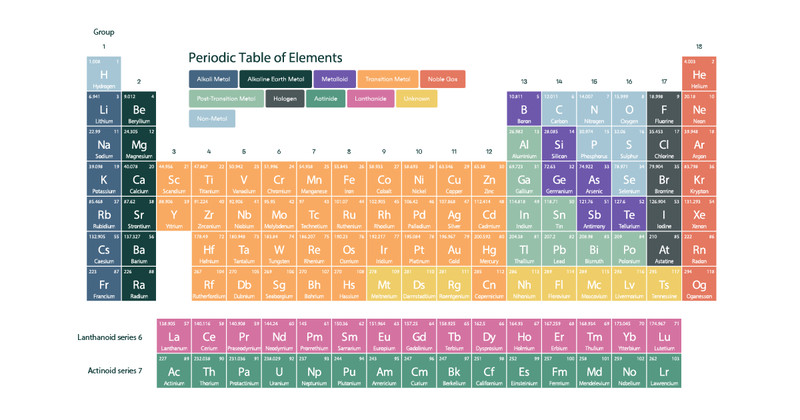
Periodic table showing groups (1-18) and periods
The repeating pattern of valence configurations explains why properties repeat.
Completely filled or half-filled subshells (like or ) add extra stability. That’s why a few ionization energy and electron affinity values don’t follow the smooth trend perfectly.
2. Coulomb’s Law, Shielding, and Effective Nuclear Charge
All periodic trends come from electrostatic attraction.
Coulomb’s Law (qualitative version)
Attraction increases with:
- Higher charge (more protons)
- Shorter distance between charges
Shielding
- Inner (core) electrons repel valence electrons.
- They block some of the nucleus’s pull.
Effective Nuclear Charge ()
This is the net positive charge felt by valence electrons.
- Across a period → increases
(more protons, similar shielding) - Down a group → roughly similar for valence electrons
(more protons but also more shielding)
Shortcut logic
- Across → stronger pull.
- Down → greater distance + more shielding → weaker pull.
When you explain a trend using charge + distance, that’s AP-level reasoning.
3. The Four Major Periodic Trends
Let’s connect each trend to electron structure.
A. Atomic Radius
Distance from nucleus to outermost electrons.
- Across → decreases
- increases → electrons pulled closer.
- Down → increases
- More shells → greater distance and shielding.
Largest atoms are bottom left.
Smallest are top right.
B. Ionic Radius
Compare ion vs. neutral atom.
Cations (positive ions)
- Formed by losing electrons.
- Smaller than parent atom
- Less repulsion.
- Sometimes entire valence shell removed.
Example: loses its 3rd shell.
Anions (negative ions)
- Formed by gaining electrons.
- Larger than parent atom
- More electron-electron repulsion.
Isoelectronic Series
Same number of electrons, different protons.
| Ion | # Protons | Relative Size |
|---|---|---|
| 8 | Largest | |
| 9 | ↓ | |
| 11 | ↓ | |
| 12 | Smallest |
More protons pulling on the same electrons → smaller radius.
Isoelectronic comparisons show up often in multiple choice.
C. Ionization Energy (IE)
Energy required to remove an electron from a gaseous atom.
- Across → increases
- Smaller radius + stronger pull.
- Down → decreases
- Electrons farther away.
Successive Ionization Energies
Each one is larger than the previous.
If data looks like this:
IE₁ = 600
IE₂ = 1200
IE₃ = 7500
The huge jump after IE₂ means the third electron removed was a core electron.
So the atom had 2 valence electrons.
That jump question appears constantly on quizzes and FRQs.
Small Exceptions
- Group 13 slightly lower than Group 2 (removing a p electron vs s).
- Group 16 slightly lower than Group 15 (paired electron repulsion).
You don’t need to write exception electron configurations on the AP exam.
D. Electron Affinity (EA)
Energy change when an atom gains an electron.
- Across → more negative
- Stronger attraction for added electron.
- Down → less negative
- More distance and shielding.
Halogens are very negative.
Chlorine is slightly more negative than fluorine because fluorine is so small that electron-electron repulsion matters more.
E. Electronegativity (EN)
Ability of an atom in a bond to attract shared electrons.
- Across → increases
- Down → decreases
- Highest: Fluorine
Same reasoning as IE and EA. Small radius + high .
4. Using Periodicity to Predict Properties
If you don’t remember an exact value, use position.
Across a period:
- Radius ↓
- IE ↑
- EA more negative
- EN ↑
Down a group:
- Radius ↑
- IE ↓
- EA less negative
- EN ↓
Bottom left elements are large, low IE, low EN, metallic.
Top right elements are small, high IE, high EN, nonmetallic.
Key Takeaways
Periodicity
Recurring patterns in element properties caused by repeating valence electron configurations.
Periods and Groups
Periods are rows with the same occupied shells; groups are columns with similar valence electrons.
Valence Electrons and Group Properties
Elements in the same group have similar outer electrons and therefore similar chemical behavior.
Shell Model
Electrons occupy energy levels around the nucleus, with outer levels farther away and more shielded.
Shielding
Inner electrons reduce the nucleus's attraction for outer electrons through electron-electron repulsion.
Effective Nuclear Charge
Net positive attraction felt by an electron after accounting for shielding by other electrons.
Coulomb's Law in Periodic Trends
Electrostatic attraction increases with greater charge and decreases as distance between charges increases.
Atomic Radius Trend
Decreases across a period and increases down a group because of charge and shell effects.
Ionic Radius
Cations are smaller than their atoms; anions are larger than their atoms.
Successive Ionization Energies
Each removal requires more energy, with a large jump after all valence electrons are removed.
Using Ionization Energies to Find Valence Electrons
Identify the large jump in values; electrons removed before it are the valence electrons.
Periodic Trend Predictions
Use an element's position, shells, shielding, and effective nuclear charge to estimate atomic properties.
Ionization Energy
Energy required to remove an electron, generally increasing across periods and decreasing down groups.
Electronegativity
Ability to attract shared electrons in a bond, generally increasing across periods and decreasing down groups.
Electron Affinity
Energy change when a gaseous atom gains an electron, generally more negative across periods and down groups less negative.
Notes
Periodicity
Recurring patterns in element properties caused by repeating valence electron configurations.
Periods and Groups
Periods are rows with the same occupied shells; groups are columns with similar valence electrons.
Valence Electrons and Group Properties
Elements in the same group have similar outer electrons and therefore similar chemical behavior.
Shell Model
Electrons occupy energy levels around the nucleus, with outer levels farther away and more shielded.
Shielding
Inner electrons reduce the nucleus's attraction for outer electrons through electron-electron repulsion.
Effective Nuclear Charge
Net positive attraction felt by an electron after accounting for shielding by other electrons.
Coulomb's Law in Periodic Trends
Electrostatic attraction increases with greater charge and decreases as distance between charges increases.
Atomic Radius Trend
Decreases across a period and increases down a group because of charge and shell effects.
Ionic Radius
Cations are smaller than their atoms; anions are larger than their atoms.
Successive Ionization Energies
Each removal requires more energy, with a large jump after all valence electrons are removed.
Using Ionization Energies to Find Valence Electrons
Identify the large jump in values; electrons removed before it are the valence electrons.
Periodic Trend Predictions
Use an element's position, shells, shielding, and effective nuclear charge to estimate atomic properties.
Ionization Energy
Energy required to remove an electron, generally increasing across periods and decreasing down groups.
Electronegativity
Ability to attract shared electrons in a bond, generally increasing across periods and decreasing down groups.
Electron Affinity
Energy change when a gaseous atom gains an electron, generally more negative across periods and down groups less negative.
