Topic 6.4 Notes – Heat Capacity and Calorimetry
1. Heat Transfer and Energy Conservation
Heat (q) is energy transferred because of a temperature difference.
It always flows from warmer → cooler until both reach the same temperature (thermal equilibrium).
- Units: J or kJ
- Heating → system energy increases
- Cooling → system energy decreases
Temperature change is:
- If , temperature increased
- If , temperature decreased
The First Law of Thermodynamics
Energy is conserved. It cannot be created or destroyed.
In calorimetry, this becomes:
or
If something loses 250 J, something else must gain 250 J. On tests, this idea is huge. If you forget it, everything falls apart.
Chemical systems change energy in three ways:
- Heating or cooling
- Phase changes
- Chemical reactions
This topic focuses on heating/cooling measured with calorimetry.
2. The Heat Transfer Equation
When temperature changes without a phase change, use:
- = heat (J)
- = mass (g or kg - must match units of )
- = specific heat capacity
- = temperature change (°C or K)
What Specific Heat Means
Specific heat (c) is the energy needed to raise 1 gram of a substance by 1°C.
- High → temperature changes slowly (water)
- Low → temperature changes quickly (many metals)
Important insight students miss:
Two substances can absorb the same amount of heat and show different temperature changes if their specific heats differ.
If 100 g of aluminum and 100 g of water absorb 500 J:
- Aluminum’s temperature rises more
- Water’s rises less
because water has a much higher
Molar Heat Capacity
Same idea, but per mole instead of gram.
Sometimes problems give moles instead of mass.
3. Types of Calorimeters
Calorimeters measure heat indirectly through temperature change.
Coffee-Cup Calorimeter (Constant Pressure)
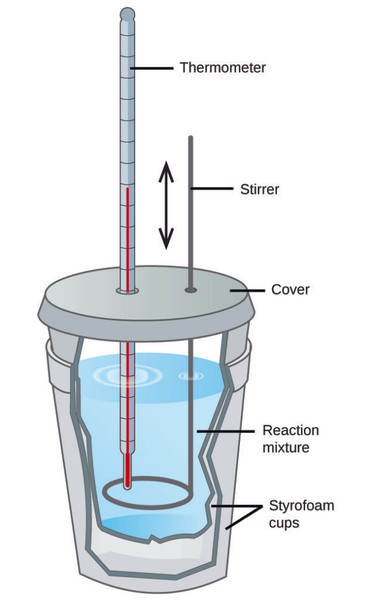
Coffee-cup calorimeter
- Insulated Styrofoam cup
- Measures temperature change of solution
- Pressure is constant (open to atmosphere)
At constant pressure:
This is the most common AP setup.
Bomb Calorimeter (Constant Volume)
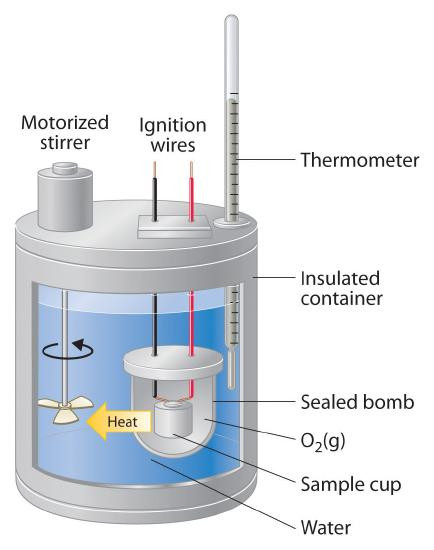
Bomb calorimeter
- Sealed rigid container
- Often used for combustion reactions
- Measures temperature change of surrounding water
Because volume is constant, it measures internal energy, not directly ΔH (you don’t need deeper thermodynamics for AP).
4. Solving Calorimetry Problems
Basic Heating/Cooling
Example:
50.0 g of a metal warms from 22.0°C to 35.0°C.
Specific heat = 0.90 J/g°C.
- J
Positive q → heat absorbed.
Watch your units. If mass is in kg but is J/g°C, convert first.
Two Substances Exchanging Heat
If no heat escapes:
This is used to:
- Find unknown specific heat
- Find final temperature
- Show energy conservation
A larger temperature change does not mean more heat transferred. Mass and specific heat matter too. The AP loves giving data where one substance changes temperature a lot and the other only a little, and asking you to explain why energy is still conserved.
Dissolution in a Calorimeter
When a solid dissolves:
- Temperature increases → solution gained heat
→ reaction released heat
→ Exothermic (ΔH < 0) - Temperature decreases → solution lost heat
→ reaction absorbed heat
→ Endothermic (ΔH > 0)
The dissolving process is the system.
The water/solution is the surroundings.
Students often flip the sign here. Always ask: Who changed temperature? That’s the surroundings.
5. Connecting q and ΔH
q is measured heat.
ΔH is enthalpy change.
In a constant-pressure calorimeter:
If the surroundings warm up, the reaction released heat. ΔH is negative.
If the surroundings cool down, the reaction absorbed heat. ΔH is positive.
Energy accounting always follows the First Law. Nothing disappears.
Key Takeaways
Calorimetry
The measurement of heat transfer by tracking temperature changes in an insulated system.
Heat Transfer Equation
q = mcΔT, where heat equals mass times specific heat times temperature change.
Specific Heat Capacity
The heat required to raise 1 gram of a substance by 1 degree Celsius.
Heat Capacity and Molar Heat Capacity
Heat capacity is heat per degree for an object; molar heat capacity is heat per degree per mole.
Temperature Change
The difference between final and initial temperature, calculated as Tfinal minus Tinitial.
First Law of Thermodynamics
Energy is conserved; it can be transferred or converted but not created or destroyed.
Heat Lost Equals Heat Gained
In an isolated calorimeter, energy released by one part equals energy absorbed by another.
Sign of q in Heating and Cooling
Positive q means heat is absorbed; negative q means heat is released.
Specific Heat and Temperature Change Relationship
For equal heat and mass, a larger specific heat gives a smaller temperature change.
Solving for Unknown Specific Heat
Set heat lost equal to heat gained, then solve q = mcΔT for c.
Energy Changes in Chemical Systems
Systems change energy through heating or cooling, phase changes, and chemical reactions.
Coffee-Cup Calorimetry
An insulated constant-pressure setup where measured heat equals the reaction’s enthalpy change.
Dissolution Calorimetry
A calorimetry method using solution temperature changes to identify heat flow during dissolving.
Thermal Equilibrium
The state reached when objects in contact stop changing temperature.
Notes
Calorimetry
The measurement of heat transfer by tracking temperature changes in an insulated system.
Heat Transfer Equation
q = mcΔT, where heat equals mass times specific heat times temperature change.
Specific Heat Capacity
The heat required to raise 1 gram of a substance by 1 degree Celsius.
Heat Capacity and Molar Heat Capacity
Heat capacity is heat per degree for an object; molar heat capacity is heat per degree per mole.
Temperature Change
The difference between final and initial temperature, calculated as Tfinal minus Tinitial.
First Law of Thermodynamics
Energy is conserved; it can be transferred or converted but not created or destroyed.
Heat Lost Equals Heat Gained
In an isolated calorimeter, energy released by one part equals energy absorbed by another.
Sign of q in Heating and Cooling
Positive q means heat is absorbed; negative q means heat is released.
Specific Heat and Temperature Change Relationship
For equal heat and mass, a larger specific heat gives a smaller temperature change.
Solving for Unknown Specific Heat
Set heat lost equal to heat gained, then solve q = mcΔT for c.
Energy Changes in Chemical Systems
Systems change energy through heating or cooling, phase changes, and chemical reactions.
Coffee-Cup Calorimetry
An insulated constant-pressure setup where measured heat equals the reaction’s enthalpy change.
Dissolution Calorimetry
A calorimetry method using solution temperature changes to identify heat flow during dissolving.
Thermal Equilibrium
The state reached when objects in contact stop changing temperature.
