Topic 9.5 Notes – Free Energy and Equilibrium
1. What Thermodynamically Favored Means
A process is thermodynamically favored when
That statement is about equilibrium position under standard conditions, not about speed.
- Thermodynamics → where equilibrium lies (products or reactants favored)
- Kinetics → how fast equilibrium is reached
Students mix those up constantly. A reaction can be thermodynamically favored and still painfully slow.
Connecting ΔG° and K
Under standard conditions:
- ΔG° < 0 → products favored → K > 1
- ΔG° > 0 → reactants favored → K < 1
- ΔG° = 0 → neither favored → K = 1
At equilibrium (no matter the starting amounts):
- ΔG = 0
- Forward rate = reverse rate
- The system is at minimum free energy
Important distinction:
- ΔG° is under standard conditions.
- ΔG is under current conditions.
- Only ΔG° connects directly to K.
That connection comes from one equation.
2. The Mathematical Relationship Between ΔG° and K
The two equations you must know cold:
Where:
- is in Kelvin
- ln is natural log
These equations are two versions of the same idea.
What the Signs Tell You
Look at the exponent in .
If ΔG° is negative:
- is positive
- Exponent is positive
- K > 1 → products favored
If ΔG° is positive:
- is negative
- K < 1 → reactants favored
If ΔG° = 0:
- Exponent = 0
On multiple-choice questions, they often give you only the sign of ΔG° and ask about K. No calculator needed if you understand the logic above.
3. Estimating K from the Size of ΔG°
The key comparison is between ΔG° and RT.
At room temperature (298 K):
That number helps you judge scale.
When ΔG° Is Close to Zero
If ΔG° ≈ 0:
- K ≈ 1
That means appreciable amounts of both reactants and products at equilibrium.
When |ΔG°| Is Much Larger Than RT
Suppose ΔG° = −40 kJ/mol at 298 K.
- Compare 40 kJ to RT ≈ 2.5 kJ
- 40 is much larger than 2.5
- is a large positive number
- K is huge
Strongly product-favored.
If ΔG° = +40 kJ/mol, same reasoning gives K ≪ 1, strongly reactant-favored.
On free-response questions, they often want qualitative reasoning like:
“Because ΔG° is large and negative relative to RT, K is much greater than 1.”
That comparison language earns points.
4. Free Energy and the Position of Equilibrium
Equilibrium is the point of minimum free energy.
Here’s the idea visually. The three panels show different signs of ΔG° and where the minimum in G occurs along the reaction progress:
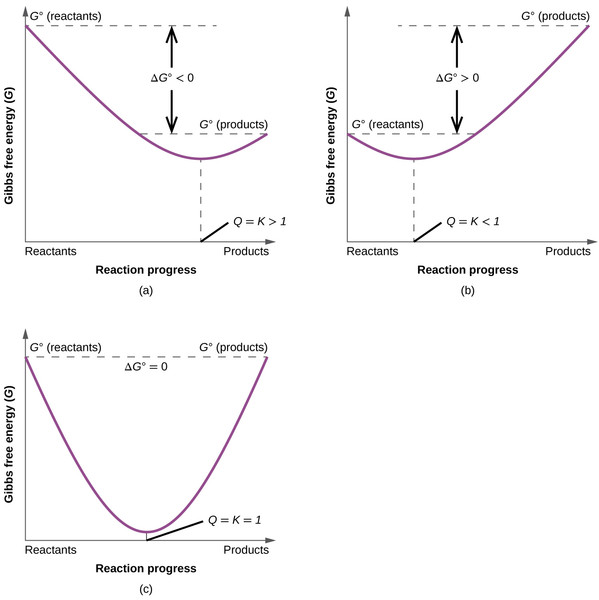
In each graph:
- The system moves in the direction that lowers G.
- It stops at the lowest point of the curve.
- At that point, ΔG = 0 and the system is at equilibrium.
Two big cases:
ΔG° < 0
- Products have lower standard free energy.
- The minimum lies closer to the products side.
- K > 1
ΔG° > 0
- Reactants have lower standard free energy.
- The minimum lies closer to the reactants side.
- K < 1
If ΔG° = 0, the curve is symmetric and K = 1.
That’s the thermodynamic definition of equilibrium. The system sits where G is lowest.
Key Takeaways
Thermodynamically Favored
A process with ΔG° < 0 under standard conditions, so products are favored at equilibrium.
Kinetic vs. Thermodynamic Definitions of Equilibrium
Kinetic: forward and reverse rates are equal; thermodynamic: free energy is at a minimum.
ΔG vs. ΔG°
ΔG is free energy change under current conditions; ΔG° is free energy change under standard conditions.
Reaction Quotient and Free Energy
Use ΔG = ΔG° + RT ln Q to relate nonstandard free energy change to reaction conditions.
Standard Free Energy and Equilibrium Constant Relationship
ΔG° = -RT ln K and K = e^(-ΔG°/RT), linking standard free energy to equilibrium position.
Equilibrium and Favorability
Equilibrium has minimum free energy, while K > 1 favors products and K < 1 favors reactants.
ΔG° and K Relationship
Negative ΔG° gives K > 1, positive ΔG° gives K < 1, and ΔG° near zero gives K near 1.
Notes
Thermodynamically Favored
A process with ΔG° < 0 under standard conditions, so products are favored at equilibrium.
Kinetic vs. Thermodynamic Definitions of Equilibrium
Kinetic: forward and reverse rates are equal; thermodynamic: free energy is at a minimum.
ΔG vs. ΔG°
ΔG is free energy change under current conditions; ΔG° is free energy change under standard conditions.
Reaction Quotient and Free Energy
Use ΔG = ΔG° + RT ln Q to relate nonstandard free energy change to reaction conditions.
Standard Free Energy and Equilibrium Constant Relationship
ΔG° = -RT ln K and K = e^(-ΔG°/RT), linking standard free energy to equilibrium position.
Equilibrium and Favorability
Equilibrium has minimum free energy, while K > 1 favors products and K < 1 favors reactants.
ΔG° and K Relationship
Negative ΔG° gives K > 1, positive ΔG° gives K < 1, and ΔG° near zero gives K near 1.
