Topic 5.1 Notes – Reaction Rates
1. What Reaction Rate Is
Kinetics is the study of reaction rates. A reaction rate tells you how quickly reactants are converted into products.
Quantitatively, rate is defined as change in concentration per unit time.
For a reactant:
For a product:
A few things to notice:
- The negative sign for reactants keeps the rate positive since reactant concentration decreases.
- Units are usually mol L⁻¹ s⁻¹ (M/s).
- Rate is about concentration, not moles. If volume changes, concentration changes too.
Quick example:
If drops from 0.80 M to 0.65 M in 10.0 s:
The negative inside cancels with the formula’s negative. Final rate is positive.
2. How Rate Appears on Graphs
Here’s a typical concentration vs. time graph for a reaction:
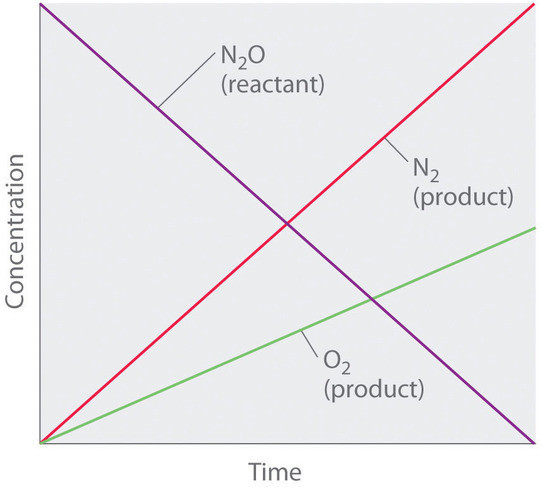
Concentration vs. time for a reactant and products
On this graph:
- The reactant () slopes down as it is consumed.
- The products ( and ) slope up as they form.
- The slope of any line represents the rate.
Average Rate
This is the slope between two points:
It depends on the time interval you choose. Early in a reaction, it’s usually larger because concentrations are higher.
Instantaneous Rate
This is the slope of a tangent line at one point. It represents the rate at that exact moment.
On AP-style questions, if they give you two time points, you’re finding average rate. If they show a tangent line drawn at a point, that’s instantaneous rate.
As time passes, slopes get flatter. That means the reaction is slowing down because reactants are being used up.
3. Stoichiometry and Relative Reaction Rates
The balanced equation controls how the rates of different substances are related.
For a general reaction:
The rate relationships are:
The coefficients act like conversion factors.
Example:
If decreases at 0.040 M/s, then:
- Hydrogen coefficient = 2
- Oxygen coefficient = 1
So oxygen is consumed at half the rate:
You’re using mole ratios, just like stoichiometry in Unit 4. If the equation isn’t balanced, the rate relationships will be wrong. That’s a common mistake on free-response questions.
4. Factors That Affect Reaction Rate
Reaction rate depends on how often particles collide and whether those collisions have enough energy.
Concentration
Higher concentration means:
- More particles in the same volume
- More frequent collisions
- Faster reaction
For gases, increasing pressure increases concentration, which increases rate.
Temperature
Temperature measures average kinetic energy.
When temperature increases:
- Particles move faster
- Collisions happen more often
- Collisions are more energetic
More collisions exceed activation energy, so rate increases. Temperature changes usually have the strongest effect in lab data.
Surface Area
For reactions involving solids:
- Powdered solid reacts faster than a chunk.
- More exposed surface means more collision sites.
This only matters when a solid is involved.
Catalysts
A catalyst:
- Increases rate
- Is not consumed
- Provides an alternative pathway
- Lowers activation energy
It does not change ΔH or the equilibrium position. It speeds up forward and reverse reactions equally.
Other Environmental Factors
- Nature of reactants. Ionic reactions in solution are often fast. Reactions breaking strong covalent bonds are slower.
- Solvent effects.
- Physical state. Gas-phase reactions tend to be faster than solid-phase ones.
Key Takeaways
Chemical Kinetics
The study of how fast reactions occur and what factors affect their speed.
Reaction Rate
The change in reactant or product concentration per unit time.
Rate Expressions for Reactants and Products
Rate = -Δ[reactant]/Δt or Δ[product]/Δt, with the negative sign for reactant loss.
Units of Reaction Rate
Usually mol L^-1 s^-1 or M/s, showing concentration change over time.
Average Rate of Reaction
The change in concentration over a finite time interval between two measured points.
Instantaneous Rate of Reaction
The rate at a specific moment, equal to the slope of the tangent line.
Rate from a Concentration-Time Graph
Find the slope of the curve; secant slope gives average rate, tangent slope gives instantaneous rate.
Stoichiometric Relationships Between Rates
Balanced coefficients relate species rates, so concentration changes occur in fixed mole ratios.
Concentration and Reaction Rate
Higher reactant concentration usually increases rate by causing more frequent effective collisions.
Temperature and Reaction Rate
Higher temperature usually increases rate because particles have greater average kinetic energy.
Surface Area and Reaction Rate
Greater exposed solid area usually increases rate by allowing more collisions at the surface.
Catalyst
A substance that speeds a reaction by providing an alternative pathway and is not consumed.
Pressure and Reaction Rate for Gases
Higher gas pressure usually increases rate by increasing particle concentration in a given volume.
Rate of Disappearance and Rate of Appearance
Reactants decrease while products increase, so their concentration changes have opposite signs.
Notes
Chemical Kinetics
The study of how fast reactions occur and what factors affect their speed.
Reaction Rate
The change in reactant or product concentration per unit time.
Rate Expressions for Reactants and Products
Rate = -Δ[reactant]/Δt or Δ[product]/Δt, with the negative sign for reactant loss.
Units of Reaction Rate
Usually mol L^-1 s^-1 or M/s, showing concentration change over time.
Average Rate of Reaction
The change in concentration over a finite time interval between two measured points.
Instantaneous Rate of Reaction
The rate at a specific moment, equal to the slope of the tangent line.
Rate from a Concentration-Time Graph
Find the slope of the curve; secant slope gives average rate, tangent slope gives instantaneous rate.
Stoichiometric Relationships Between Rates
Balanced coefficients relate species rates, so concentration changes occur in fixed mole ratios.
Concentration and Reaction Rate
Higher reactant concentration usually increases rate by causing more frequent effective collisions.
Temperature and Reaction Rate
Higher temperature usually increases rate because particles have greater average kinetic energy.
Surface Area and Reaction Rate
Greater exposed solid area usually increases rate by allowing more collisions at the surface.
Catalyst
A substance that speeds a reaction by providing an alternative pathway and is not consumed.
Pressure and Reaction Rate for Gases
Higher gas pressure usually increases rate by increasing particle concentration in a given volume.
Rate of Disappearance and Rate of Appearance
Reactants decrease while products increase, so their concentration changes have opposite signs.
