Topic 8.1 Notes – Introduction to Acids and Bases
1. What pH and pOH Actually Measure
When we talk about acidity, we are measuring the concentration of hydronium ions, , in solution.
For bases, we measure hydroxide ions, :
A few log facts that save time on quizzes:
- If , then pH = 4.00
- A lower pH means a higher
- Each 1-unit drop in pH means 10× more hydronium
(pH 3 is 10× more acidic than pH 4)
H⁺ vs. H₃O⁺
In water, a free proton does not exist alone. It attaches to water:
On the AP exam, and are treated as the same for calculations. Just remember that chemically, is more accurate.
2. Water Autoionization and
Water is not completely neutral in the sense of “no ions.” It slightly reacts with itself:
This is called autoionization.
The equilibrium constant for this process is:
At 25°C:
This number is huge conceptually. It means:
- In any aqueous solution,
- If you know one concentration, you can always find the other.
Example:
If ,
That reciprocal relationship shows up constantly in MCQs.
3. Neutral Solutions and the pH + pOH Relationship
In pure water, every hydronium formed creates one hydroxide. So:
Using :
So at 25°C:
- pH = 7.00
- pOH = 7.00
- The solution is neutral
Taking the negative log of :
At 25°C:
This applies to any aqueous solution at 25°C, not just pure water.
All of those relationships connect pH, pOH, , and in a tight loop:
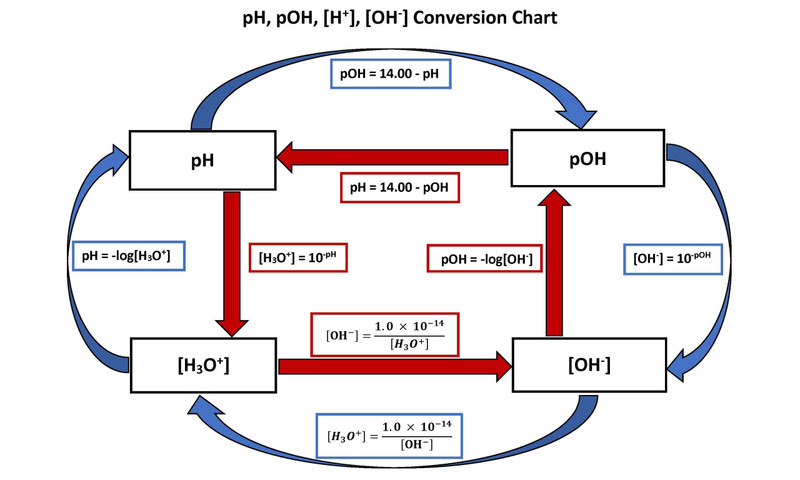
pH, pOH, , and conversion relationships at 25°C
Focus on the top connection: at 25°C. When one goes up, the other must go down.
4. Temperature Dependence of
Here’s where students slip up.
changes with temperature.
- If temperature increases → increases
- If temperature decreases → decreases
Neutral means:
It does not mean pH = 7.
At temperatures above 25°C:
- Neutral pH is less than 7
At temperatures below 25°C:
- Neutral pH is greater than 7
On most tests, if temperature is not mentioned, assume 25°C. But if they give you a different temperature and a different , do not automatically use 14.
5. Solving pH and pOH Problems
You should be able to move between four forms:
Given
Given
Given pH
Given pOH
Be careful with significant figures. The number of decimal places in pH equals the significant figures in concentration. That detail shows up on FRQs.
Key Takeaways
Arrhenius Acids and Bases
Acids increase [H+]/[H3O+] in water; bases increase [OH-] in water.
Hydronium Ion / Hydrogen Ion
H3O+(aq), often written H+(aq), is the aqueous form of a proton.
pH and pOH
pH = -log[H3O+] and pOH = -log[OH-].
pKw and the pH + pOH Relationship
At 25°C, pKw = 14.0, so pH + pOH = 14.0.
Temperature Dependence of Kw and Neutral pH
As temperature changes, Kw changes, so neutral water does not always have pH 7.
Calculating [OH-] or [H3O+] from Kw
Use [H3O+][OH-] = Kw to solve for the unknown ion concentration.
Water Autoionization and Kw
Water self-ionizes to form H3O+ and OH−, giving Kw = [H3O+][OH−].
Neutral Water at 25°C
In pure water at 25°C, [H3O+] = [OH−] = 1.0 × 10^-7 M.
Notes
Arrhenius Acids and Bases
Acids increase [H+]/[H3O+] in water; bases increase [OH-] in water.
Hydronium Ion / Hydrogen Ion
H3O+(aq), often written H+(aq), is the aqueous form of a proton.
pH and pOH
pH = -log[H3O+] and pOH = -log[OH-].
pKw and the pH + pOH Relationship
At 25°C, pKw = 14.0, so pH + pOH = 14.0.
Temperature Dependence of Kw and Neutral pH
As temperature changes, Kw changes, so neutral water does not always have pH 7.
Calculating [OH-] or [H3O+] from Kw
Use [H3O+][OH-] = Kw to solve for the unknown ion concentration.
Water Autoionization and Kw
Water self-ionizes to form H3O+ and OH−, giving Kw = [H3O+][OH−].
Neutral Water at 25°C
In pure water at 25°C, [H3O+] = [OH−] = 1.0 × 10^-7 M.
