Topic 8.5 Notes – Acid-Base Titrations
1. What an Acid-Base Titration Is
A titration is a controlled neutralization used to determine the concentration of an unknown solution (the analyte) by slowly adding a solution of known concentration (the titrant).
In acid-base titrations, the reaction is a proton transfer:
- Strong acid + strong base
- Weak acid + strong base
- Weak base + strong acid
As titrant is added, we measure pH and graph it vs. volume added. That graph is the titration curve.
Below are typical titration curves for a weak acid with a strong base (left) and a weak base with a strong acid (right). Focus on the overall shape and where the equivalence point falls relative to pH 7.
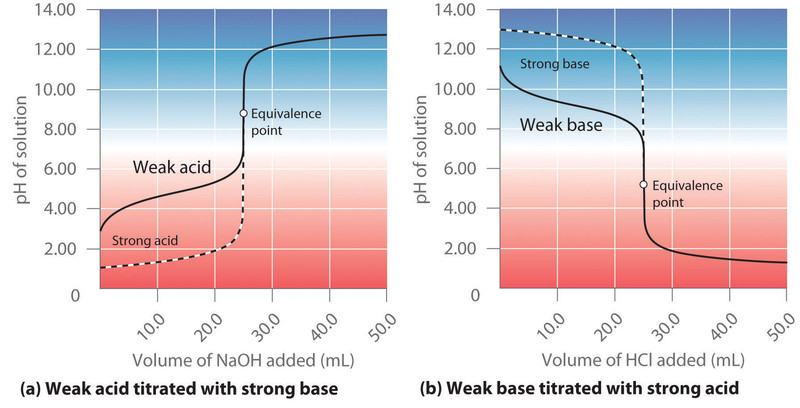
Titration curves for weak acid-strong base and weak base-strong acid
Key regions to notice on these curves:
- Initial pH → determined only by the analyte.
- Equivalence point → moles titrant added = moles analyte originally present.
- Half-equivalence point (weak systems) → halfway to equivalence.
- After equivalence → excess titrant controls pH.
2. Equivalence Point and Stoichiometry
At equivalence, the reaction has reached stoichiometric equality.
For a monoprotic acid and base:
This works because moles acid = moles base at equivalence.
If coefficients aren’t 1:1, include them from the balanced equation.
Example (quick setup)
Suppose 30.0 mL of an unknown solution requires 18.0 mL of 0.200 M to reach equivalence.
Moles base added:
That equals moles acid. So:
That’s the classic FRQ-style move.
What Determines pH at Equivalence?
It depends on the major species left in solution.
| System | Species at Equivalence | pH |
|---|---|---|
| Strong acid + strong base | Water + spectator ions | = 7 |
| Weak acid + strong base | Conjugate base () | > 7 (basic) |
| Weak base + strong acid | Conjugate acid () | < 7 (acidic) |
Equivalence does not automatically mean neutral. It means equal moles reacted.
That mistake shows up constantly on MCQs.
3. Weak Acid or Weak Base Titrations
Before equivalence in a weak system, both the weak species and its conjugate are present. That’s a buffer.
Example:
As base is added, you have both and .
Henderson-Hasselbalch
You use this anywhere in the buffer region.
Half-Equivalence Point
At halfway to equivalence:
- pH = pKa
This is huge.
From a curve:
- Find equivalence volume.
- Cut it in half.
- Read the pH there.
- That value = .
For weak base titrations:
- At half-equivalence, , so . Equivalently, the pH read from the curve at half-equivalence equals the of the conjugate acid . You can then find .
The AP loves giving a curve and asking for . You read pH at half-equivalence and convert.
4. How to Read a Titration Curve
Think in terms of what’s in excess.
Before equivalence
- Strong systems → leftover strong acid/base controls pH.
- Weak systems → buffer calculations.
At equivalence
- Identify the species remaining.
- Ask whether it reacts with water.
- Conjugate base → produces .
- Conjugate acid → produces .
After equivalence
- Excess titrant dominates.
- Ignore the original analyte.
What the shape tells you
- Initial pH very low → strong acid analyte.
- Equivalence pH above 7 → weak acid titrated with strong base.
- Multiple steep jumps → polyprotic acid.
You should be able to look at a curve and identify the system without numbers.
5. Polyprotic Acid Titrations
Polyprotic acids donate more than one proton:
Each step has its own , and typically:
When a diprotic acid is titrated with a strong base, the titration curve shows separate steps for each proton removed.
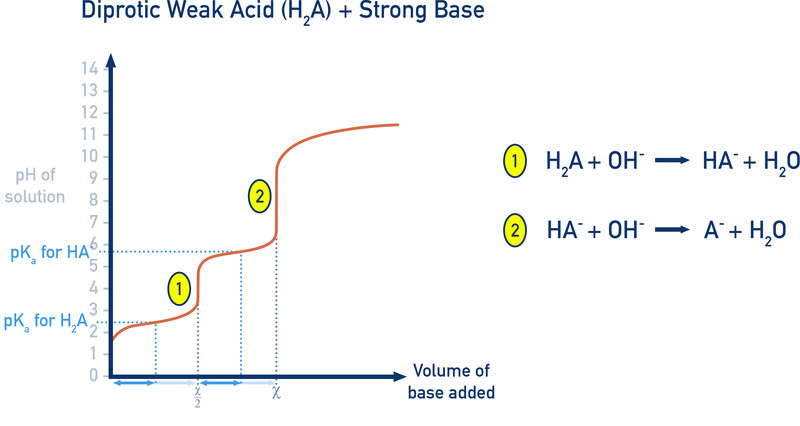
Diprotic weak acid titrated with a strong base
What you learn from the curve:
- Number of equivalence points = number of acidic protons.
- Each half-equivalence point gives a different .
- Between equivalence points → buffer regions.
You are expected to:
- Identify major species in each region.
- Determine how many protons are acidic.
- Read values from half-equivalence points.
You are not expected to calculate full equilibrium tables for every species in polyprotic systems. Focus on dominant species reasoning.
Key Takeaways
Acid-Base Titration
A controlled neutralization used to determine an unknown acid or base concentration.
Analyte and Titrant
Analyte is the unknown solution; titrant is the known solution added from a buret.
Titration Curve
A graph of pH versus volume of titrant added during a titration.
Equivalence Point
The point where stoichiometric amounts of acid and base have completely reacted.
Equivalence-Point Stoichiometry
Use balanced-reaction mole ratios at equivalence to relate titrant moles to original analyte moles.
Half-Equivalence Point
The midpoint to equivalence where a weak acid and conjugate base are present equally.
pH = pKa / pOH = pKb at Half-Equivalence
When conjugate pair concentrations are equal, pH equals pKa or pOH equals pKb.
Buffer Region in a Weak Acid or Weak Base Titration
The pre-equivalence region containing a weak species and its conjugate partner, so pH changes gradually.
Major Species at the Equivalence Point
The dominant particles after neutralization determine pH through reactions with water.
Strong Acid-Strong Base Titration Curve
Starts at extreme pH, changes gradually, then has a steep jump centered at pH 7.
Weak Acid-Strong Base and Weak Base-Strong Acid Titration Curves
Both show a buffer region and half-equivalence point, but equivalence pH is basic or acidic.
Equivalence-Point pH in Acid-Base Titrations
At equivalence, pH depends on whether the remaining species reacts with water.
Interpreting a Polyprotic Acid Titration Curve
Multiple equivalence points reveal proton count, major species, and pKa values for each step.
Notes
Acid-Base Titration
A controlled neutralization used to determine an unknown acid or base concentration.
Analyte and Titrant
Analyte is the unknown solution; titrant is the known solution added from a buret.
Titration Curve
A graph of pH versus volume of titrant added during a titration.
Equivalence Point
The point where stoichiometric amounts of acid and base have completely reacted.
Equivalence-Point Stoichiometry
Use balanced-reaction mole ratios at equivalence to relate titrant moles to original analyte moles.
Half-Equivalence Point
The midpoint to equivalence where a weak acid and conjugate base are present equally.
pH = pKa / pOH = pKb at Half-Equivalence
When conjugate pair concentrations are equal, pH equals pKa or pOH equals pKb.
Buffer Region in a Weak Acid or Weak Base Titration
The pre-equivalence region containing a weak species and its conjugate partner, so pH changes gradually.
Major Species at the Equivalence Point
The dominant particles after neutralization determine pH through reactions with water.
Strong Acid-Strong Base Titration Curve
Starts at extreme pH, changes gradually, then has a steep jump centered at pH 7.
Weak Acid-Strong Base and Weak Base-Strong Acid Titration Curves
Both show a buffer region and half-equivalence point, but equivalence pH is basic or acidic.
Equivalence-Point pH in Acid-Base Titrations
At equivalence, pH depends on whether the remaining species reacts with water.
Interpreting a Polyprotic Acid Titration Curve
Multiple equivalence points reveal proton count, major species, and pKa values for each step.
